Classical Music

At the end of the concert

79 replies 10,628 views

Started by

Kappa

Member

Member

Opening post by Kappa

Posts
146

I would like to share this observation of mine; I might have just been unlucky, but I noticed that when an avant-garde music concert ends... the end of the concert is very silent, the listeners leave the hall silently, almost in an orderly and thoughtful manner.

In contrast, traditional music concerts... the end of the concert, however, is very noisy, the listeners leave the hall talking and commenting loudly; clearly, by dialoguing, the expressive side is more emphasized.

There is no ulterior motive in this post, but it is something that struck me and I would like to discuss the subject... do you think music can condition its "aftermath"?

Moderator

Reply 2 by Frank

Posts
3,838
City
-

In my opinion, it is a difficult subject and for now I am abstaining but ...

... I had already mentioned it but I will try again given the final question:

When one has listened to Mozart, the silence that follows is still Mozart's... (Sacha Guitry)

One must see at the end of the concert what is happening on an inner level

Member

Reply 3 by Carlos

Posts
759
Kappa wrote:

I would like to share this observation of mine (...) I noticed that when an avant-garde music concert ends ...the end of the concert is very silent, the listeners leave the hall silently, almost orderly and thoughtful.

Above all, it is unlikely that anyone asks for an encore...

Member

Reply 5 by LucaCavaliere

Posts
860
City
Segrate

the concerts I attend, so far, are 'rearguards'. Therefore, I don't have the elements to make a Kappa comparison myself.

However, it could be due to something analogous to what happens during digestion.

A thing that happens to me, almost always, when I have something challenging to digest is being . . . little company (if I am also silent, one should ask others!)

Member

Reply 6 by danielescarpetti

Posts
1,032
City
Castel San Pietro Terme
LucaCavaliere wrote:

the concerts I attend, so far, are 'rearguards'. Therefore, I don't have the elements to make my own comparison of Kappa.

However, it could be due to something analogous to what happens during digestion.

For me, almost always, when I have something challenging to digest, I am . . . little company (if I am also silent, one should ask others!)

Luca's intervention really made me laugh heartily and, naturally, in the best possible sense.

In reality, what you are saying is not at all far-fetched. Those who go to 'rear guard' music concerts know by heart what they are listening to and, therefore, can well afford to make comments on the direction, the execution, or the beauty or lack thereof of the piece.

Those who, instead, go to listen to avant-garde music, very often listen to pieces for the first time or, at any rate, have listened to them very little, and thus, it becomes difficult to speak about them with detail and full knowledge of the subject.

I think this is, fundamentally, the reason for the difference.

Moderator

Reply 7 by thallo

Posts
1,170
City
Crema

I share Daniele's observation.

I would add that at "avant-garde" music concerts, an adjective we could talk about a lot, enthusiasts do not always attend. Sometimes, especially in Italy, one finds a large fauna of councilors, fake intellectuals, obscure characters in need of social affirmation, composition professors, students of the aforementioned composition professors etc. etc.—all people who, with highly laudable exceptions, do not experience the concert as a moment of pleasure but as a more or less complex ritual.

I move the issue to opera houses: in opera houses where there is a tradition of operatic listening, there is always a murmur at the end of closed pieces; in the opera houses of "preppy" cities, but where there is no tradition of operatic listening, silence is sacred, and if you speak, you are accused of ignorance :-)

Member

Reply 8 by RedScharlach

Posts
496
City
-

Interesting case of musical sociology! ... From what I have been able to observe, it is true, in "avant-garde music" concerts, encores are generally not requested.

Instead, I haven't noticed particular silences at the end of a concert; on the contrary, it seems to me that comments on the novelties, perhaps on world premieres, are more frequent compared to what happens at the end of "traditional music" concerts. At least, this is my experience.

Moderator

Reply 9 by Frank

Posts
3,838
City
-

I don't understand one thing, why must pieces of traditional musical setting be known and those of avant-garde setting not?

And when an avant-garde piece ... "crosses" ... and returns to the other "shore"

In short, which category would Boulez's Structures belong to?

Last Saturday they performed one of my pieces, which I consider to be of a traditional setting because of how it is constructed... despite its modernity (for which novelty? I ask. The avant-garde is more experiment than true novelty in music... it will depend on what comes after, we return to Structures) it maintains, for example, a narrative character; which category would it belong to?

Curiosity... where do we put Gesualdo?

Has the discussion perhaps shifted unconsciously to the capacity of music to be remembered or not?

In effect, it is an interesting discussion.

In addition, perhaps it could also be interesting to talk about the individual listening that musicians like Francesco Filidei propose... for example, in his latest experiments, the audience listens through headphones.

Member

Reply 10 by ttw

Posts
277

Isn't interpretation also an element of novelty? I don't know, I go to listen to The Ring of the Nibelung sung by Thallo, it won't be the same thing as when I sing it... right?

Moderator

Reply 11 by Frank

Posts
3,838
City
-

Yes TTW, interpretive novelties can also be discussed at the end of a concert. When Pollini won the Warsaw competition in his youth, he presented very innovative ideas....of course there is something to discuss at the end of a concert.

And then one should also count that category of works like Cage's Music for Four, or the new orchestration of Bach's Art of Fugue, or the new staging of opera X

In short, the theme of modernity in music cannot be dismissed in two words; that is why I was asking why everything had been immediately put into "Avant-garde novelty" and "cliché tradition".

Member

Reply 12 by Tiger

Posts
447

Don't you find that research is useful, Frank?

Moderator

Reply 13 by thallo

Posts
1,170
City
Crema

I continue to think that part of the problem is our approach to the concert hall.

Among other things, I don't understand why film forums exist but music forums do not. Perhaps because there are no "audiences" capable of truly talking about music, going beyond judgments like "it was beautiful" or "it was boring". But it is a vicious circle, and if we don't start talking, we will never talk.

Moderator

Reply 14 by Frank

Posts
3,838
City
-
Tiger wrote:

Don't you find that research is useful, Frank?

Of course! If it weren't so, I wouldn't have been able to prepare the material for my piece with Open Music. Without IRCAM, no OM... it is also true, however, that "practice" cannot be dismissed solely in this way. Then it would indeed be just experimentation.

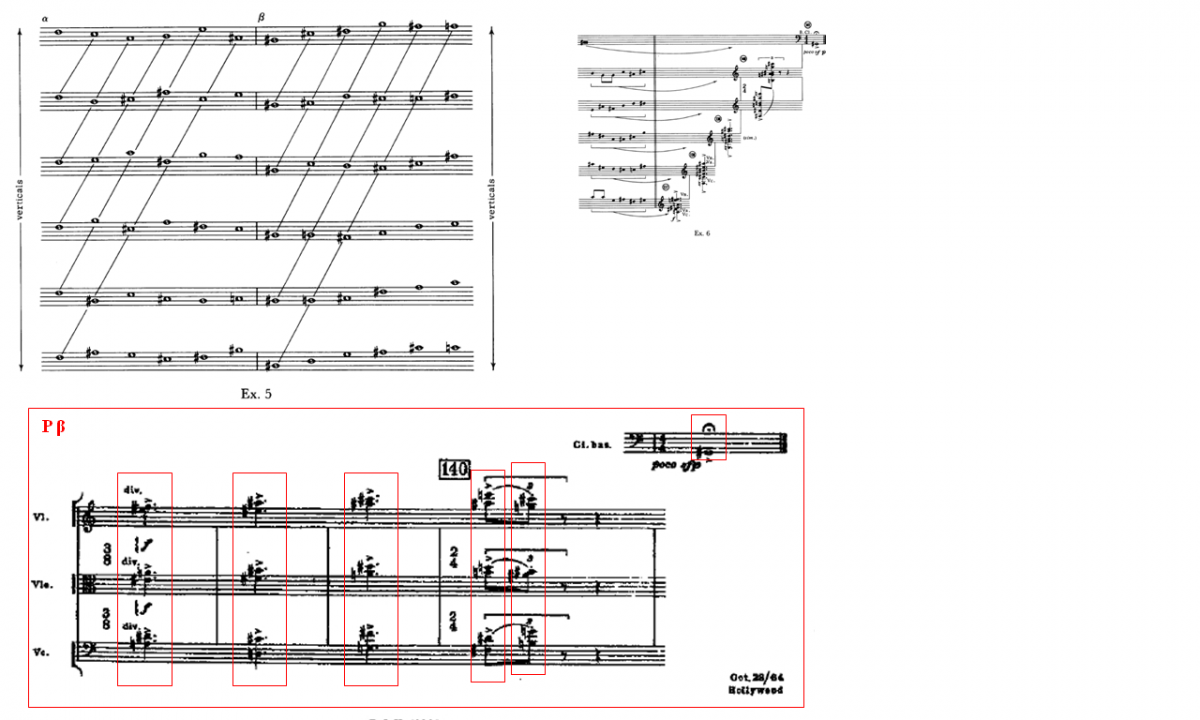
In the end, when I showed the OM patches to a couple of interested people, they had the same look as those who for the first time realize that the closing of Stravinsky's variations is a pre-constituted matrix. Try it and see, look at the attached image.

Stravinsky uses the notes of the matrix to generate chords, and this, for example, justifies:

the prevalence of certain octave doublings in the formation of the chords themselves;

the predominance of the same 6 sounds within the chords;

the strong concentration, in relation to Bb, of major and minor triads.

If you look closely at all six vertical vectors of Bb proposed for retrograde motion, they close the variations and provide the key to reading the last note of the piece (G#).

But there is all the craftsmanship, orchestration, conducting of parts... which isn't necessarily done in OM... eh! (obviously speaking about myself)

When will there be news? Can music no longer truly narrate?

Note that narrativity is the ability of music to be remembered... returning to the first post

Attachment

Moderator

Reply 15 by Frank

Posts
3,838
City
-
thallo wrote:

i keep thinking that part of the problem is our approach to the concert hall.

You know, I have my doubts about when one can speak of a concert and even more so of a hall? If Philideus is right... a pair of headphones is enough, I could speak to you of a few intimate settings... like Beyrouth"}

Member

Reply 16 by JazzMania

Posts
116

More surprise than facing a jazz improvisation is not possible... if there is a score someone already knows

Member

Reply 17 by LucaCavaliere

Posts
860
City
Segrate

Thallo, don't kill me! . . . but musiforum exists: it is this place where we are talking! or not?

In my substantial ignorance of modernity and the avant-garde, many of the questions posed by Frank touch upon themes that I have carried within me for some years.

What happens at the end of a concert on an inner level? . . .

I think that, for every person, a resonance occurs - a harmonic - of what that same person gave to the music during the concert. It is clear that everyone can give within the limits of their own sensitivity and experience, but a disposition of 'openness' must exist so that something happens at the end of the concert (even if just something small).

And what are those factors to which the possibilities of a piece being remembered "cling"?

Can I propose 'repetitiveness'?... I mean: the return, even if varied (but with even minimal traits of recognizability) of its elementary motivic formulas.

Translating the discussion: is rhyme (in poetry) not that 'element of repetitiveness' that allows for a foothold for memory? (whether one likes the poetry or not)

Is it not the repetitiveness of twin-lighted columns, pilasters... that establishes that sweet foothold that allows one to remember a building? (whether one likes the building or not)

But when one comes to conceiving music that has a narrative character (and it can be done), here I must confess my weakness. 'Narration' performs something in which, generally, there is no repetition. To me, 'narrative' music seems impassable: it offers me no footholds to enter, little by little, into its movements: it surprises me at every corner, and I must follow it hanging from its lips (just like a narration).

Can I hope that after repeated (and repeated) listenings I will manage to remember it "as a whole"? Perhaps I can hope so. But it takes a lot of... determination.


Moderator

Reply 18 by Frank

Posts
3,838
City
-

I don't have much time right now, but just a necessary and quick clarification, Luca. Extreme repetition (minimalism) was avant-garde just like extreme differentiation (structuralism)... in between there are all the shades of gray. The traditional approach lies within the hexagon inscribed in two triangles....the first is the "fork" that represents repetition from left vs right, the second is the "fork" that represents differentiation from right vs left.

As far as repetition is concerned, the boundary between minimalism and pop is very thin; it's no coincidence that those who started seriously in the '60s (even with excellent results) later gave themselves over to the god of money (and how many wouldn't?).

Member

Reply 19 by RedScharlach

Posts
496
City
-
LucaCavaliere wrote:

And what are those factors that the chances of a piece being remembered "cling" to?

Can I suggest 'repetitiveness'?...

A this regard, I assure you that even for "avant-garde music" it is only a matter of habit. After listening to a few pieces (I wouldn't know how to quantify), even in "absolute premieres" you begin to recognize repetitions, references, historical recurrences, clichés, and the trends that were discussed in another post.

Moderator

Reply 20 by Frank

Posts
3,838
City
-

And indeed, as RedScharlach says, as was being said in the other thread, more and more progressively the narrative course is being rediscovered; regardless of syntax and code, the music is starting to narrate again and therefore to regain that capacity to be remembered. So much so that Shark himself felt a resurgence... but if he had listened more deeply, there would have been so much more. Which obviously did not happen in the post-WWII avant-garde... there, you certainly didn't remember a thing, and Boulez's work is a testament to that... something particularly worth keeping in mind

Log in to participate