Jazz

Diatonic approach, Dominant approach, Parallel approach, Chromatic approach

23 replies 4,923 views

Started by

Frank

Moderator

Moderator

Opening post by Frank

Posts
3,838
City
-

I am looking at these harmonization techniques; some manuals indicate the following terms:

1) Diatonic approach
2) Parallel approach

3) Dominant approach

In others, I have also found the term Chromatic approach (4), but with the omission of the Parallel approach.

Since, apart from the Diatonic approach, the others are not yet perfectly clear to me, is it just a matter of overlapping nomenclature due to the inconsistency of manuals? Since I imagine that is not the case, what are the substantial differences between these harmonization techniques?

Thanks in advance.

Member

Reply 2 by DrJellyfish

Posts
576
City
Par Bastet

Quick question…

Diatonic approach: non-chord tones are harmonized with chords belonging to the scale relative to the chord;

Parallel approach: all voices move in parallel; in effect, the chromatic approach is also a parallelism;

Dominant approach: non-chord tones are harmonized with the dominant chord (generally altered) relative to the indicated chord;

you can also use a diminished seventh chord built on the leading tone of the indicated chord (generally used on ∆, 6, -7, -6).

Alternatively, independent lead, meaning the lower voices move together via oblique or contrary motion relative to the lead;

Bill Russo used a harmonization made with pre-established intervals (regardless of whether they were perfect, major, minor, augmented, or diminished) derived from a specific scale; for example: harmonization with fourth intervals extracted from a diminished scale); this is also a form of parallelism, even if the quality of the intervals changes. I think he called it organum. Finally, there is the linear approach mentioned by Bill Dobbins, but that is a long story…

Member

Reply 3 by leoravera

Posts
60
City
Massa Carrara

When I studied "Jazz arranging and composing, a linear approach" I was initially disappointed: I was hoping for some easy and fast technique, but instead Bill Dobbins' linear approach consists of making the individual parts sing so that each has its own complete meaning and fits well with the others.

Obviously, it was my expectations that were wrong: there are no shortcuts, not even Bill Dobbins possesses one. Bill Dobbins' lesson: knowing many techniques only to then rely on none...

Member

Reply 4 by DrJellyfish

Posts
576
City
Par Bastet

ehehe, in fact I glissed over the linear approach…

Bill Dobbins ultimately explains the procedure correctly, compared to other techniques (and indeed his book seems more interesting to me for the demonstration of these than for the linear approach, whose effectiveness depends almost exclusively on the taste and skill of the arranger; in fact, among the examples of this technique used by Dobbins and those of Gil Evans or Julius Hemphill, the comparison is uneven…).

Moderator

Reply 5 by Frank

Posts
3,838
City
-

First of all, thank you for the contributions.

I think my intention was misunderstood because I am not interested in looking for an easy and fast technique; especially since what Leo describes:

“Bill Dobbins' linear approach consists of making the individual parts sing so that each has its own complete meaning and fits well with the others.”

is nothing more than counterpoint.

My problem is giving my arrangements an even more exquisitely jazz flavor... let's just say that once I have taken a melody (a standard), I have various tools to write a counterpoint (a linear approach) for it that is more or less singable and makes sense.

To put it in other words, I came across a manual that is not by Bill Dobbins (whom I know well instead) which proposes exercises to practice these techniques. I am delving into Block Chords and honestly, despite the author of the text pushing for the use of these techniques, I don't feel the need for them. Furthermore, comparing definitions with other texts (as it happens), I have also discovered these different nuances on the matter.

I will try to post some of these exercises and mark the solutions that I consider adoptable in order to understand where I might eventually use alternatives... but above all, I would be interested in the 'why'.

Moderator

Reply 6 by Frank

Posts
3,838
City
-

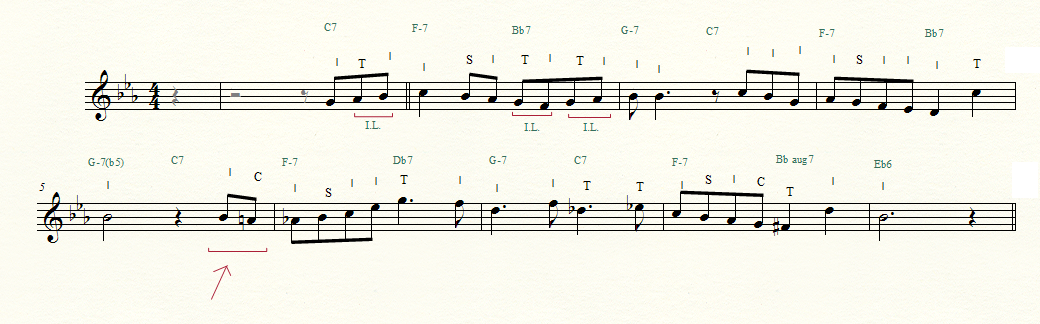
Sorry, but I couldn't do it sooner. Here is a little example. I did a minimum analysis of the melody

In my opinion, the only point where one of the Additional Approach Methods could eventually fit is on the chromaticism at measure 5, but if I used Independent Leads (descending semitone in the melody, therefore ascending chromatic motion of the block chord notes) wouldn't I get a Chromatic approach after all? (provided I understood the Chromatic approach correctly)

What do you think?

What would be your best harmonization?

Attachment

Member

Reply 7 by DrJellyfish

Posts
576
City
Par Bastet

If I understood correctly what you mean, indeed all parts move chromatically, but by definition in the chromatic approach the lower voices move parallel to the lead, whereas in an independent lead they move obliquely or in opposition to it.

Member

Reply 8 by DrJellyfish

Posts
576
City
Par Bastet

I took a look; it's not very simple to use independent lead in the points you mention, if you proceed with tight voicings; keep in mind that if the other voices move in contrary motion relative to the melody, the voicing expands or contracts and sometimes returning to 4 tight parts involves some quite significant leaps

Maybe at measure 5 it can be done, but perhaps a chromatic approach is more effective. How would you do it?

Member

Reply 9 by Tronky

Posts
37
City
S

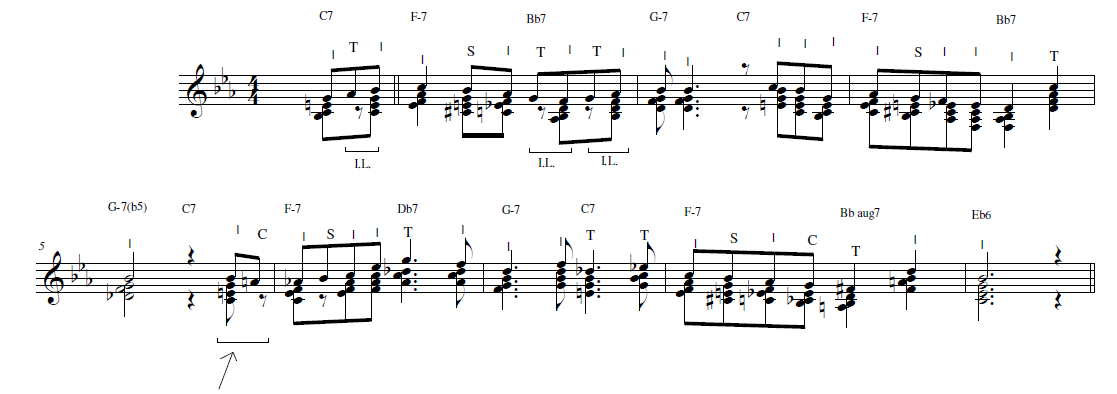
I tried to develop the exercise proposed by Frank; in fact, I am having a bit of difficulty with the problematic points ...independent lead and chromatic approach. I am asking DrJellyfich, who seems very expert to me, how this issue should be resolved.

Thank you in advance.

Attachment

Member

Reply 10 by DrJellyfish

Posts
576
City
Par Bastet

Very expert seems excessive to me… I was even getting a bit tangled up myself

The harmonization you did seems good, except for the G over Db7 on beat 2 of the second line; I would have harmonized it without the Ab, which clashes a bit with the augmented eleventh and, above all, that way you sacrifice the third; then the Bb7aug should be a dominant chord, so with the Ab.

I tried to harmonize the other notes, but I must say I am not very satisfied (besides, this harmonization method also has its limits).

I used Ebdim a lot, both on C7 (as C7b9) and on F-7 (as VII to harmonize non-chord tones), and also on Bb7, treating the Bb9 as an F-6;

in the third bar of the first line I added some tension to the C7, to make the melody stand out a bit more;

in the last bar of the first line I used a diatonic harmonization of Eb to avoid repeated notes, but it doesn't blow me away;

in the first bar of the second line I used a double chromatic approach; alternatives could be an independent lead in which the three lower voices harmonize the A natural with B natural, D, E natural, but it's not very nice; at most you could try harmonizing it with C13b9; all to avoid repeated notes (which in the end aren't actually that terrible).

I harmonized the G over Db7 in drop 2 to free up the lead a bit; in tight voicings, it came out as a somewhat harsh chord with a sound slightly different from the rest of the harmonization, all in the upper register; in the following bar I harmonized the Eb over C7 with C7#9b13 - I don't like the #9 with the perfect fifth and, yes, there is a repeated note :) There are probably others, I'll take a closer look later and see if anything else comes to mind. Take a look and let me know if it makes sense to you.

Member

Reply 13 by DrJellyfish

Posts
576
City
Par Bastet

Ok, thanks. In this latest harmonization I inverted the interpretation of some notes in the second measure of the first line (F-7 Bb7): I tried to consider the F on Bb7 as non-chordal, whereas in the first one I had treated the two Gs as non-chordal.

Member

Reply 14 by Tronky

Posts
37
City
S
DrJellyfish wrote:

'Very expert' seems excessive to me… I was even getting a bit tangled up myself.

The harmonization you did seems good, except for the G over Db7 on beat 2 of the second line; I would have harmonized it without the Ab, which clashes a bit with the augmented eleventh and, above all, sacrifices the third; then the Bb7aug should be a dominant chord, so with the Ab.

I tried to harmonize the other notes, but I must say I am not very satisfied (besides, this harmonization method also has its limits).

I used Ebdim a lot, both on C7 (as C7b9) and on F-7 (as VII to harmonize non-chord tones), and also on Bb7, treating the Bb9 as an F-6;

in the third measure of the first line I added some tension to the C7, to make the melody stand out a bit more;

in the last measure of the first line I used a diatonic harmonization of Eb to avoid repeated notes, but it doesn't blow me away;

in the first measure of the second line I used a double chromatic approach; alternatives could be an independent lead in which the three lower voices harmonize A natural with B natural, D, E natural, but it's not very nice; at most you could try harmonizing it with C13b9; all to avoid repeated notes (which, in the end, aren't actually that terrible).

I harmonized the G over Db7 in drop 2 to free up the lead a bit; in tight voicings it came out as a somewhat harsh chord with a sound slightly different from the rest of the harmonization, all in the upper register; in the following measure I harmonized the Eb over C7 with C7#9b13 - I don't like the #9 with the perfect fifth and, yes, there is a repeated note :) There are probably others, I'll look at it more closely later and see if anything else comes to mind. Take a look and let me know if the math adds up for you.


Thanks DrJellyFish, two words on Drop2?

Moderator

Reply 15 by Frank

Posts
3,838
City
-
DrJellyfish wrote:

in the first one I treated the two Gs as non-chord tones.

Ok, non-chord tones. But using the diminished scale, it's as if we considered those notes of the scale ... instead, I perceived them as tension and wanted to manage them with the independent lead.

Moderator

Reply 16 by Frank

Posts
3,838
City
-

Still in the first Doc version, you harmonize the Bb on C7 in the first measure of the second line with chromaticism, but isn't it clearly a chord tone? Practically, you considered it a double chromaticism, but the first one isn't even a passing tone. I mean, I like the result... it's just to better understand how much you are referring to the Chromatic approach that I was hypothesizing.

Moderator

Reply 17 by Frank

Posts
3,838
City
-

No matter how great Doc is, it's always a pleasure to read your posts! Especially how technical they are

Member

Reply 18 by DrJellyfish

Posts
576
City
Par Bastet
Frank wrote:

Ok, not chordal. But using the diminished scale, it's as if we consider those notes of the scale ... I instead perceived them as tension and wanted to manage them with the independent lead.

in the second harmonization, I harmonized them as tensions (13) and the F as non-chordal with a dominant approach (F+7); however, all in all, that F could also be understood as harmonized with an independent lead: in effect, the three lower voices move in parallel and in contrary motion relative to the lead.

Member

Reply 19 by DrJellyfish

Posts
576
City
Par Bastet
Frank wrote:

In the first Doc version, you harmonize the Bb on C7 with chromaticism in the first measure of the second line, but isn't it clearly a chordal note? Practically speaking, you considered it a double chromaticism, but the first one isn't even a passing tone. I mean, I like the result... it's just to better understand how much you are referring to the Chromatic approach that I was hypothesizing.

Yes, the Bb is chordal, but in this case I prioritized chromatic movement, so I harmonized the last two notes of the measure so that all voices rose chromatically up to F-7, without giving much importance to what the initial note was. Alternatively, one could harmonize the Bb as chordal and the subsequent note as chromatic; that is a matter of taste.

The chromatic approach (simple, let's say) is in the last measure of the first line and in the penultimate measure of the second line; it is also in Tronky's harmonization.

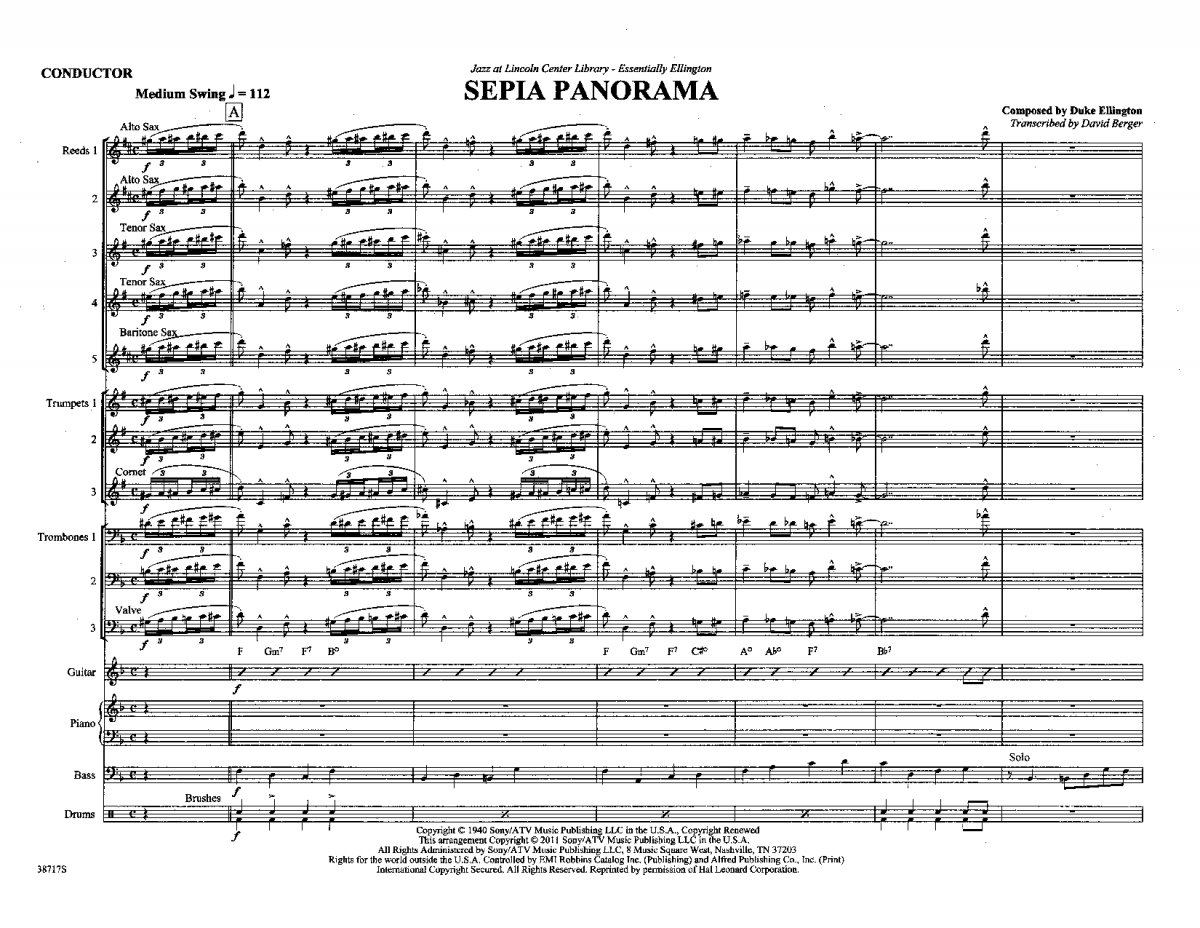
In this Ellington piece, there is a long chromaticism that only takes the arrival note into account.

Attachment

Moderator

Reply 20 by Frank

Posts
3,838
City
-

Thanks for everything, I've re-launched

DrJellyfish wrote:

In this Ellington piece there is a long chromaticism that only takes into account the arrival note.

True, and at that speed it is understandable

Log in to participate