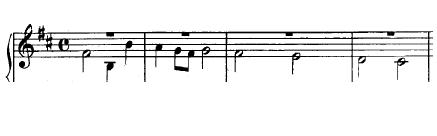
Since I am here, I draw from the previous "vote" to propose a new subject with characteristics different from the 2 previously addressed and with a certain openness in order to further differentiate the compositions.
Write a fugue on the attached subject.
Instrumentation: free
Number of voices: free
First publication 15/05/2013
Participants: no limitation, anyone who wants to try their hand
Interesting theme for a little piece with alternative harmony that I hope to manage to present...
One curiosity... after presenting the subject to the alto, as in this case, if the answer is to be given by a voice with a different texture such as the bass or the soprano, I imagine that's correct?
In the case where 5 voices are present, soprano, soprano, alto, tenor, bass, what is advisable to do?
My idea so far is based on a 5-voice realization, but I fear the harmonic repetitiveness of the exposition.
As an alternative, I could think of a fugue consisting only of the exposition, having a countersubject enter directly along with the subject (so entries at 2 simultaneously... 2, 4 and finally 5 or 6) to have a seventh-based harmony that is as complete as possible from the start.
Inevitably, I will find myself quite limited from a contrapuntal point of view, so it should turn out to be a sort of half-fugue...
I am writing to you to present my idea; perhaps with some advice, I can get a clearer vision of this alternative "to-do"… or just a "to-do" anyway...
Perhaps you can have the fifth entry arrive after a divertimento
As far as the simultaneous entry of S and CS is concerned, there is no prohibition; furthermore, in a free fugue, let alone... it's just a matter of taste, and in a school-style 2-part CS fugue, it is even provided for.
As far as the first 4 entries are concerned, it can be C S T B or C T B S ... in short, up to you.
Just one curiosity... after presenting the subject to the alto, as in this case, if the answer is to be given by a voice with a different texture, such as the bass or the soprano, I imagine that's correct?
The answer must be to the tenor or the soprano, not the bass, because since the answer is to the dominant, it will result in an uncomfortable register for the bass; furthermore, in a fugue, entries are almost always with non-corresponding voices, so the bass does not answer the alto and vice versa, and the tenor does not answer the soprano and vice versa.
For this theme, it is more convenient to have the tenor answer, as they would have a bit more ease in performing the octave jump fa# - fa# that is created in the answer compared to the soprano; in this case, it is better to have the soprano enter last, when there are already 3 other voices present.
N
Natan
Member
Reply 8 by Natan
Posts
239
I will add that the subject can also be transposed, so at this point the fugue could even start from another voice.
in this case I agree with Geppino ... this theme is perfect for contraltos as it is in their best tessitura, especially in the descent of minims where they can provide thickness.
The octave jump F#-F# is much more manageable and easier to intonate for tenors ... having sopranos do it with only the contraltos supporting is risky due to a lack of harmonics, which are better and provide better support in male voices.
with the octave jump, transporting the subject could create problems later on, still speaking of a fugue for choir, obviously.
I have received news that perhaps 3 new friends interested specifically in the field of fugue will be added... we'll see. For now, it is only a half-promise
In the meantime, I would look for some fugues from the 5-voice repertoire to understand how they are constructed
But what I want to do is an attempt at madness rather than a fugue from the repertoire...
I see that good Frank is already writing me off for sure... well, I hope so too... especially because I have been asked to write a work that will be performed, so I will probably invest time in that but... you never know!
I see that good Frank is already counting on me... well, I hope so too... especially because I've been asked to write a work that will be performed, so I'll probably invest time in that but... you never know!
The work certainly has priority; to write an excellent academic 4-part fugue takes about 18 hours... from now until 9 months...
It's clear that if, from what I've understood, the intention is to experiment... it will take a bit more time.