

B W V 6 3 9

Member
Opening post by LucaCavaliere
- Posts
- 860
- City
- Segrate
Started by
Member
Member
B W V 6 3 9
Member
it was not my intention to propose listening to these pieces... 'just like that': without proposing a discussion.
the fact is that, on one hand, I felt the urgency, on the other, I cannot find the words to ask you what I would like. I will try.
What do you think of Busoni's piano transcriptions of Bach's keyboard works?
What do you think on a personal level? (do you like them, or not?)
What do you think as an operation on a compositional level? (if I may use this term)
But above all... how do you see the relationship between the spirit of the Bachian chorale and the sonority of the grand coda?
How do you perceive this relationship?... possible, inadmissible, misrepresented, improved, evolved...?
Member
I will respond later, I need to meditate for a moment calmly...
Member
What I think... I'm not particularly crazy about them, especially those organ/piano ones; regarding the compositional aspect, I prefer to leave that word to others. As for the relationship between the Bachian chorale and the piano, that doesn't make me go crazy either; I find the organ to be decidedly the most suitable instrument for chorales, especially considering the type of music a chorale is... I am not so intransigent as to say it's impossible, but personally, I find it neither improved nor evolved.
Member
I like them very much. Transcriptions are never a walk in the park, especially if one sets the goal of staying as close as possible to the composer's intention. In my opinion, Busoni transposes for the piano by adding that touch of his own that serves to enhance the instrument without transfiguring the idea and atmosphere intended by the composer. I know many "purists" do not appreciate it, but I wonder why we shouldn't simply enjoy the effect of this operation. It would be different if the transcription resulted in compositions with a spirit different from the original. In that case, it would seem like plagiarism to me!.
Member
Personally, I have nothing to add and nothing to take away from what Nancy wrote.
A propos of Busoni, what he maintained is very interesting and deserves, at the very least, some kind of meditation.
As an interpreter and performer, he said that Bach is the base and Liszt is the top of the tree of pianism and that, between these two pillars, there lies a column called Beethoven, and this column can only be approached thanks to them,
Member
nancy wrote:I like them very much. Transcriptions are never a walk in the park, especially if one sets the goal of staying as close as possible to the composer's intention. In my opinion, Busoni transposes for the piano by adding that little touch of his own that serves to enhance the instrument without transfiguring the idea and atmosphere intended by the composer. I know many "purists" do not appreciate it, but I wonder why we shouldn't simply enjoy the effect of this operation. It would be different if the transcription resulted in compositions with a spirit different from the original. In that case, it would seem like plagiarism to me!.
I also like Busoni's transcriptions very much.
Although, I must say, one arrives at something not just 'different' but in some cases - and «Ich ruf zu dir» is one of these - even 'opposite' to the original spirit.
And yet, it is precisely because of this that I like it so much. I don't like it more than the original organ version, but as much as the original. And yet, the spirit of the piece seems opposite to me.

Member
I can't stand them. I don't even know why. Maybe because I just can't stand the octaves in Bach. Maybe because from Gospel commentaries they turn into concert pieces. I can't even listen to her Chaconne - the Brahms version is much better!
Even if it is another world, this one - BWV 614 - seems closer to the right spirit (to tell the truth, the Duet is even made with octaves!).
Member
RedScharlach wrote:I can't stand them. I don't even know why. Maybe because I just can't stand the octaves in Bach. Maybe because from Gospel commentaries they become concert pieces. I can't even listen to his Chaconne - the Brahms version is much better!
Even if it is another world, this one - BWV 614 - seems closer to the right spirit (to tell the truth, the Duet is even made with octaves!).
ok. you can't stand the octaves in Bach.... but not in the bass, I imagine! ... and what would they be, on the pedalboard, Principal 8' and Principal 16' if not... octaves (in the bass, ok)
Concert pieces?.. it could be. But not necessarily.
I don't think this can be stated just because a piano is usually on a stage in a theater while the organ stays in church.
If it is no longer a commentary on the gospel (I agree), couldn't this chorale be seen - first of all - as a piece for personal meditation (of the pianist)?... And then, if anything, as a concert piece. What do you say?
Member
RedScharlach wrote:I can't stand them. I don't even know why. Maybe because I just can't stand the octaves in Bach. Maybe because from Gospel commentaries they turn into concert pieces. I can't even listen to her Chaconne - the Brahms version is much better.
Even if it is another world, this one - BWV 614 - seems closer to the right spirit to me (to tell the truth, the Duet is even made with octaves!).
Perhaps superfluous to say... but I'll say it anyway! You are referring specifically to the style of the transcription and not to how they are interpreted... right? Because certainly Lisitsa is, shall we say, "very concertante" and perhaps not very meditative?!?!
Between the composer and the transcriber, there is always the performer who plays a very strong role in giving the right character to the piece....understanding first the spirit of the composer and then that of the person who transcribed it.
Member
nancy wrote:You are referring specifically to the style of the transcription and not how they are interpreted... right?
Exactly, I am referring to Busoni and not to the performer of Busoni.
LucaCavaliere wrote:ok. you can't see the octaves in Bach.... but not in the bass, I imagine!
In reality, I simply cannot see them, not even in the bass. Perhaps it is simply the visual impact, but those octaves - in Bach - disturb me (regardless of the sonic result).
Member
«Ich ruf zu dir, Herr Jesu Christ» (I call to you - I invoke you - Lord Jesus Christ).
This piece is absolute music - as absolute as one could wish - but it is also indubitable that Bach honors the spirit of the chorale: a prayer of invocation. Anyone listening to this piece, if they wish, can also set aside a strictly Christian spirituality; what they will nonetheless always feel in these notes is an earnest song lifted by a soul toward the heavens.
In my opinion, all of this should not be lost in Busoni's transcription. But if at the organ I hear a tone of certain hope that there is Someone in heaven listening to the song rising with their prayer of supplication, in the sound of the piano I feel a tone of mournful fear that that heaven is empty: the anguish that the song - and the prayer - will be lost in a sidereal void.
I know that this last thing I wrote is very much... "free thoughts and words." But so be it.
Is it possible that it is only the sound of the piano that changes the tone of the prayer so radically? (at least for me)
Member
In my opinion, it is partly due to the fact that the sound of the organ, for cultural and historical reasons whether you like it or not, is linked to the concept of Christian spirituality, and Christianity is based on the comfort of life in the hereafter. The piano is more secular and has a deeper sound, leaving spirituality free to wander.....
Then if you listen to the chorales played by Lisitsa....restlessness finds no peace.
I appreciate her very much. Fantastic technique, and I don't find it true when people say she is cold... on the contrary, I think she might give this impression only because of the excellent control and naturalness with which she plays, but she certainly does not have a "placid" musicality....she is very intense!!!
Member
LucaCavaliere wrote:«Ich ruf zu dir, Herr Jesu Christ» (I call to you - I invoke you - Lord Jesus Christ).
This piece is absolute music - as absolute as one could want - but it is also indubitable that Bach honors the spirit of the chorale: a prayer of invocation. Anyone listening to this piece, if they wish, can also set aside a strictly Christian spirituality; what they will nonetheless always feel in these notes is an earnest song lifted by a soul toward the heavens.
In my opinion, all of this should not be lost in Busoni's transcription. But if at the organ I hear a tone of certain hope that there is Someone in heaven listening to the song rising with their prayer of supplication, in the sound of the piano I hear a tone of mournful fear that that heaven is empty: the anguish that the song - and the prayer - will be lost in a sidereal void.
I know that this last thing I wrote is very much... "free thoughts and words." But so be it.
Is it possible that it is only the sound of the piano that changes the tone of the prayer so radically? (at least for me)
I think you are right, and it is certainly not the sound of the organ or the sound of the piano that makes the difference.
In reality, as we have already said many times, one of the characteristics that distinguishes much of the culture of the late nineteenth and early twentieth centuries is precisely that feeling of fear of living under an uninhabited sky and, in this regard, Brahms' music - I am thinking of the German Requiem or the Song of Destiny - is a magnificent example.
I want to draw attention to the Busoni finale - absolutely absent in Bach - that hesitation, that silence between one note and the next... there, I feel very much what you are asserting.
Member
nancy wrote:I appreciate her very much. Fantastic technique and I don't find it true when people say she is cold... on the contrary, I think she might give this impression only because of the excellent control and naturalness with which she plays, but she certainly does not have a "placid" musicality....she is very intense!!!
How I love reading things like this: I adore Lisitsa and I find her genius in her playing
Member
I think Daniele's point is definitely spot on... but without the timbre that the piano achieved in its development, I believe the composers of that era would have been less successful in expressing their sense of restlessness.
In my opinion, the two things are indispensable
Member
I read very intelligent things... and indeed an intricate argument just like the philology of interpretations... Antares and I have also discussed this fact a lot... what can I say!! And I must say, without reaching a definitive conclusion... but not because we did not want to understand... simply because the solution... does not exist.
we could not set aside Bach nor Busoni... but then what?
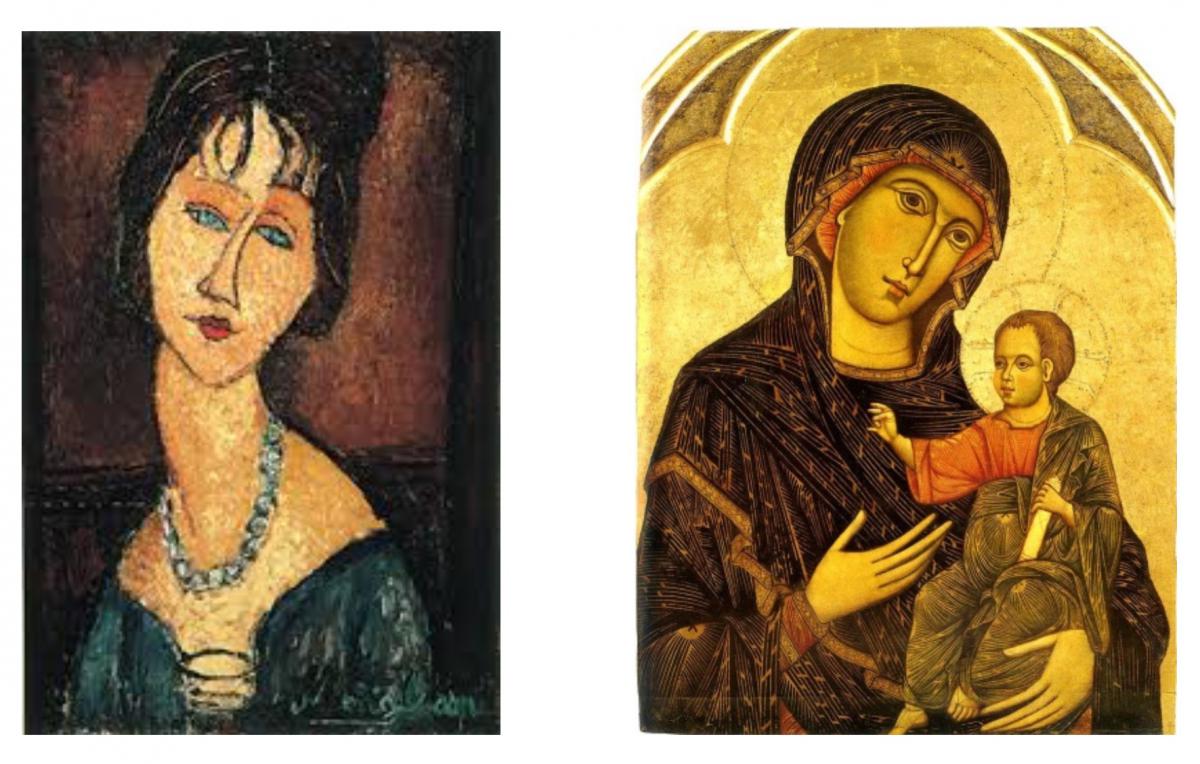
i could respond with these two images that in the end say the same thing..
I believe that those who make transcriptions build bridges to want to return to something lost by finding it for us, to seek an ancient golden age... finding themselves in that era... Busoni to me is a light upon which we must all reflect. Father of the "new classicism," he was searching for tonality but also for the new... to put it in terms of painting... he saw deep roots in the Gothic... in his case represented by Baroque music (Bach) but he also held Modigliani by the hand... in a sort of inseparable embrace.
I quote Luca for what you define as "SIDEREAL VOID"—good heavens!! What a beautiful image... and... how true it is... and Nancy for "the cultural context of the piano as an instrument... PAGAN..." just like the portrait of Modì... but what does it... I wonder, does it matter to us in the end?
I would say the work, done well... and with conscience.
For me, both Bach and his transcriptions have a right to exist. What do you say?
Member
As far as I'm concerned, I don't particularly appreciate them (the Romantic transcriptions by Tausig even less), but I certainly wouldn't dream of saying they have no right to exist... I am only saying that the originals for organ are much more to my liking
Member
I fully agree regarding the piece itself. They were written for the organ and they must remain so.... or rather... for the organ they will yield their greatest results and also be listened to in church.
In fact, I am also opposed to the fashion or (necessity) of the 900s [1900s].. of moving the altarpieces of ancient masters to museums.. rather, one should leave them in the precise spot where they were located and intended by the artist. If Titian set up a painting to be placed in a certain spot.. he did all the necessary calculations from the perspective of color rendering with that light, the tones of the colors, lights on faces and drapery etc etc... everything was calculated... then the fine arts arrive and move it..( I repeat, sometimes for good reason to protect the work ). but.... much is lost.
In painting as in music ...Bach certainly composed in that way for the sonorities of the environment he knew well, and therefore it is not the same thing to listen to them in a different environment ....let alone at the piano..
However, the matter had a broader view as a consideration and I would say it wouldn't be bad to discuss it thoroughly since this is a major problem inherent in our era. On one hand... pianists who have now become "ancient" in the eyes of those who delight in pseudo-mentalisms or intellectual games, and on the other (even more aside) devotees of the old manner (technique and instruments included... harpsichords, clavichords...)
The goal, in my opinion, would be to provide a summary of everything, trying to make beauty continue to live.
Things change over time...
"pain passes, Renoir used to say, but beauty remains"... he died very old in a wheelchair with hands devastated by arthritis but with the brush tied to his wrists... poorly made copies of his paintings were brought to him and he, being a good man, would correct them by adding something rather than becoming indignant..
Things really do change.
Even the piano... which had two pedals... then it had a third.. the tonal one [sostenuto]... and if I am not mistaken it was precisely Busoni who promoted it by insisting with the Steinway builders
the fourth perhaps.... will be up to us to do it..
Member
Well, but in the 1800s there were instruments with 6 pedals eh ahahahahah the Conrad Graf ones almost all had 5-6 pedals, I saw an Italian instrument by Giovanni Heikele with 6 pedals including resonance, a string, Turkish mode, bassoon, mute and double mute, you decide


