

Do you think a sound catalog is already music?
Started by
Historical author

Member
Reply 2 by Piccinesco
- Posts
- 1,231
- City
- Villanova di Guidonia
I think I understood the question, is it ironic?
Member
Reply 3 by Piccinesco
- Posts
- 1,231
- City
- Villanova di Guidonia
I understood correctly regarding the question about the catalog of sounds and music in another post. I partially agree, let's say that (and I have listened to two works by this composer, but not just her) for how I currently perceive certain contemporary music compositions, I understand that even to compose works that seem more like a rehearsal regarding one's ability to take risks in terms of performance techniques, various effects, the use of any noise generator, a control and conception of the work itself is necessary which sometimes escapes an insufficiently prepared listening, such as mine. I must also say that sometimes works of this kind can be stimulating, sometimes less, other times not at all. I feel like saying also that a "classical" approach to composition is often criticized; but while not wanting to generalize, it is almost impossible not to notice similarities between different compositions, concerning particular ways of treating, for example, strings—in short, without summarily judging a certain type of music with this, I think it is an aspect that is not difficult to notice, an aspect that does not relegate the modus operandi (I mean a style and not one's own language) of a certain historical period, for example, to something that is now outdated; on the contrary, I perceive a certain conformism in this regard, and perhaps as in the past, and maybe more than before, it is difficult to stand out.
Reply 4 by Historical author
Therefore a double "failure", just a catalog and mostly useless or difficult to distinguish ....

Moderator
Reply 5 by Frank
- Posts
- 3,838
- City
- -
Helmut Lachenmann's soundscapes are easily recognizable
Perhaps this article, although dated, can contribute to the discussion... I don't know .... you decide Jack
Member
Reply 6 by micamahler
- Posts
- 428
- City
- Val Maira
I don't understand the question, perhaps (to facilitate my understanding) it should be formulated in a more exhaustive manner, thank you
Reply 7 by Historical author
micamahler wrote:I do not understand the question, perhaps (to facilitate my understanding) it should be formulated in a more exhaustive manner, thank you
... free reflections .... after listening to Clara Iannotta and a response post in another topic
jack wrote:From my point of view, a true composer is Messiaen, who did not stop at a catalog.. a composer, if they wish, also creates a catalog of sounds, but then they must make music with it.... see indeed Messiaen
Moderator
Reply 8 by Frank
- Posts
- 3,838
- City
- -
Given the reference to Messiaen... a "catalogue"... and a crazy singing jungle


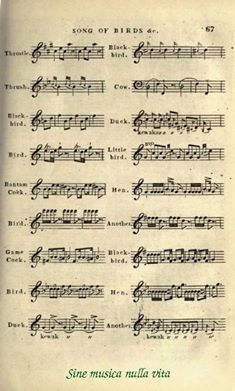
Reply 9 by Historical author
What a beautiful image Frank, thank you for sharing... and also for the Music (the capital M is not accidental). Probably it couldn't be said better in words... let's listen....
Moderator
Reply 10 by Frank
- Posts
- 3,838
- City
- -
Jack, Messiaen's music is timeless to me and places M. among the greatest composers... regarding the music written today, time must still pass, the kind that sets everything straight and establishes the correct proportions... so I think that after a single listen, one can only formulate an opinion of personal taste... in any case, obviously.
Of course, when faced with a piece, it may be more legitimate to speak of beauty or interest... but that is a different matter altogether...
Member
Reply 11 by micamahler
- Posts
- 428
- City
- Val Maira
A catalog of sounds is music if the order in which the sounds have been arranged expresses what the composer wanted to achieve. Then it is up to us to discuss whether that order suits us or not

Member
Reply 12 by RedScharlach
- Posts
- 496
- City
- -
I fear I have gotten a bit lost in the thread of posts, and therefore hope I am writing in the right place.
I will not delve into the initial question: it is purely rhetorical as it already implies an aesthetic judgment in itself. It is a question that has been formulated ten thousand times, and repeated every time one is faced with music that, instead of working with prefabricated (and pre-listened to) notes, tries to explore the potential of sound a little. Besides, I don't understand what specifically constitutes a catalog, so as to be able to distinguish it from "real music". Does it mean, for example, a table of multiphonics? Or Leporello's cavatina?
I will instead take the opportunity to make an observation on a pair of quotation marks used in the post http://www.pianoconcerto.it/forum/index.php?/topic/3086-piccolo-brano-per-fagotto-e-piano/?view=getnewpost
CromaDiBrera wrote:Iannotta is a "real" composer... She makes music that is much more complex than this simple and catchy theme of mine.
I don't know if the quotation marks are used with ironic intent or not. In the latter case, I would say they don't fit: not so much because of the intrinsic quality of the music (which we can continue to discuss, and very gladly!) but because Clara Iannotta is a professional musician, and for those who compose not as a hobby or in their spare time, but for work, I think we can easily do without the quotation marks.
Moderator
Reply 13 by Frank
- Posts
- 3,838
- City
- -
In my opinion, with "true" in quotes, Croma meant something else
Moderator
Reply 14 by Frank
- Posts
- 3,838
- City
- -
... the catalog from my point of view is a palette. There are those already made and some try to make new ones.
If instead Jack means “how the palette is used” (whether new or used), I think I have already answered: ...too early to say the last word.
I take for granted that a palette alone does not make music... obvious, I would say
Member
Reply 15 by micamahler
- Posts
- 428
- City
- Val Maira
If it was rhetoric, then what kind of question is it??
I mean, if an aesthetic judgment was implicit, then I could say: "That piece seems to me to reproduce the sound of a flock of sheep" and then open a thread
"Is a flock of sheep already music?" But if it's just my judgment.....
Member
Reply 16 by Piccinesco
- Posts
- 1,231
- City
- Villanova di Guidonia
Replying to RedScharlach: the use of prefabricated notes (I understand what you mean) hasn't reached saturation for me; there would still be solutions (for those who find them and manage to put them on paper); as I experience it, the problem is that it exists, I personally feel too radical a break between what was written even shortly after the beginning of the 1900s and now; I have the feeling that the path music took from the 6/700s onwards to the early 1900s was more gradual than in these last 30/40 years. I haven't listened to much in my life and surely there is a repertoire that I am ignorant of, but despite this, I feel an abyss between these eras and the transformation of music over time. What would also be interesting to know, and I do not take it for granted, is whether some avant-garde composers would be able to compose in a "standard" way—mind you, I don't mean or ask if they know the methodologies; having completed a certain course of study, I think they would know how to do it, but I am not sure they would be able to be convincing, at least not based "solely" on the fact that as cultural background they know what is meant in terms of composition in a certain style. I am not talking about the sense or lack thereof of writing "simple things" versus "very complex things"; everyone finds their own way of expressing themselves based also on experiences and studies. The idea I am forming right now as I write, and I think it could be a metaphor that better conveys what I am trying to mean, is: if we take for example Beethoven and Sciarrino (without comparing them because the historical context changes, etc.) and two books, probably to tell the story of Beethoven, an author would be more inclined (without overlooking the technical side) to describe his character, his passion, what leaks out from his music; for Sciarrino (who is a particular case), a preface with a legend would be necessary (which is anyway often present in the scores of certain music); in short, it would be much more similar to a technical book for professionals. As if we were facing a novel and a text on logic or mathematics. All this despite (I say despite) there being passages in many avant-garde works that result in being interesting, stimulating, and even possessing a certain aesthetic beauty. With this, you understand that the search for a "different" sound is well-received; it is indeed research, moving forward; therefore, the greater break lies in the fact that some works (always remaining within the scope of personal opinion) turn out to be at the same time musically interesting and technically advanced, while others seem a bit too forced in seeking the effect, and in those cases, even the search for sound risks becoming an end in itself. Certain avant-garde contemporary music (I define it this way because rock, pop, and everything else is also contemporary, without going into research now on pieces that even in those genres turn out to be foundational) has a certain effect on me; it may seem paradoxical, but it produces sensations antithetical to the more immediate ones, such as a sense of peace, contemplation, etc..
Member
Reply 17 by Shark
- Posts
- 106
Very diplomatic Piccinesco, let's just say that Jean Françaix is more alive than certain self-proclaimed composers; frankly, to me, the experimental approach to music feels old, its time has passed. In short, I justified it more in the '60s ... than now ...
Moderator
Reply 18 by Frank
- Posts
- 3,838
- City
- -
micamahler wrote:I mean, if an aesthetic judgment was implied, then I could say: "That piece sounds to me like it's reproducing the sound of a flock of sheep" and then start a thread
"Is a flock of sheep already music?" . But if it's just my own judgment.....
I got a bit tangled up in the reasoning ...
Member
Reply 19 by RedScharlach
- Posts
- 496
- City
- -
Piccinesco wrote:The idea I am forming right now as I write, and I think it might be a metaphor that better expresses what I am trying to convey, is: if we take for example Beethoven and Sciarrino (without comparing them because the historical context changes, etc.) and two books, an author would probably be more inclined (without overlooking the technical side) to describe Beethoven's character, his passion, and what leaks through from his music; for Sciarrino (who is a special case), a preface with a legend would be necessary (which is anyway often present in certain musical scores), in short, it would be much more similar to a technical book for professionals. As if we were facing a novel and a text on logic or mathematics.
Curious that you take Sciarrino as an example. Partly because he composed cadenzas for Mozart's Piano Concertos: precisely in Mozart's style, as if to demonstrate that he is capable of writing "à la Mozart". Partly because his music (often, not always!) is among the most atmospheric of the entire contemporary era, and precisely because of this atmospheric quality it has given rise to numerous "poetic" interpretations, which anyway involve sensations much more than mathematics. In short, Sciarrino doesn't seem like a very fitting example to me (perhaps Xenakis would have been a more pertinent case!).
http://www.youtube.com/watch?v=gyrgT85C0N0
Frank wrote:In my opinion, with "real" in quotes, Croma meant something else
Evidently I missed it!

Member
Reply 20 by micamahler
- Posts
- 428
- City
- Val Maira
Let me explain myself better: if the question 'Is a catalog of sounds already music?' arises from the listener's judgment, finding that a musical piece they are listening to is nothing more than a catalog of sounds, and does not instead arise from a premise by the composer ("this composition of mine is a catalog of sounds"), then all questions of this type are legitimate; for example: I listen to a track and my judgment leads me to think that the piece sounds like a drill, then I will write: 'is the sound of a drill already music?'
I agree with what Red said about Sciarrino—or rather, in the booklets of various concerts, or even in his own statements as well as in his book—Sciarrino is much more poetic than mathematical; I would also refer to other composers (the IRCAMians, for example...)