Technical problems and their resolution

Key action heaviness problem

25 replies 7,769 views

Started by

Fabrizi0

Member

Member

Opening post by Fabrizi0

Posts
12
City
Catania

Good morning everyone,

i am writing this discussion for the following reason,

i was given a Kawai grand piano as a gift, produced in the 90s, rarely used; now the problem is that the keyboard is slow and a bit hard uniformly, except in the highs where the keys are more fluid and responsive.

i tried to check the let-off weight of all the keys with 5 cent coins with the dampers raised, as explained in another post:

the result is 15 (58gr) coins from the lows up to 14 (54gr) in the highs,
while the key return to the rest position (that is, level with the other keys):

is 6 (24gr) or 5(20gr) starting from the lows (most of the time slow in returning), up to 7 (27gr) coins in the highs (fast in returning).

in your opinion, could it be the fact that since it hasn't been played for more than 5 years, friction has increased?

thanks everyone!

Moderator

Reply 2 by pianoexpert

Posts
3,876
City
rocca di papa

When friction increases, return decreases and drop increases. I would say we are within the limits. The Kaway is not very docile and it all also depends on the length of the key lever. I advise checking the regulation of the action and possibly not exaggerating with the spring tension. Try to reduce, especially in the highs, the hammer-string distance by 2-3 mm. Without altering the standard regulation, you can place a strip of light cardboard (about 0.30 mm) under the hammer rest felt, on the non-glued length. The action will seem more "smooth," even if the hammer's attack energy decreases slightly. Everything depends on the regulation, the tuning, and the voicing of the hammers. Also check the lateral "smoothness" of the keyboard bushings.

Member

Reply 3 by Fabrizi0

Posts
12
City
Catania
pianoexpert wrote:

4 hours ago, pianoexpert said:

When friction increases, return decreases and drop increases. I would say we are within the limits. The Kawai is not very docile and it all depends also on the length of the key lever. I advise checking the mechanical regulation and perhaps not exaggerating with the spring tension. Try to reduce, especially in the treble, the hammer-string distance by 2-3 mm. Without altering the standard regulation, you can place a strip of light cardboard (about 0.30 mm) under the hammer rest felt, on the non-glued length. The action will seem more "smooth," even if the hammer attack energy decreases slightly. Everything depends on the regulation, the tuning, and the hammer voicing. Also check the lateral "smoothness" of the keyboard bushings.

thanks for the quick response!

I wanted to clarify that I am a beginner and have no experience; I like to take an interest and try to do my best to understand the world of the piano, please forgive me for any nonsense... that being said,

then I believe the lever length is quite long since the piano measures 225 cm, the mechanical regulation seems homogeneous and correct, the hammers are aligned as well as the wippens. However, extracting the action and testing the keys by removing the hammers (lifting them completely), it seems to me that the springs are harder compared to the treble; even without the hammers, the mechanism is somewhat stiff.

also, the hammer attack energy is not a problem; the result I want is greater fluidity and smoothness, even at the expense of lower sound volume.
the piano hasn't been played for more than 5 years, so it is out of tune; as for the hammer voicing, I really wouldn't know...

does lateral keyboard smoothness mean checking the pins where the keys fit?

could lubrication be an idea?

thanks

Moderator

Reply 4 by pianoexpert

Posts
3,876
City
rocca di papa

Absolutely no lubrication!!!!!! You can disassemble a hammer and see if the repetition lever falls slowly and uniformly under its own weight. That gives you the right friction (about 3-6 gr.). Check the repetition levers of the jack rails this way too. The escapement studs must, once the spring is disengaged, fall by their own weight. If everything is in order, the sensation felt depends on a lack of regulation. The keyboard bushings are central and front. They could create some impediment if worn or too tight. An "expert" technician will know how to evaluate all these interdependencies and will make your instrument work better.

P.S. The spring force must be such that, when the key is released after the hammer has been caught by the backcheck, it makes the hammer rise sharply but without making it jump. This, however, has to contend with the friction of the hammer's repetition lever itself, which, if excessive, requires more force from the spring etc....

Member

Reply 6 by Fabrizi0

Posts
12
City
Catania

I have examined the various parts; I believe that some hammer shaving work has been carried out, and they might not even be original. Is it possible that changing the hammer weight by using sturdier springs (for a greater weight) could make everything heavier? The action remains hard even after removing the hammers; perhaps the original design intended for a greater hammer weight... I will surely be wrong, but I wanted to share this hypothesis.

In the meantime, I have called a technician; as soon as they arrive, I will update the situation.

thanks for your kindness

Moderator

Reply 7 by pianoexpert

Posts
3,876
City
rocca di papa

In the meantime, if you want, attach some photos. It is necessary to see what has been done and whether the keyboard's regulation (piombatura) has been altered. The non-original shaving and hammer felt are all things that need to be seen.

Member

Reply 8 by Fabrizi0

Posts
12
City
Catania

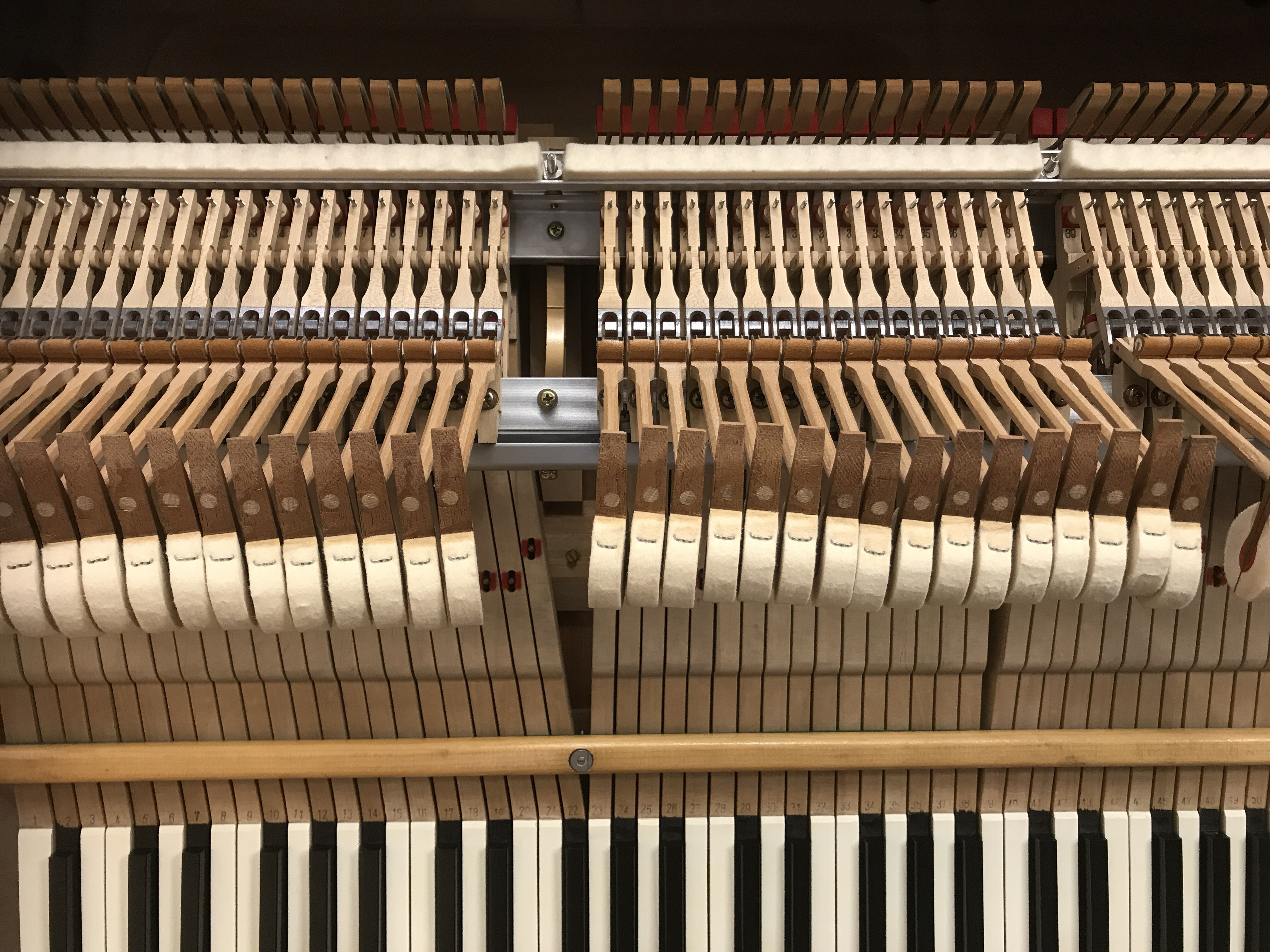
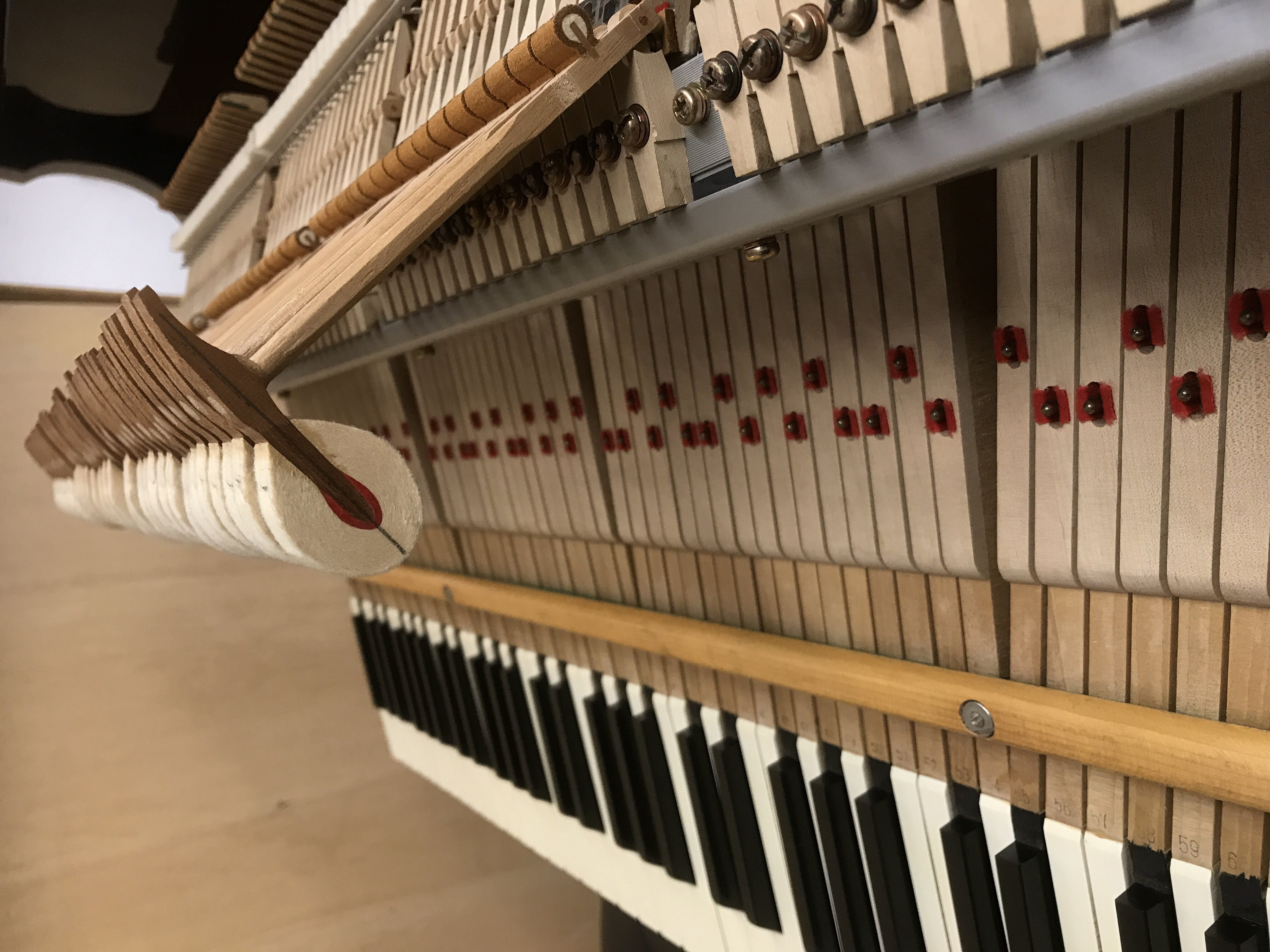
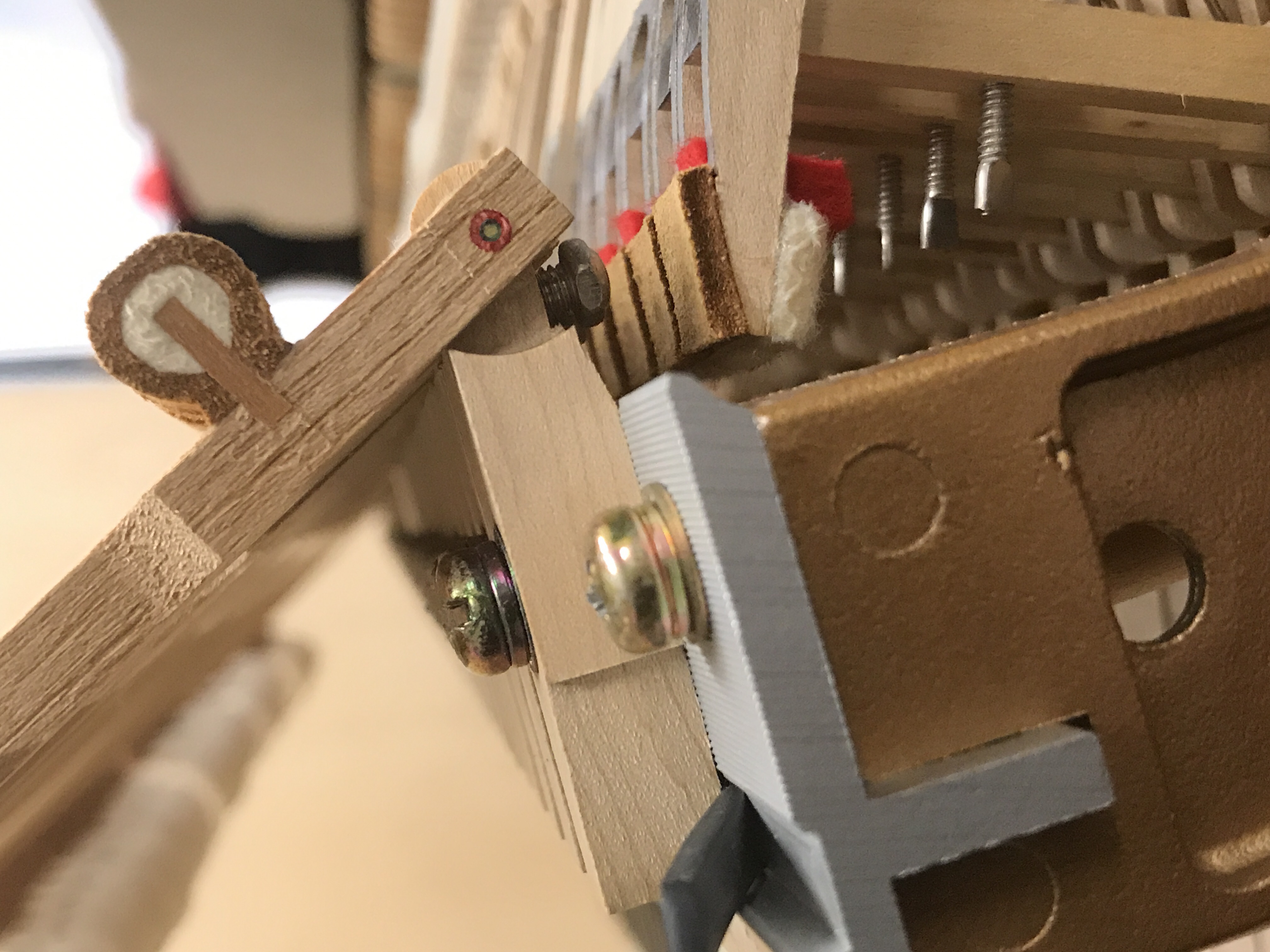
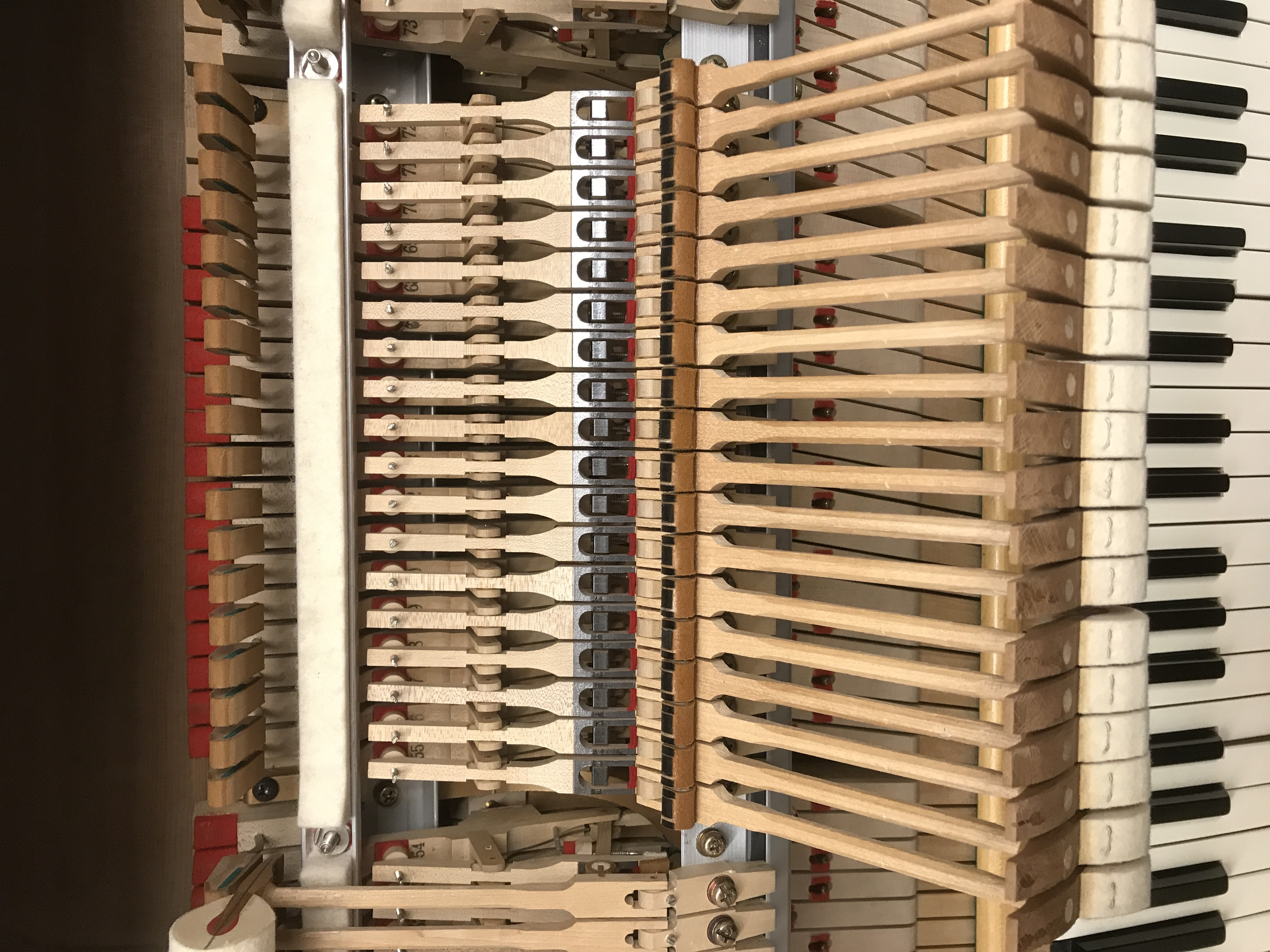
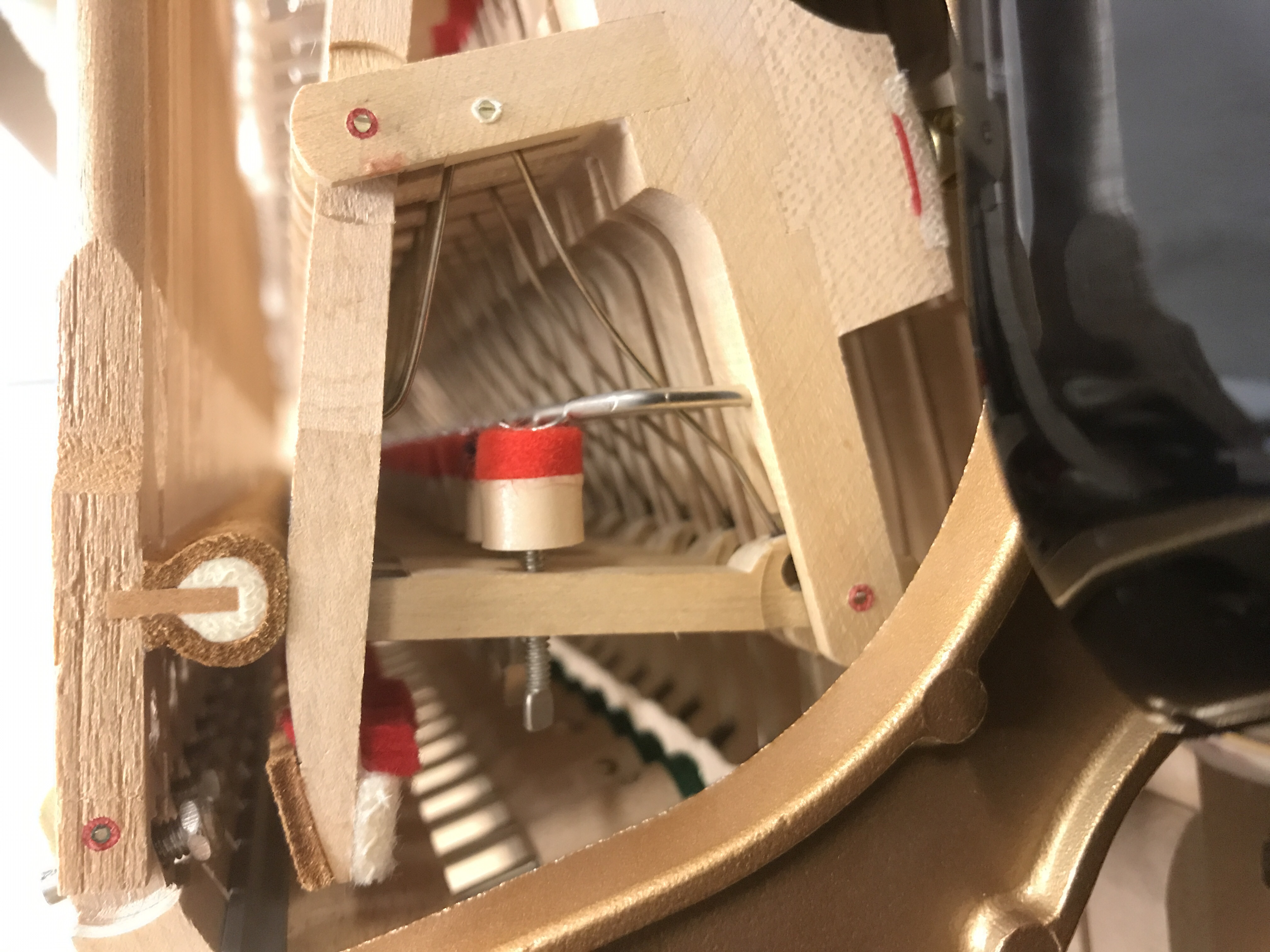
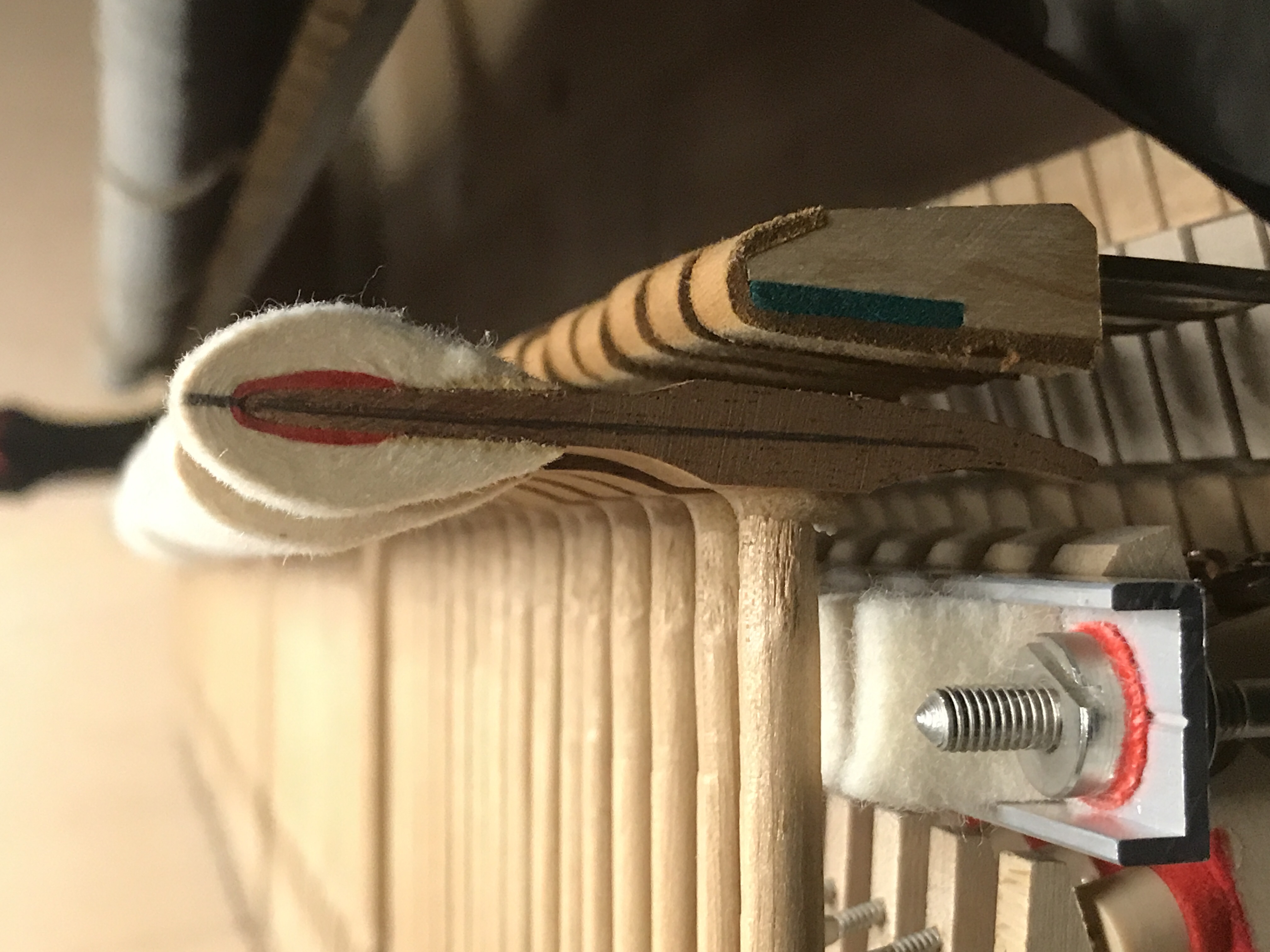
I took some photos of it, I hope they are helpful.

Also for those visiting this site for the first time, or who like me want to learn, or solve problems related to the piano.

image.jpgimage.jpgimage.jpgimage.jpgimage.jpgimage.jpg

Member

Reply 10 by giovannig

Posts
514
City
Monza

It all seems original to me; the piano has nothing strange about it.

I have happened to see new pianos coming from Japanese factories with hammers treated even more crudely than these: when one performs "acupuncture," the residues should then be finely sanded and the holes made to disappear, in order to obtain a dignified result also from an aesthetic point of view. It costs more time, more hours...

The compression of the repetitions is that which is obtained solely from the weight of the hammers pressing on the capstans. You can find perfectly cylindrical repetitions only before assembly, but two weeks after assembly under the weight of the hammers they would already be deformed. In fact, I seem to see excellent centering, considering also that photos exaggerate defects, and high-quality felt.

What I think needs to be done is to compensate for the compression of some parts and the natural settling of the action: it might be necessary to compensate for the natural crushing of the repetitions by raising the regulating levers by half a turn, for example. In fact, one must consider that a slight lowering of the repetition, even by a few tenths, results in an increase in the hammer-to-string distance of one or two millimeters, and this does not allow for a comfortable movement of the jack, which struggles so much to exit the repetition, making the action feel "stiff."

Another measurement to compensate is probably the height of the repetition lever, which may have lowered too much, hindering the return of the jack into position during the repetition phase (another factor that determines a feeling of fatigue).

The measurements you reported are within Kawai standards. The piano is like new.

It is clear that the adjustments made in the factory are done with actions that have just been installed, especially if the factory produces large numbers and does not have time for long settling periods (which would be uneconomical). Therefore, it is the technician's job to review them after some time, without overturning what is good, but "by turning the right screws."

By limiting yourself to these two operations, you could find greater pleasure in playing your piano. Loosening the repetition springs, which are generally very tight, is an extra step and probably should be done, without overdoing it. One must achieve a decisive hammer rebound that is not unstable due to too little or too much force...

Bye

Member

Reply 11 by giovannig

Posts
514
City
Monza

Anyway, to better understand how much felt on average was removed during the initial preparation, one needs profile photos of the last high notes, the hammers of the bass or mid ranges; setting aside shape factors which can be debated, they do not wear down easily. It is also true that by scraping and voicing, scraping and voicing etc., sooner or later... one reaches the wood...

Member

Reply 12 by Fabrizi0

Posts
12
City
Catania

I thank you Giovannig, truly prepared and exhaustive!

I am happy to have your positive feedback on the fact that it is new and in good condition. Since I do not have experience, I have had no way to compare or have an idea.

By the first operation, did you mean the pilot?

How can I adjust the height of the repetition lever? Which part regulates its position?

Thank you again for your availability and for your patience

Member

Reply 13 by giovannig

Posts
514
City
Monza

Here are some very valid tutorials on regulation; they should be watched at least to understand where to act.

Anyway, it is fundamental to verify the height of the repetition lever before touching anything: one by one with a finger, you make the pushers come out from under the roller into the resting position (pushing them down slowly with the index finger under the escapement button, where the lever takes its "L" shape) and then release them to gently re-enter. The pusher must settle back under the roller without effort, but by grazing it: this grazing is evidenced by a downward movement of the hammer of about one millimeter when the pusher leaves the roller, and an upward movement back into position when it re-enters. If no hammer movement occurs, the lever is too high and must be lowered by adjusting the screw at the bottom of the rail, almost under the hammers. If, instead, the hammer falls down and does not return up, the lever is too low, and the same button screw must be turned in the opposite direction. Just a little bit—quarter turns—is enough to observe differences.

Obviously, the hammer must be high enough so that the jack does not rest on the white brake felt. In this case, lift all the repetitions slightly before performing this check.

As for verifying the correct height of the repetitions, taking the background as a reference since the piano is new, it is done by slowly triggering the mechanism by pressing the key all the way down. The hammer must fall comfortably onto the repetition lever once the key is tripped (escapement) and stop suspended one to two millimeters below the escapement position (many call this second escapement). In essence, after the escapement, there is a key travel gap towards the felt, and while traveling this distance by pressing all the way down (without compressing the felt too much), a minimal rise of the hammer must be visible.

So: first escapement (trip) -> fall (on the second) -> post-escapement (slight gap) with a slight rise of the hammer.

If no minimal rise is observed, say half a millimeter, everything might still work, but it is not certain that the post-escapement is sufficient for the easy movement of the pusher and for the pianist when playing. The hammer must be raised by unscrewing the repetitions until this "intention" of rising is observed. It doesn't take much; it is often just half-turns.

I cannot explain it better than this; for me, it is harder to write what to do in this case. I don't know about you, but in my opinion, these are not beginner checks.

Member

Reply 14 by giovannig

Posts
514
City
Monza

The height of the repetition lever must be checked for all 88 keys.

As for the pilot, it is sufficient to check it for the first and last hammer of each section, then realign all other hammers to the samples using the pilots.

Member

Reply 15 by Fabrizi0

Posts
12
City
Catania

I thank you again for the quick and exhaustive response.

no absolutely I am not modifying anything, I called a technician to tune and regulate the action, but I am very interested in these things, and I am pleased to understand their complicated operation.

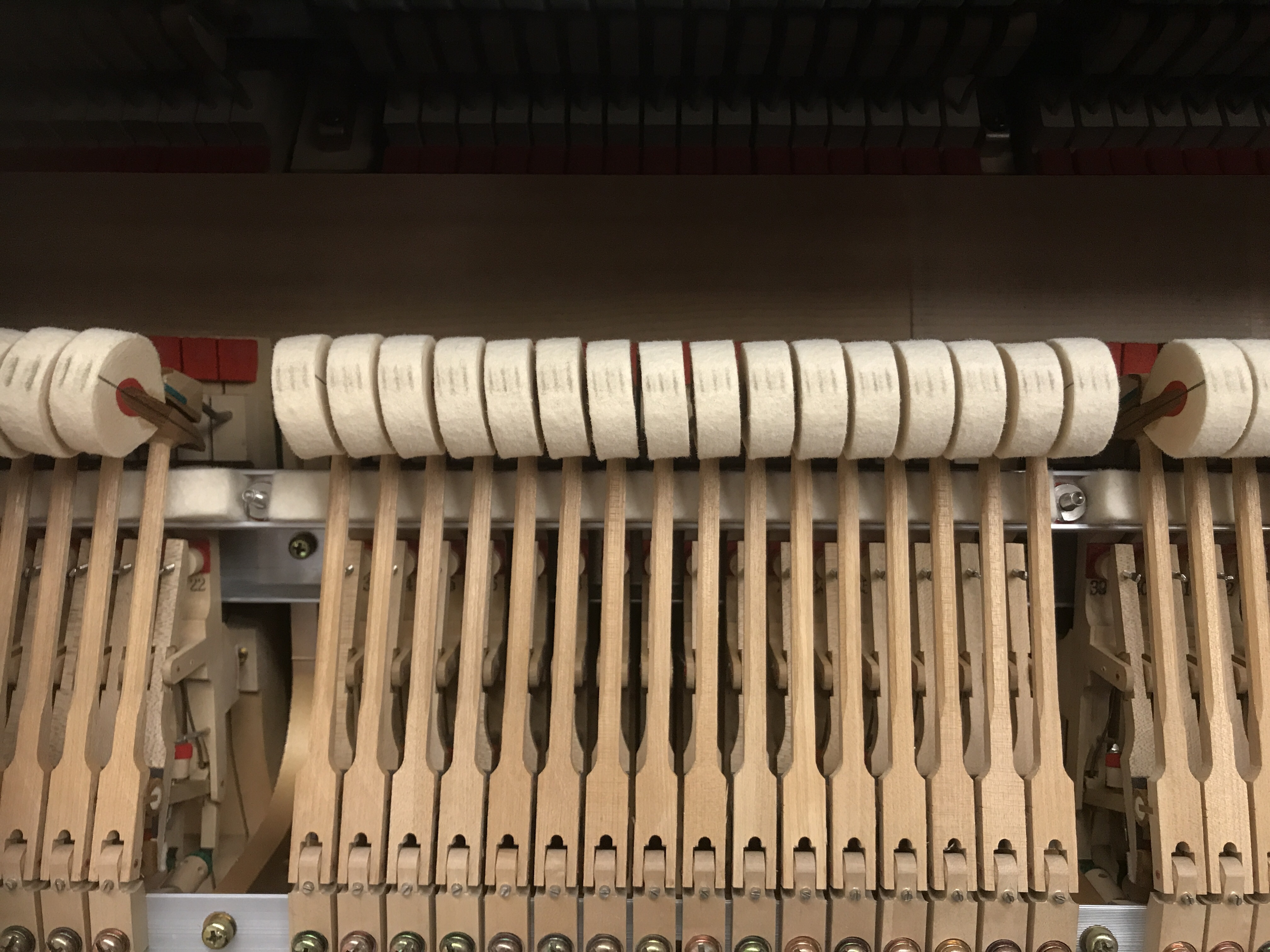
That being said, following the explanations, I checked the height of the repetition lever of the hammers, which based on the description seems correct to the point that when the hammer moves the pusher (which grazes the roller) it lowers by 1 mm (or slightly less) and then rises by releasing it. (the hammers are raised from the rest felt by 2-3 mm).

As for the verification of the pilots, it seems correct to me as well

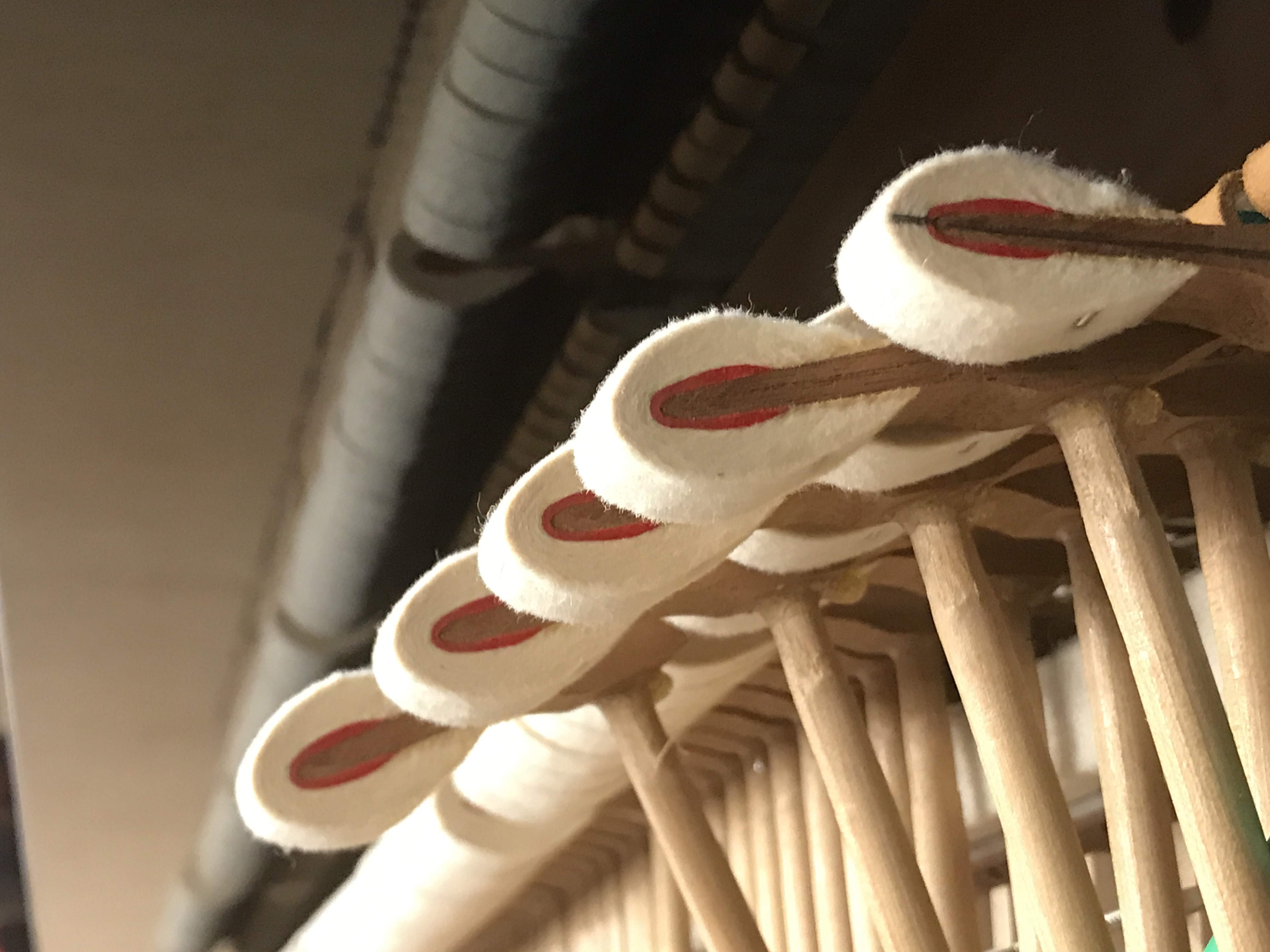
i am attaching a photo of the hammers of the treble section

image.jpgimage.jpg

Member

Reply 16 by giovannig

Posts
514
City
Monza

Everything is fine, don't worry; the technician will have to regulate and check the springs and escapements, at most.

bye

Member

Reply 17 by Fabrizi0

Posts
12
City
Catania

Thank you very much, very kind!

i will update you as soon as the technician arrives next week

Member

Reply 18 by giovannig

Posts
514
City
Monza

Regarding the replacement of the hammers, it is likely yes ... from the glue joints.

check on the sides of the small wooden pieces if you find any marks. Check them all.

Moderator

Reply 20 by pianoexpert

Posts
3,876
City
rocca di papa

Giovanni, you beat me to it. That's fine. I agree. A proper regulation first of all. It doesn't seem to me either that the hammers have been shaved. I am observing the vertical alignment - the inner part of the roller which is on the same line!

Log in to participate