Free thoughts and words

The danger of the web: mediocrity

41 replies 6,116 views

Started by

Thesimon

Administrator

Administrator

Opening post by Thesimon

Posts
4,504
City
Ariccia, RM

I am opening this topic, which will be long-winded but which I believe will produce a long and profound discussion, following some comparisons I had both with Francesco a few days ago here in Rome and with Paolo just yesterday; and today something happened to me, quite by chance, that fell perfectly into place, confirming all the various arguments formulated...

We are talking about mediocrity and cheap populism, which are gradually becoming viruses that attack the categories of true professionals.

The subject is decidedly very complex, and I am certain that in this forum a great debate could emerge, perhaps with some illuminating ideas on how to curb and fight the problem, given that, as we know, even antibiotics have no effect on viruses. Perhaps, who knows, we might find a vaccine to save what can be saved.

Internet has certainly allowed everyone to express themselves freely in all areas of human experience. From political and social ideologies to science and art. This is certainly a positive and incredible milestone, but at the same time risky, because within the word 'everyone' also hide those who, every time they open their mouths, miss an opportunity to remain silent; namely, the mediocre.

This happens because, perhaps, in the absence of direct and visual confrontation, everyone feels entitled to treat a subject with the pretension of a Nobel Prize winner despite, based on what they say and write, it being clear regarding that subject that they do not even know its basics. Why does this become risky? Because those who are completely clueless but interested in the subject risk believing that the truth lies in those words.

This generic reasoning can then be applied to all categories of the cultural world.

Where does the virus originate? The virus is born when the mediocre person pushes forward or is pushed by someone who knows how to do image promotion, gaining followers and, as a corollary, making themselves important in the eyes of others. On the internet, a person's "popularity" is measured by video views, the number of channel subscribers, and the number of followers on a Facebook page. At this point, it is a short step: they have many views -> therefore they say the right things -> therefore they are a guru, while the one who goes against them and has fewer followers is an idiot (even if the antagonist might actually be a professional in the sector). Quite by chance, I demonstrated to Frank that behind many self-proclaimed "gurus," there are only scripts that, through lies, exploit the work of others to make themselves look good; but that is another problem.

That is when the masses begin to believe that beauty lies in minimalism, not because it is intentional and considered, but only because whoever published it is unable to do more. A glaring example: Francesco Trocchia (but I could have brought up any other professional composer here on the forum), our forum moderator and a professional, is not known or followed on a web scale because he has not invested in his public image, despite having quality material to promote; therefore, the masses prefer to listen to and esteem someone who wakes up in the morning playing 4 confused notes and 2 major triads without any preparation in composition, just throwing them out there because they sound good according to him; but that person has the media power to make those 4 notes pass as if they had been placed there by the new Beethoven. This is how the virus has materialized.

Paolo also told me that the situation, at least here in Italy, is getting worse and worse, concluding that nothing more can be done to reverse this cataclysm. I disagree.

Frank and I talked about how important it is, for those who know how to do it, to share and begin building one's own public image. But on one hand, I also understand that, by necessity, if you are a professional in a sector, you do not have the material time to think about your public image. On the other hand, however, he also confessed to me that he does not love self-promotion.

At this point I wonder... These people cannot continue to pass for deities descended to earth if they do not even possess the basics of the ground on which they move, and this virus must end.

Paolo said to me yesterday: - Ok, go to a concert where a mediocre person is playing, what are you going to do? -

Me: "I'll get up and leave! If it is true that time has value, why should I give my time to an imbecile who struts as if he were Rubinstein but who in reality has the abilities of a child at their first piano recital?"
Paolo: "And if he asked you what you think?"

Me: "I would tell him: do you want the naked, raw truth or the usual pleasantries? Obviously, everyone would answer with the truth. And let there be truth! You must study because"

what you composed, passing it off as Liszt's second Hungarian Rhapsody, would actually be played better by 11-year-old children in their first year of piano; they would certainly have more imagination"

I say the solution is: enough with this fake politeness. These people must be confronted with the facts and, if necessary, publicly ridiculed, because, out of respect for those who have sacrificed their existence dedicating it to passion and study, these individuals must be stopped!

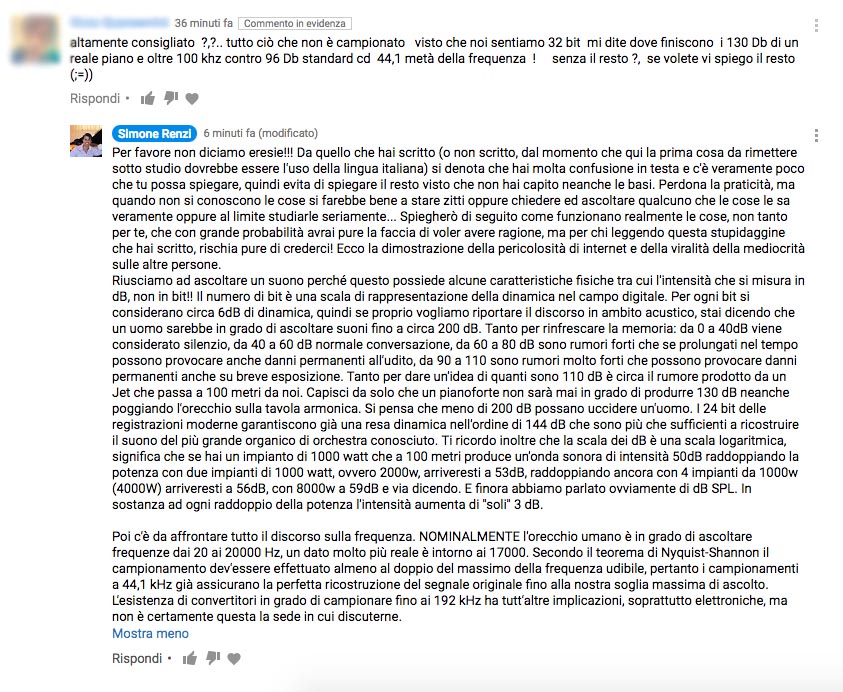
Connecting back to what happened to me today... I received a comment on a piano library comparison video from someone talking about bits, dB, and frequency without even knowing what they were, with such a sense of self-importance that to a non-expert it would have sounded like gospel. Tired of this bullshit, I sat him down without even giving him a chance to reply. It is time to say enough and call crap what crap is and chocolate what chocolate is. There you go... Fixed for the holidays.

Update: he replied with the following comment: "excellent response"; he subscribed to my channel and even added me to his circle on Google+. After all, what else could he have said after that demolition?

Every comment and idea of yours, perhaps even more diplomatic than mine, is welcome; sincerely, I haven't been able to find any diplomatic way to put an end to this disgrace, other than the "forceful" manner.
Attachment

Member

Reply 2 by antares86

Posts
1,414
City
Bologna

Well, I've never been a diplomat... sarcastic, yes

I fear there is no cure, however, but I hope I am wrong; I need to organize my thoughts before saying anything else, though.

Moderator

Reply 3 by Frank

Posts
3,838
City
-

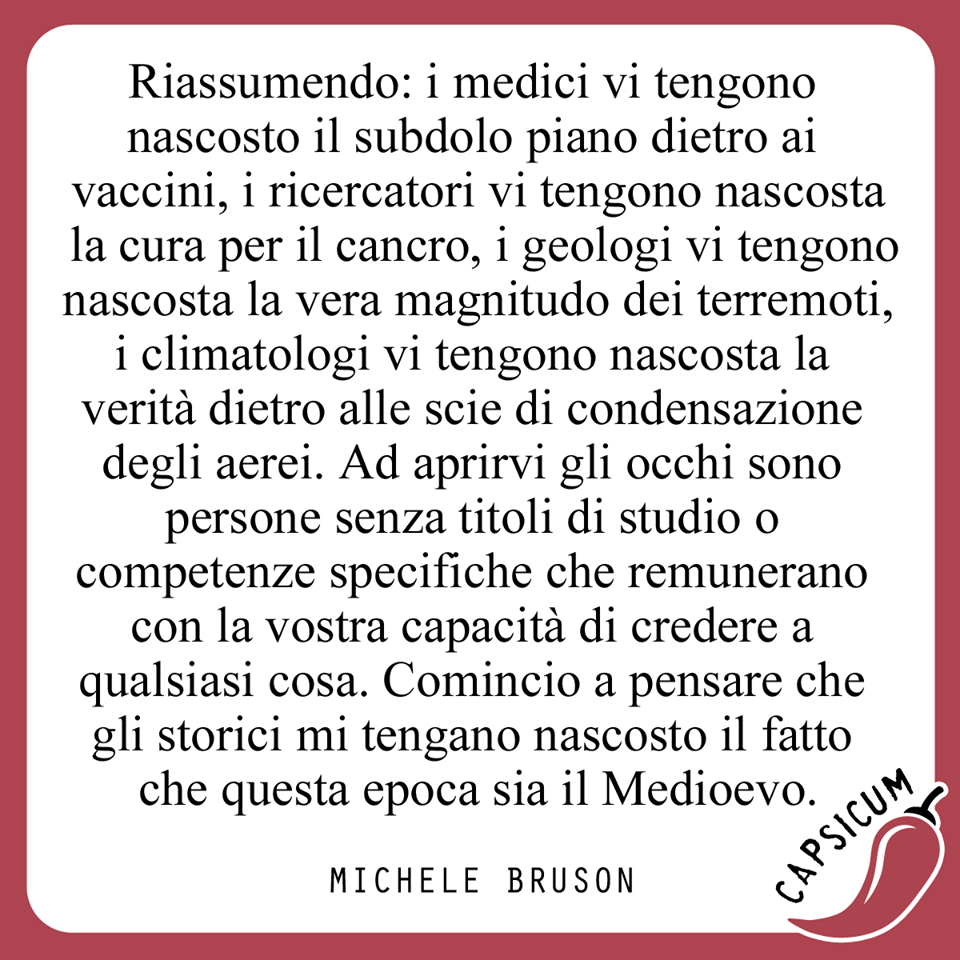
I recently read this image... it responds partially but ironically. In the discussion, I think perhaps a point of view is missing: mediocrity lies not only in the braggarts but also in the gullible ones, and one feeds the other. Someone who is truly interested in something doesn't go to braggarts, but they can fall for it and get cheated. But if you have a heart problem... in the end, you stop looking for a diagnosis on the internet.

Anyway, personally speaking, I am the first to be aware that marketing is the soul of commerce, but commerce is a word that can have many meanings. A reflection should also be made on things "not for sale".

Let's see what other contributions come out on the subject... then I will return to it.

Attachment

Member

Reply 4 by giovannip

Posts
553

Simone, you did the right thing by "slaughtering him" with facts, so next time he will think twice before talking nonsense. He even had the audacity to reply; if I were in his place, I would have retired to a convent to meditate for the rest of my life.

Member

Reply 5 by francescochopin90

Posts
355
City
.

Freedom of speech and the press is, in my opinion, an illusion. Only those who have the expertise to do so can speak. I am a nurse, but I often hear people talking bullshit and I find myself in a situation where I cannot counter them. If you don't have expertise in physiology, biochemistry, pathology, you must shut up, stay silent! Instead, grandmother's remedies magically become more effective than what science proposes just because they are popular (I am fighting against certain high-protein or gluten-free diets proposed by self-proclaimed dietitians or doctors expelled from the register!). It is the same in music: if you don't know, you must shut up, stay mute, or at least say that you are ignorant on the subject. I posted a message on this forum proposing a system for digital escapement, while admitting to being ignorant on the matter. You cannot talk about everything!

Member

Reply 6 by Gerardo

Posts
277

If you want, shall I explain the rest?

No thanks. Two notions of acoustics that were mandatory in conservatory during the music history course (a complementary subject that every graduated musician knows) ... old system are enough to understand that there is more than something wrong with the phrasing brought by Simone.

TheSimon wrote:

i also understand that, by necessity, if you are a professional in a sector, you do not have the material time to think about your public image. On the other hand, however, he also confessed to me that he does not love self-proclamation.

... there is also the economic aspect; advertising costs money and in a niche sector like classical music, it doesn't pay. If we consider pop music, however, it's a completely different story; there it is worth it since one must "impose" quality products on the market.

Member

Reply 7 by Zazza

Posts
250

Money is always the key to everything; if I had it, I would have the best performances in the world... instead, it happens that they commission works from me and then they don't pay me, but they don't even (later) have them performed. Quality combined with money can also (and even) be equivalent to a place in music history; quality without money certainly equates to remaining poor

Advertising, as Gerardo says, has a cost, and a high one at that, and above all at the beginning, who has so much to invest just to advertise work already done? (And not the work I will have to do). No follower would give a cent to make a project a reality; at least you can say you are "followed"... but what if you pay for the clicks yourself? This is also a psychological scam: you think you are a God, but you might just be mediocre.

Member

Reply 8 by Zazza

Posts
250

... ah, I often distrust those who proclaim themselves saviors of the world... and just because they have 10,000 subscribers on a YouTube channel

Member

Reply 9 by nancy

Posts
521

....I believe that the internet has simply exacerbated and highlighted a problem that has always existed. True culture, which inherently possesses humility and an awareness of its own limits for the sake of consistency, cannot proclaim itself, and thus always remains in the shadow of the pettiness and cunning of those who instead sell smoke as roast... with "skill" and marketing abundance. Gullible people make all this possible because they do not have and do not want to have expertise... sometimes one becomes gullible simply out of laziness.

Unfortunately, in this way, falsehood manages to obscure true culture. It is a problem with deep roots that could be countered by increasing the cultural level of society... but political and social tensions and dynamics do not always move in this direction; on the contrary. For these reasons, I greatly admire those who do not get discouraged and seek to disseminate as much culture as possible. Everyone in their own field....and being an idealist by nature, I hope that sooner or later society reaches the maturity to recognize true merit...

Administrator

Reply 10 by Thesimon

Posts
4,504
City
Ariccia, RM

They all seem like excellent analyses of the problem to me. However, none of you has contributed to providing some kind of solution to the problem... Who wants to try?

Member

Reply 11 by nancy

Posts
521

solutions?!?!?

difficult if one thinks big (one would enter the field of politics in my opinion)... many if one thinks about giving small contributions... everything that can be true cultural dissemination!

Member

Reply 12 by ttw

Posts
277

Think about one thing: for Bergoglio's eightieth birthday Baglioni sings, for Ratzinger's, in 2007, there was the Stuttgart orchestra. To good connoisseurs, few words are needed

Moderator

Reply 13 by pianoexpert

Posts
3,876
City
rocca di papa

In fact, the answer is difficult. Only the most demanding will seek excellence. Today, confusion reigns supreme (it seems as if the '900 continues!). Once at a conference... let's say... on somewhat spiritual-esoteric concepts etc.. to which I participated, I was amazed: The speaker drew a square and a circle whose circumference touched the vertices of the square itself. He asked the audience what they saw. Everyone, speaking in turn, saw something different. I believe that anyone among us who "has no eyes to see" and/or "ears to hear" may be far from awareness. It is certain that "shaking each other up" to convince one another of reality is perhaps not the best recipe. Opinion, however, is legitimate. When I go to listen to something that is a thousand miles away from my convictions, I applaud the effort and leave... if then the friend in turn asks me for an opinion, I spill the beans, not without difficulty, for two reasons: 1) because I must be sincere, detailing the reasons for my judgment 2) so that a trace of my observations remains in his mind, in case the author realizes it in his choices. And anyway, it is hard and mortifying to receive criticism or negative judgments, and when it happens that I express them, I feel in difficulty; I must strive hard trying to present my opinion, should it be contrary, with delicacy... but perhaps with determination.

Member

Reply 14 by danielescarpetti

Posts
1,032
City
Castel San Pietro Terme
nancy wrote:

....I believe that the internet has simply exacerbated and highlighted a problem that has always existed. True culture, which inherently possesses humility and an awareness of its own limits for the sake of consistency, cannot proclaim itself, and thus always remains in the shadow of the pettiness and cunning of those who instead sell smoke as roast... with "skill" and marketing abundance. The gullible make all this possible because they do not have and do not want to have expertise... sometimes one becomes gullible simply out of laziness.

Purtroppo, in this way, falsehood manages to obscure true culture. It is a problem with deep roots that could be countered by increasing the cultural level of society... but political and social tensions and dynamics do not always move in this direction; on the contrary. For these reasons, I greatly admire those who do not get discouraged and seek to disseminate as much culture as possible. Everyone in their own field....and being an idealist by nature, I hope that sooner or later society reaches the maturity to recognize true merit...

TheSimon wrote:

They all seem like excellent analyses of the problem to me. However, none of you has contributed to providing some kind of solution to the problem... Who will try?

Nancy, from my point of view, hits the nail on the head: the mediocre have always existed, just as the gullible have always existed.

Until a few years ago, the gullible used to say "it's like this because television said so"; today they say "it's like this because I read it on the internet."

Internet is the most democratic tool that the human mind has ever been able to conceive, and it is good that it remains so.

However, those who use the internet to inform themselves must learn to do so by knowing how to distinguish charlatans from people who have clear expertise in the subject they wish to deepen.

It is not that easy, but it's not that difficult either. If someone wants political information, they cannot rely on a piece written by some random "nobody," but must turn to those information channels that refer back to newspapers, while obviously knowing how to distinguish the ideological source behind that newspaper.

This is true for all topics: cultural, social, economic... And it is always important to try to compare various opinions, but this was already valid in the days of print, radio, and television... and today even more so.

The solution is therefore left to us individuals; there are no other solutions... or at least, frankly, I don't see any.

A small musical example: how many still believe that Salieri - poor Salieri - killed Mozart? So many! Because a movie said so, because a television program said so, and.... a young music teacher from my son's middle school!

Mediocrity and ignorance are rampant everywhere, and if one wants to defend oneself, there is only one solution: study, study, study! and never stop doing it!"

Member

Reply 15 by Terenzio

Posts
212
City
Roma

I believe that only time will put things right.

Today, there is no possibility of intervening in stupidity.

An example:

In recent days I saw a post on Facebock saying Gentiloni was the fourth non-elected prime minister. I pointed out that Gentiloni is a deputy of the Italian Parliament and therefore it would have been correct to say: the first elected prime minister after three non-elected ones.

My observation was immediately deleted and the post continued with the scandal of the four non-elected ones.

We are now at the point where when you try to correct blunders, you are told that you are ignorant and advised to go study.

Member

Reply 16 by danielescarpetti

Posts
1,032
City
Castel San Pietro Terme
Terenzio wrote:

I believe that only time will set things right.

Today, there is no possibility of intervening in stupidity.

An example:

In recent days I saw a post on Facebock saying Gentiloni was the fourth non-elected Prime Minister. I pointed out that Gentiloni is a deputy of the Italian Parliament and therefore it would have been correct to say: the first elected Prime Minister after three non-elected ones.

My observation was immediately deleted and the post continued with the scandal of the four non-elected ones.

We are now at the point where when you try to correct blunders, you are told that you are ignorant and advised to go study.

Terenzio ... it's not quite like that!

In reality, the argument would be different and, anyway, if we want to look at it from the perspective of being a deputy elected by Parliament, Letta was also one even though he has now resigned. There have only been two non-elected members in Parliament: Monti and Renzi.

Member

Reply 17 by nancy

Posts
521

The problem of blunders or hoaxes, if you will, in my opinion, cannot be corrected with a system of censorship. It would give too dangerous an instrument of judgment to subjects who could instrumentalize the matter according to their own "subjectivity". Eventually, one could mandate the publication of sources alongside the news. This would leave the freedom to those reading to evaluate the truthfulness of the "news". But out of laziness and ignorance, I am sure that very few would delve deeper anyway, and thus even the sources would be cited with malice and would be other hoaxes....

Member

Reply 18 by giovannip

Posts
553

Nowadays the web is teeming with braggarts and false news; most of these are "harmless," but if we think about "Fake News" created ad hoc to discredit this or that politician of a certain weight, then things get serious. I take as an example the false news circulated during the American elections, in which it was made to be believed that in a pizzeria in Washington frequented by Democratic politicians and therefore also Clinton, in reality abuses on minors etc. were being perpetrated, and someone thought it was a good idea to take up a weapon and do a bit of spring cleaning; by pure chance, yet another massacre was avoided. The serious thing is that the false news was spread by Trump supporters, people who knew very well what they were saying, but evidently did not evaluate the possible consequences of their action... perhaps.

Now there is a desire to take corrective measures, and a few days ago this news broke that "Facebook has launched a plan against 'Fake News' using the help of software."

Is the news true, or is it yet another hoax?

I believe that the recipe for bringing some order does not exist—no one has the guts, and setting limits would be wrong; it is up to all of us to verify the truthfulness of what we read by deepening our understanding with further research and cross-checking.

Member

Reply 19 by Bianca

Posts
510
City
Torino

Dear Simone,
if you are looking for solutions, the first response that comes to mind is this: it is necessary to create one (or more) "authorities."
This is an approach of a political and institutional nature and, if you wish, also very pragmatic: establishing a series of accredited bodies that deal with monitoring the credibility and reliability of circulating claims. One could even think of creating a logo to be applied to various statements produced or by the respective news outlets. A bit like what happens for food products. In times past, such an idea would have appeared utopian and unachievable, but today in reality much greater efforts are made for much less important things, and such a project, with existing tools, would be far from science fiction.

But as we know, practice always clashes with theory, and as far as I am concerned, in this case, not in the way one would expect.
Perhaps, in fact, we should first clarify for ourselves what the problem is that we are seeking a solution for. If it is simply the reliability of a technical claim, then we might have some hope, even if everything on this earth is debatable and falsifiable. But if we are also looking for certification for aspects that are more or less difficult to measure, then I fear that almost every solution will be a dead end.
Take the case of a musical work. To some, it seems evident that certain figures enjoy an undeserved and absurd success compared to others who are much more capable and deserving. One then wonders if it has always been this way or if this digital world has only exacerbated and worsened things. On the other hand, one also finds comfort in saying that time and history will set things right, since only products of value will last and the rest will be discarded by natural selection.
But are we really sure about this? I believe that things are much more complex and even less comforting than how we would like to tell them, and in this regard, I make some provocations:

-Time and the future will only confirm the success of those who already have it (if not everyone, at least most of them).

-Time and the future will only confirm the failure and oblivion of others (if not everyone, at least most of them).

-The history of the past has not selected the absolute best, but only those whom it (history and historiography) deemed appropriate to select.

-The history of the past has erased all those whom it did not choose, not based on their value, but based on interest (which, however, often includes value as well).

I imagine how hair-raising these words can be, but I believe that, for honesty's sake, sooner or later everyone must deal with them, or at least try to reflect on them if they do not want to remain clinging to the comforting but utopian idea, however productive it may sometimes be, that truth always wins.

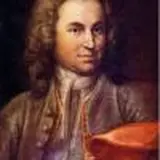
Certainly, based on the previous provocations, one can discuss, for example, what value is or what is better. However, those are not the issues I want to raise and, with a little goodwill, it can be understood. Rather, many, or some, contrary examples can be objected to. For example, let's take the well-known case of Bach, of whom it is often said that in his time he was not properly accounted for and that he was only revalued with Mendelssohn, thus showing that history always puts things in order. Bach, however, was not truly a person of little success, as the myth would have it and, even if Telemann seemed to be preferred over him at the time by far, history would have still passed him through for the roles and consideration he already had in life. However, one can object that being a court master is not enough to go down in history, but one must have quality. Certainly, and certainly not all (in fact perhaps none) court masters had Bach's qualities, but the point is rather to ask how many had his qualities but could not become court masters. None, some, many? Of these, we could never know, and not because history is unable to find them, but because the present (the present of each of them) has erased them irretrievably. This is an inevitable fact. It is a matter of selection (even if artificial, because in the human there is little that is natural). How many Bachs and Telemanns could indeed have been endured by the courts of those times if not one or two at a time. If already in an era like the one we live in, composers and artists of wonderful abilities rain down from everywhere, then today, in a world where imagination is certainly not superior to that of the Renaissance man, what should we suppose about those so prolific centuries?

I remember that on the first day of Politecnico, the professor of Analysis I began with a speech that made me think: she said that, since there were too many freshmen that year, they would have had to in one way or another"}

...reduce us in the other (by any means) to at least a third. And so they did. Now it is legitimate to think that those who remained were the best and most deserving, while the rest did not have the qualities to become engineers. Even if in the following years I never had reason to doubt it, I asked myself a question even that day: but if only those who would later be eliminated and judged inadequate had presented themselves for that course, then what kind of engineers would have emerged? And then I realized that this could be exactly the real situation, that is, precisely the one we were in at that moment: the others, the truly better ones, simply might not have enrolled in the course.

There is also to be considered that perhaps the beauty and value of a work might not depend solely on intrinsic factors. Who can guarantee us that many of those much-vituperated fake composers are not actually better than many of those we consider such? As long as it involves evaluating technical ability based on certain more or less shared parameters, it is one thing; but beyond that, who knows? After all, a work becomes beautiful also because of the fact that it is considered beautiful. With this, I do not want to surrender to what I would like to fight against. I only want to consider this aspect of reality as well, without denying it for convenience. Art is, in fact, also communication and expression of inner contents towards a community, and the sharing and understanding of this communication is in itself a part of the beauty, intrinsic if you will, of the work of art. From which it also follows that a work can never be beautiful or superior in an absolute sense, but only as the fruit of a social process. But here I am going too far and I will stop.

If all this is too disturbing, pretend I didn't write it and take, eventually, only the first part as good.

Member

Reply 20 by LucaCavaliere

Posts
860
City
Segrate
TheSimon wrote:

They all seem like excellent analyses of the problem to me. However, none of you has contributed to providing some kind of solution to the problem... Who will try?

some solutions?

It seems to me that there are two problems.

1) separating authoritative information from nonsense on the internet

2) popularity and success, in artistic or scientific fields, etc., which often touch those who do not deserve it and not vice versa

in internet, regarding the problem of finding (ready-to-use) correct information, it seems to me that Frank's good example is worth noting: if someone has a heart problem, in the end, they stop looking for the solution on the internet.

it is a strong example but it gets the idea across. That is to say that: it is obvious that everyone cares about their own health and does not approach problems so lightly. Therefore, even regarding other things (e.g., knowledge about audio recording), if a person truly cares, they do not stop at the first things they read (wherever they read them).

And thus - if they care - this process can occur:

1) reads info on the internet

2) reads a lot of info on the internet... and compares

3) procures (purchases or borrows) printed works on the subject

4) moves from printed works like "ABC of audio recording" to publications more targeted at specific problems

(...and in the meantime, their ability to discern will have increased....)

5) perhaps they will consider taking a course with teachers to increase their skills

In short: for problem 1, the solution is that: if you really care, you work hard at it; you don't stop at the first thing you hear.

for problem 2, I would stick to Nancy's words: increasing the general cultural level.

How?... I am afraid that the problem is not so much the "how" but that people don't really want to.

Log in to participate