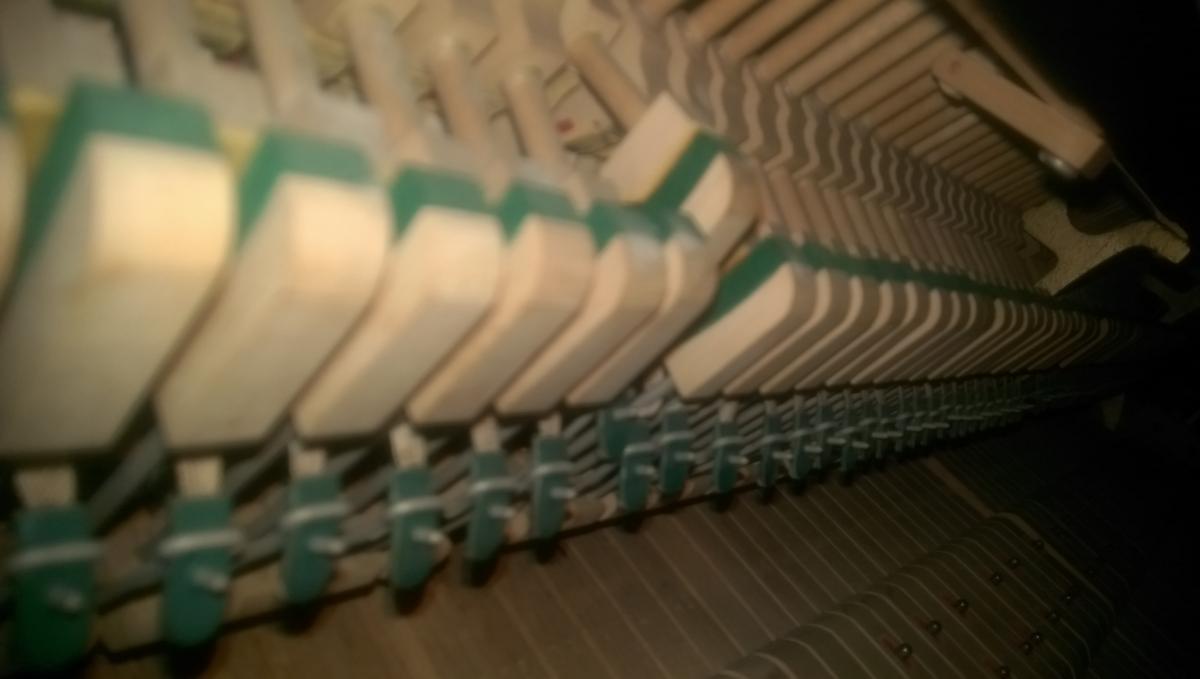
As in my introduction post, I would kindly like a technical opinion on the setup of the instrument.
So, it arrived just two days ago, and for tuning I am waiting two weeks for it to settle; I would like to know what interventions you think should be carried out to truly bring it back to its original splendor. I should preface that the piano is still exactly as it came from the factory, no interventions have been made and it has been played very little.
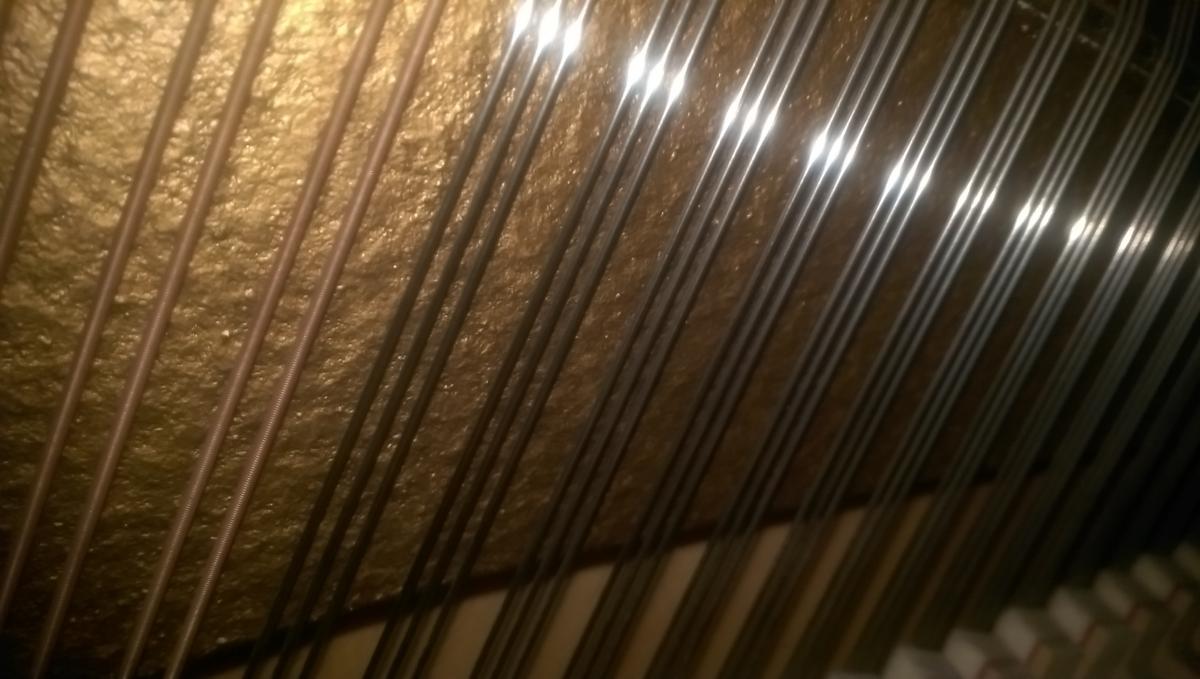
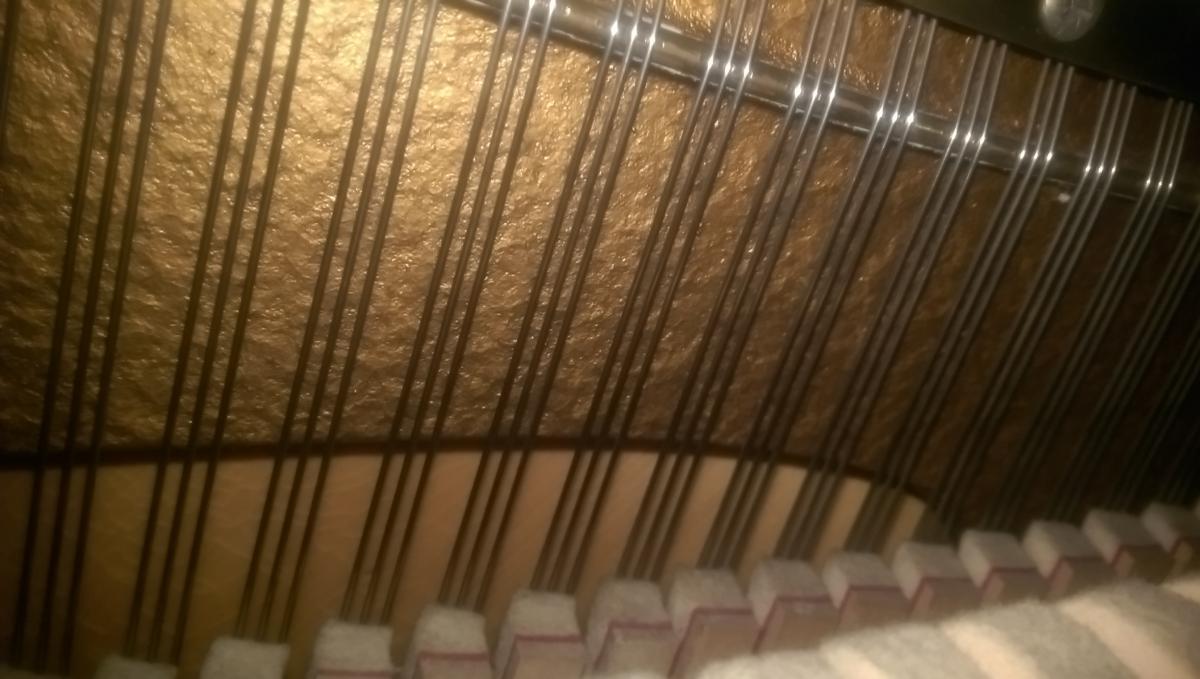
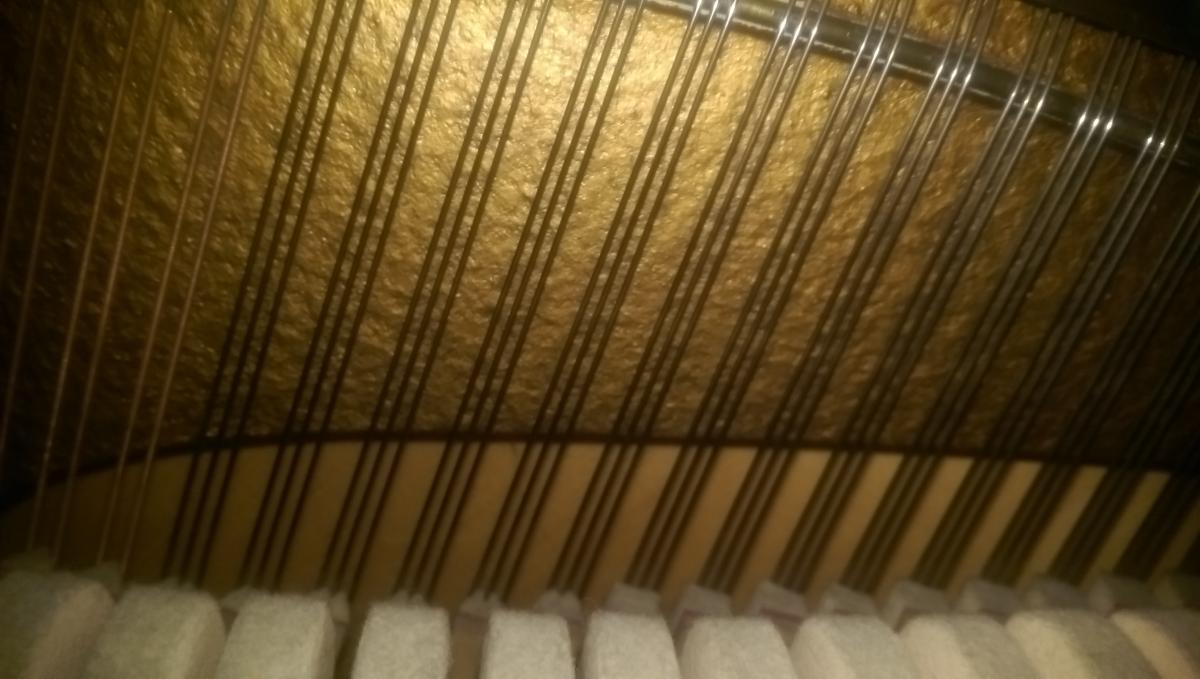
But.. I must tell you that the hammers are quite marked and, don't take it personally, it doesn't seem "factory fresh" to me. Strings with rust and if you look closely the hammers are stained by some presence of excessive relative humidity. How can one say what I need? One must check if this humidity that made the strings so rusty has compromised the smoothness of the action and the compactness of the hammer felt. It's not just about tuning, regulation, or voicing. A general inspection is necessary. The rust on the strings can be partially removed....but not too much and not very well. Also check the tuning level. If excessively below 440 Hz, tune with caution. In any case, some strings might break. It might not happen either! Don't panic. It seems to me anyway an old piano that hasn't been maintained for a certain number of years. Even the grooves in the bass hammers say that the piano has certainly been played! So it is not just a matter of waiting, but also of immediately and clearly checking the general condition of the instrument. An inspection of the soundboard as well. An inspection of the tightness of the tuning pins/string hitch pins as well.
This is my opinion and my suggestions...from what I see. Let me know Paolo
I thank you Paolo, I always read your opinions with pleasure. So yes, I will call a technician as soon as possible! Can you suggest someone here in Genoa? Regarding the smoothness of the action, I can already tell you that it responds very well and I feel it is very uniform under the hands. So changing the strings and replacing the hammer rail could be a nice "wake-up"..
I cannot suggest an "expert" person to you. I always say that the best thing is to invite a recommended tuner. In that setting, you can hear how they express themselves regarding the general state of the instrument and evaluate whether their points are technically well-substantiated or a bit "stuffed" with some minor "chatter" (which, if in minimal form... is acceptable and forgivable).
A piano with new strings and hammers returns to new life!
I thank you again Paolo, I will eventually ask for a quote for all the strings and the original Renner hammer rail. I will let you know
Last question considering that the piano arrived on Saturday, can I already proceed with the tuning or should I wait a few more days? Thank you very much again
It depends on your urgency requirements. Of course, waiting for the heating to be turned off would be ideal. Unless there are urgent pending situations with the seller regarding the assessment of the mechanical efficiency status.
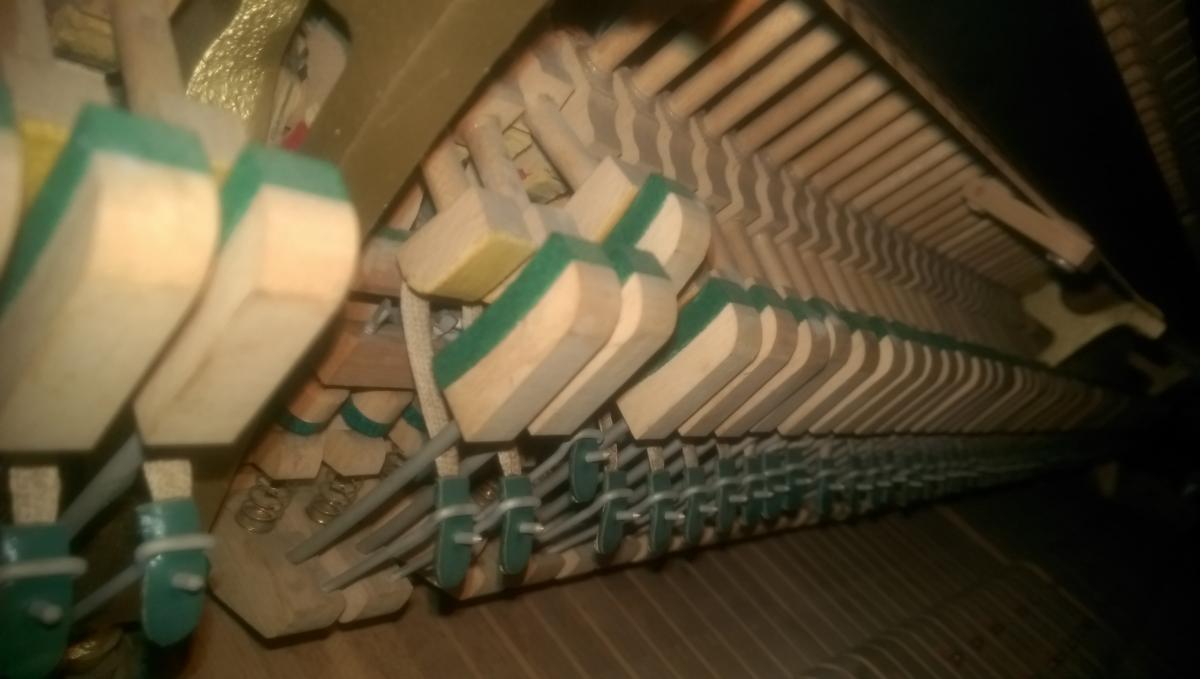
Hi Paolo, so yesterday I removed some rust with steel wool, disassembling the visible mechanics on all the strings. Unfortunately, on those that cross with the basses, I don't know how to proceed; fortunately, the rust was at a primitive stage and wasn't very deep. I wanted to ask you something regarding the height where the capstan rests against the hammer rest; I had some hammer rests too far from the capstan and especially in pianissimo, the hammer would bounce against the string. So, I pushed the hammer rest slightly further forward and now that annoying bouncing play is gone. The question is this: why are there some keys where the hammer rest brakes the capstan right at the highest part, as seen in the photos? The other photo shows the standard regulation level of all the other capstans. Thanks
Yes, it is fine to regulate the hammer parameters, but you must also check that the key dip is sufficient to allow the escapement lever to emerge from the hammer butt. Insufficient dip tends to cause the hammer to "rebound" during pianissimo playing, near the string
I checked with a plastic ruler that the key dip is always around 9.8 9.9 mm, while the black keys go down to 11.8; for now everything is okay, I am waiting for the technician who is coming next week to take a look. Do you roughly know how much a new Renner hammer rail costs for that model?
Replacing a hammer rail is delicate work. It involves a lot of work and precision. You must consult the Technician; I cannot provide advance pricing. Furthermore, the qualities of hammer rails vary greatly. The two measurements are slightly inconsistent. The black key must sink to such an extent that when leveling two adjacent hammers (black key and white key) with equal leveling, the respective hammer slips in their resting position must result in being aligned.
Hi Paolo, so I have carried out the first tuning and I must say it really has the beautiful sound I was looking for; the technician struck a few strings that were a bit above the bridge, he told me that the soundboard is fine, he only adjusted the key dip a little which, having little travel, was causing it to bounce back during pianissimos. Regarding the action, he told me it's fine, but in fact, it is well-balanced under the fingers, I feel it very compact and it responds very well. As for the hammers, he told me not to shave them yet, to use them a bit more, and maybe in a few years he said that Renner does felt replacement without changing the hammer shank or the hammer core, does that sound right to you? Anyway, if you want, there is a video I uploaded here regarding the sound quality.
If I may, the piano needs to be tuned better and is a little out of intonation. It is sonorous and fine, but it needs to be prepared a bit better. I am against shaving the hammers for many reasons that I have explained in many other posts. Re-felting is appropriate when dealing with historical and very particular pianos, but in this case, one replaces the hammer heads with a hammer rail for this piano of identical shape, density, with identical drilling, identical strike point, etc... but it seems to me that now is not the time. Anyway, re-felting involves shipping all the hammers including styli and nuts..... You did well to increase the let-off, as I was telling you. To see if the soundboard is okay, one must measure the crown, the angle at which the strings press against the bridge. The important thing is that there are no cracks, swellings, or sudden collapses of the soundboard itself.
Hi Paolo, thank you as always; so yes, the soundboard does not show swellings, cracks, or various signs of splitting. Regarding the hammers, are you advising against shipping everything? Do we need to contact Grotrian for the hammers? You are right about the tuning; perhaps the technician did not want to tune it completely because he told me that it is necessary for it to stabilize a bit before proceeding with the normal tuning because it was really very out of tune. Perhaps he didn't have time for the voicing... I don't know, I'll ask him next time.. Thanks Paolo, have a good Sunday
I advise replacing the hammer heads. The Technician must verify the pitch stability at 440. Therefore, a confirmation tuning is needed shortly; otherwise, the instrument loses its recovery and we are back to square one. The hammer assembly can be replaced by a Technician with a Renner or an Abel for that piano!!!! Demand the return of the old hammers. It is important.