21st Century Listening

21st Century Listening

34 replies 4,001 views

Started by

Frank

Moderator

Moderator

Opening post by Frank

Posts
3,838
City
-

We thank Simone for opening this new section in the forum entitled “21st Century Listening” which I, the good RedScharlach (and hopefully others as well) will try to animate to the best of our ability.

It is about reporting works written/published in the 21st century about which one has curiosities, doubts, interest, etc.

So, happy music

Frank and RedScharlach

Reply 3 by Historical author

I am timidly approaching this section of the forum; I am a bit disoriented as, in most cases, I am seriously and embarrassingly struggling... a bit as if the pieces were violating my idea of sonority... I am trying to persevere....

Moderator

Reply 4 by Frank

Posts
3,838
City
-

Hi Jack, you made me think of this writing by Messiaen... the key point is "laziness" ... an expense in another context but I think it conveys the idea well

In this 1939 writing, he referred harshly to neoclassicism... more or less shareable but :

«This feverish century, this upset century, is nothing but a century of lazy people. Lazy are the composers who produce too much without taking the time to reflect, to mature their rushed conceptions. Lazy are the artisans of pseudo-Fauré, of pseudo-Ravel. Lazy are the maniacs of false Couperin, the makers of rigaudons and pavanes. Lazy are the odious contrapuntalists of the return to Bach who offer us, without remorse, dry and colorless lines, poisoned by a semblance of atonality. Lazy are the vile flatterers of habit and of "letting things slide" who despise any rhythmic impulse, any variety, any breath, any alternation in the so difficult art of musical division. We are served, on the illusory plate of perpetual motion, vague triple meters, even vaguer quadruple meters, unworthy of the most vulgar of public dances, of the least compelling of military marches. And what to say of the regular audience of our concert halls? Their hatred for change is truly unheard of! A good number of them do not yet admit names already archived such as Stravinsky, Berg, Bartok, Milhaud. If they listened to pure Gregorian chant, authentic Hindu ragas, would they perhaps whistle? Their darkened brains only register certain sound combinations, excluding all others. Against such a category of lazy people, the necessary genius, the great liberator of the music of the future, what thunders, what treasures of furious hail or sweet snow will he send?»

Member

Reply 5 by RedScharlach

Posts
496
City
-
jack wrote:

I am timidly approaching this section of the forum; I am a bit disoriented as in most cases I am seriously and embarrassingly struggling... a bit as if the pieces were violating my idea of sonority... I am trying to persevere....

A curiosity: do all the pieces trouble you in the same way, or is there someone more difficult and some others more accessible?

Thanks... RedS

Reply 6 by Historical author

Red, let's say that the two extremes are pieces proposed by Frank; on one hand, I have no difficulty listening to Negri's piece, but on the other, for me, Billone is a mountain.

This is one of the beautiful things about this section, the demonstration of how varied music is today and how many nuances it can contain. For sure, among them all, I struggled the least with Bertrand, even if I have my limits.

I am speaking of struggle, so the Messenian "metaphor" proposed by Frank regarding laziness fits, but the point is that to escape laziness there must be something that pushes you, entices you, interests you, incentivizes you to the point of accepting the struggle to reach the summit and make the climb. Only if there were a beautiful woman at the top, okay... but if there were nothing particularly attractive (obviously, for me)...

And since I am speaking of women, being straight and male, on one hand I recognize that there isn't just one form of sensuality but several... if it weren't so, we would all be here fighting over the same woman... but on the other hand, if the spark doesn't fly... it doesn't fly.

And I must be honest, but not offensive (believe me), if you hadn't proposed Billone's first piece in this section and in this forum... to be clear, if I had tracked it down on the web by myself, I would have wondered if it were a joke. In the opening bars, I even find Billone's vision/performance funny; it seems as though he is trying to make movements in a way that reminds one of anyone having difficulty performing them, of taming that tool governed in his hand.

Then clearly in the following seconds, it becomes understood that we are in a musical context and eventually those are just gestures in search of I don't know what and what kind of sonorities.

I hope my point of view is clearer; anyway, I will follow along because I am curious to discover what other possibilities the composers of this century offer...

Reply 7 by Historical author

Ah, one more thing. Sorry for drawing from the topic on Billone.

RedScharlach wrote:

Anyway, he is one of the composers who currently interests me the most, for his intelligent and sensitive work on instruments, and for the "physicality" of his approach to sound.

Perhaps as much praise is directed at the instrument itself rather than the instrument for the purpose of making music... after all, shouldn't the sound eventually become music? Of course, one could talk for hours about the boundary between sound and music... but if only the sound remained...?...where would the music be?

I hope I have explained myself clearly...

Member

Reply 8 by RedScharlach

Posts
496
City
-
jack wrote:

And why I speak of women, being hetero and masculine, on one hand I recognize that there isn't just one form of sensuality but several... if it weren't so, we would all be here fighting over the same woman... but on the other hand, if the spark doesn't fly... it doesn't fly.

Look, in my opinion your attitude is the right one... I subscribe to every word!

A composer whom I admire very much, and about whom maybe sooner or later I will speak, during a conference gave a very significant answer to an interviewer who kept insisting on technique. He told him: "The first thing, for me, is fascination. If the music does not fascinate you, then it is of no use" (applause from the audience).

Maybe you will continue not to like Billone, or maybe after a while and after more listening he will start to interest you... The important thing is not to lose curiosity!

Regarding the relationship between sound and music, I don't quite know how to answer you, also because these are words so "broad" that they can accommodate different and even contrasting meanings. In this context, by sound I mean exactly "sound", as could be the "sound" of the Beatles, which is very different from the "sound" of the Beach Boys... Likewise, I could say that Sciarrino (by the way, Billone's teacher) has a sound that you recognize immediately, after three seconds, partly because of the instrumental techniques he uses, partly because of the way he constructs the musical discourse. But Donatoni also has a very recognizable sound, after you have heard four or five of his pieces. I could also speak of the "music" of Sciarrino, of Donatoni, of the Beatles and the Beach Boys... but it seems to me that "sound" is more fitting! What do you think?

In short, I like the sound of Sciarrino, of Donatoni, of the Beatles, of the Beach Boys and of Billone... and obviously I also like their music!"}

Reply 9 by Historical author

Red, the problem arises if the spark never catches ... or almost ... staying within the metaphor, it is true that there are Homosexuals, Bisex, etc. ... but does it mean, stepping outside the metaphor, not accessing a certain type of music

For this reason I think that surely music cannot be universal...

Member

Reply 10 by RedScharlach

Posts
496
City
-
jack wrote:

That is why I think music certainly cannot be universal...

Without a doubt...

However, I would like to know...

jack wrote:

For sure, of everyone, I struggled the least with Bertrand, even if I have my limits.

In your opinion, why did you have fewer problems with Bertrand? Could you explain what is more accessible in his piece? (if you want, feel free to continue the discussion in the thread dedicated to him...)"

Reply 13 by Historical author

RedScharlach wrote:

mmm... I'm losing the connection with the subject of our discussion...

Perhaps it refers to my "laziness"

Member

Reply 14 by Bianca

Posts
510
City
Torino
jack wrote:

Maybe it refers to my "laziness"


but no, come...

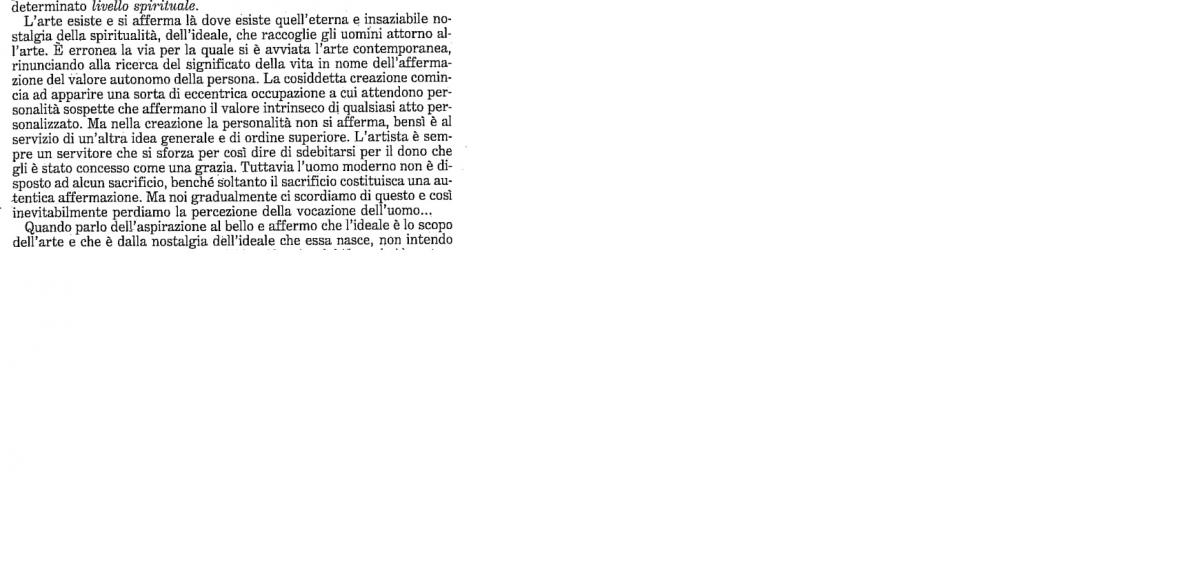
simply reading the quote by Messiaen, this piece by Tarkovsky came to mind, especially when he says that the (presumed) creative process can become an "eccentric occupation" to which personalities dedicate themselves, asserting the intrinsic value of "any personalized act."

Then, everyone can read whatever they want into it


As for laziness, I don't think it is the main cause of what Messiaen stigmatizes; it is certainly secondary to it.

Member

Reply 15 by Bianca

Posts
510
City
Torino
jack wrote:

And I must be honest, but not offensive (believe me), if you hadn't proposed Billone's first piece yourselves, in this section and in this forum… to be clear, if I had tracked it down on the web by myself, I would have wondered if it were a joke.

That is indeed the point. And it is not a matter of opinions, but of numbers. An access of a work to the public occurs only through mediation, or by chance, out of necessity. Today, due to the large numbers at stake, this holds even more true than in the past. For this reason, mediators have an enormous moral responsibility, and must in turn be educated to this awareness and this responsibility. Your example is striking in this regard. Your attention toward a certain work was channeled, somewhat forced, by a form of mediation activity. If you did not perceive the mediator as "authoritative" or "authorized," you would not make an additional effort to understand and, as you say, in this case you would even have thought it was a joke. Obviously, the opposite is also true, in the sense that a work that might seem valuable to you, if disparaged, or simply not supported by authoritative mediation, risks losing value and being neglected.

Obviously in the long run, always due to a matter of numbers and probability, things can also change. An author with strong mediation behind them who actually has not much to say risks being reabsorbed, although that is not always certain. The opposite, however, happens with more difficulty, but it does happen.

I would like to be able to say that one can break free from this mechanism simply by cultivating one's own awareness and personality. But unfortunately, that is not the case, or at least only partially so. In the sense that if I do or do not like something, after having reached a secure awareness of my theoretical abilities, I may be able to establish it myself, but unfortunately the things submitted to me will continue to remain always entangled in the mechanism of mediation and filtering, or chance. Mediators are themselves "disciples" of mediators.

Member

Reply 16 by RedScharlach

Posts
496
City
-
Bianca wrote:

Your attention toward a certain work has been channeled, in some way forced, by a form of mediation activity. If you did not perceive the mediator as "authoritative" or "authorized," you would not make an additional effort to understand and, as you say, in this case you would even have thought it was a joke.

If I understand your argument, I (or Frank, regarding the case of Billone, but it's the same thing) would be a "mediator." Very well... But where does this "authority" you speak of come from, which I do not believe I have invoked in any of my interventions?

Bianca wrote:

For this reason, mediators have an enormous moral responsibility, and must in turn be educated to this awareness and this responsibility.

Could you explain this point better? What should or should not I do, specifically regarding my moral responsibility, when I talk about the music that I like or am interested in?

Bianca wrote:

I would like to be able to say that one can break free from this mechanism simply by cultivating one's own awareness and personality..

A instead, I would like you to get to the heart of the matter: what is your qualitative assessment of the pieces we have proposed? In your opinion, what are the weak points and the strong points? What are the reasons for interest or lack of interest?

PS regarding the Tarkovsky quote, I fear it is a bit too easy to get away with saying "everyone can read whatever they want"...

Reply 17 by Historical author

RedScharlach wrote:

If I understand your point, I (or Frank, regarding the Billone case, but it's the same thing) would be a "mediator". Very well... But where does this "authority" you speak of come from, which I don't believe I have invoked in any of my interventions?

From my point of view, "there is a good atmosphere"; there are people I have followed for 7 years and I repeatedly read high-level interventions, listen to pieces, read analyses, etc.... I recognize "authority" in you, and the concept is clearly evident from my writing

Member

Reply 18 by Bianca

Posts
510
City
Torino
RedScharlach wrote:

If I understand your point, I (or Frank, regarding the Billone case, but it's the same thing) would be a "mediator". Fine... But where does this "authority" you speak of come from, which I don't believe I invoked in any of my interventions?

Could you explain this point better? What should or should not I do, specifically regarding my moral responsibility, when I talk about the music that I like or am interested in?

I would instead like you to get to the heart of the matter: what is your qualitative assessment of the tracks we have proposed? In your opinion, what are the weak points and the strong points? What are the reasons for interest or lack of interest?

PS regarding the Tarkovsky quote, I fear it is a bit too easy to get away with saying "everyone can read whatever they want"...

It seems to me that jack has responded and understood what I meant.

I certainly wasn't referring to RedScharlach, who might even be a mediator for some people. Let's try not to always carry everything onto a personal level, because otherwise the meaning of things is lost sight of.

Just as I was not referring to any specific track proposed here, but simply to an anthropological and social aspect of communication, clearly highlighted by a user's post.

Moderator

Reply 19 by Frank

Posts
3,838
City
-

I find Bianca's point interesting, regardless of the esteem that Jack may or may not have for her (I will return to this later); in effect, it must be said that at a certain point in history, the premises were laid so that anything, even common objects (the classic chair or a bicycle wheel, just to be more explicit), could and can become art, if the entire context in which it is placed falls within the presentation canons of an "artistic" work. Thus, if you find the famous chair on display in an exhibition, there is an audience to admire it... that thing which lacks the connotation to be art can become so.

Which is not far from what may have happened in this section, precisely a "virtual" concert hall, where what is heard is presumed to be art or at least has this ambition.

The point, however, is that "filters" come into play and trust towards them on the part of the listeners... the problem is always linked to the "genuineness" of the source. And I don't know to what extent I can be "genuine"... or rather:

there are numerous young people under thirty (or older) worthy of attention, but they certainly do not have the professional circle of names that I am trying to propose. Then there are others who might be very performed at the moment but, since I consider them bluffs, I don't even report them."

Thus, my choices are already based on 2 parameters: how much I believe in that musician and, no less importantly, the fact that they have more or less a "market."

Phen, since I don't think I possess any divine knowledge, I include musicians like "Rytis Mazulis" where my "judgment" is not yet as definitive or clear as I would like... I still owe an answer to MicaMahler... which I will give sooner or later...

The last point I share from Bianca's post is precisely about the autonomy of "judgment"... even if in an "authoritative" concert hall (let's mention Blue Note Milan not by coincidence?) art is expected, it can happen that my autonomy of judgment makes me realize that we are not always facing a Chick Corea... (and we all know how, in order to "survive"... an important stage may resort to "compromises")

Therefore, in this post of mine, I have tried to describe some parameters of my choices... which as such, are relatively subjective... and in many cases driven by taste and the need for comparison...

But with great pleasure, reports from many other forum members arrive and, from my point of view, variety has always been a strength of every culture.


Member

Reply 20 by Tiger

Posts
447

I generally take the forum's suggestions as a 360° way to deepen my knowledge... so, aware of the fact that I receive much more than I give, out of curiosity I also follow this section trying to form my own idea about something that I still know too little about...

Log in to participate