4/4, right hand 4 eighth notes, left hand a triplet of eighth notes.
Is it normal to have difficulties during practice? Is it par for the course to encounter this type of polyrhythm? The first pieces in the repertoire that used it? ...dividing them into two cases: those that open with this rhythm and those that use such a solution as a form of development.
Thanks in advance
C
Carlos
Member
Reply 2 by Carlos
Posts
759
Marziano wrote:
4/4, with the right hand 4 eighth notes, with the left hand a triplet of eighth notes.
Question: by doing what? Solfegging? Playing a percussion instrument?
Marziano wrote:
Is it normal to have difficulties during practice? Is it par for the course to encounter this type of polyrhythm?
Of course it is normal, and it is also normal to encounter that polyrhythm, but generally entrusted to more than one performer: in this regard, my question above...
L
Lestofante
Member
Reply 3 by Lestofante
Posts
107
Waiting for the answers to Carlos's questions, Beethoven's sonata op 14 no., on the last page of the rondo there are some interesting combinations.
da 108 to 111 it would be a 6 against 4 but the hypothetical "four" travel in quarter notes
a 121 6 against 4
Also in op 14 no. 2 there is 4 against 6, see measure 20 of the allegro..
....actually 4 against 3 ...
M
Marziano
Member
Reply 4 by Marziano
Posts
64
... I was referring to the piano, thanks Lestofante for the reports. I really cared about the 4 against 3...
L
Lestofante
Member
Reply 5 by Lestofante
Posts
107
I find it very difficult to execute this rhythmic combination, method and tricks to master it? I am talking about the 4 against 3
C
Carlos
Member
Reply 6 by Carlos
Posts
759
Lestofante wrote:
I find it very difficult to perform this rhythmic combination, any method or tricks to master it? I am talking about 4 against 3
"4 against 3" can be treated as "twice 2 against 3". Let me explain.
A triplet can be decomposed into two triplets if you double each note:
DO RE MI will become DO do RE / re MI mi, where the two notes in bold correspond to the first and third notes of the quadruplet that you must accompany the triplet with, but by subdividing the sounds of the "large" triplet, you also have a sound that attacks exactly in the middle (the re).
In turn, you can consider the quadruplet as two consecutive duplets:
FA sol la si will become FA sol / LA si.
At this point, you have two triplets (DO do RE + re MI mi) and two duplets (FA sol + LA si) where the bold notes of the two rhythmic groups correspond to each other (DO with FA, re with LA). Managing 3 against 2 will be easier and, once you have assimilated the problem that way, it will be sufficient to gradually eliminate the sounds written in small (perhaps keeping only the central ones for convenience, like this: DO_ RE re MI_, to still have an exact reference on the midpoint of the two rhythmic groups); until you play the original triplet, because by then you will have "decomposed" it in your head and it will no longer be necessary to do so practically.
L
Lestofante
Member
Reply 7 by Lestofante
Posts
107
Thanks Carlos, as always very clear.
...but these examples in the repertoire? One gets a real bucketful of these subdivisions... and then?
C
Carlos
Member
Reply 8 by Carlos
Posts
759
Lestofante wrote:
Thanks Carlos, as always very clear.
...but these examples in the repertoire? One gets a good bucketful of these divisions... and then?
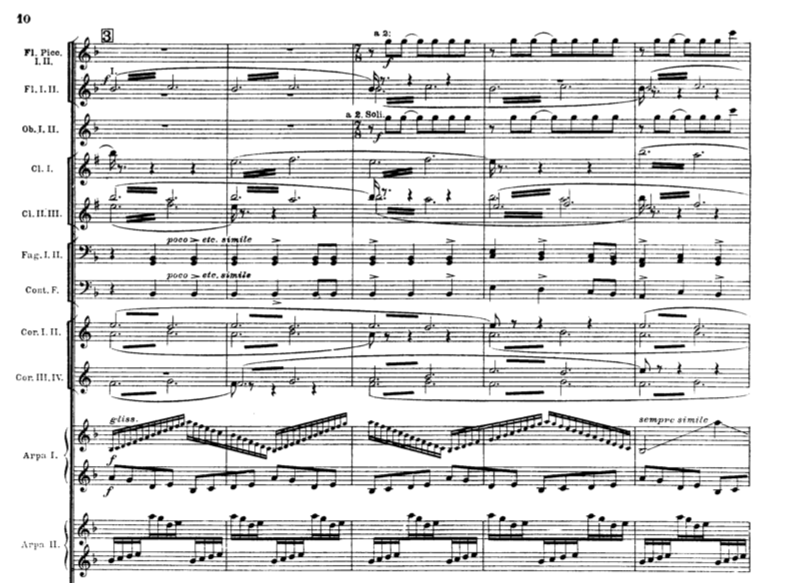
Well, the repertoire of the '900 is full of similar things and even much more complex ones. As an illustrative example, I'll show you a small detail from Stravinsky's Petrouchka. As you will see, it is in 3/4, but the two piccolo oboes and the two oboes play in 7/8 (actually, in the revised version Stravinsky changed it and wrote a little bit in 3/4, but that changes absolutely nothing). There «one is saved» because it is quite lively, but... far from 4 against 3
M
Marziano
Member
Reply 9 by Marziano
Posts
64
Thank you for the further contributions, so before the '900 the 4 against 3 was not used, right?
C
Carlos
Member
Reply 10 by Carlos
Posts
759
Marziano wrote:
Thank you for the further contributions, for which before the '900 the 4 against 3 was not used, right?
I didn't say that... I said that the '900 is full of even more complex examples, not that the 4 against 3 was not used before
M
Marziano
Member
Reply 11 by Marziano
Posts
64
ok...I am renewing the question
"The first pieces of the repertoire that made use of it? ...dividing them into two cases: those that open with this rhythm and those that use such a solution as a form of development."
at this point pre-'900, because that is full...regarding what came before, there are doubts or no verifiable proposals.
I just had an identity crisis regarding the 4 against 3.
Everyone agrees that the 3 are a triplet of eighth notes... are the 4 eighth notes or sixteenth notes? Or rather, how or what should they be? Do both possibilities exist?
I am asking because the topic author speaks of 4 eighth notes, the example proposed by Frank is on 4 sixteenth notes, not to mention Schubert's 4 against 3... I was thinking about the 4 against 3 originally proposed and made of eighth notes, do the numbers add up?
Perhaps one case is a deficit and the other an excess? Am I making a mountain out of a molehill?
Is my doubt clear?
N
Natan
Member
Reply 15 by Natan
Posts
239
Interesting, how could Carlos have explained it and the others understood it? Even Gozzo's example is "strange" in relation to the question.
In my opinion, everyone was thinking of 4 sixteenth notes; in fact, 3 eighth notes in a triplet make a quarter, if 4 eighth notes make 2 quarters... it doesn't add up; perhaps the triplet was of quarter notes?
... I am asking
C
Carlos
Member
Reply 16 by Carlos
Posts
759
Natan wrote:
Interesting, how could Carlos have explained it and the others understood it? Even Gozzo's example is "strange" in relation to the question.
How could I have done it? 4 against 3 means that in the same span of time one part plays a quartet and the other a triplet. Period. The notation can be multiple, but whether the topic author was confused or not about whether the quartet consists of eighth notes or sixteenth notes matters little: one must not calculate "how much" a quartet of eighth notes is worth against a triplet of eighth notes; what matters is the overlap of the two rhythms, which always and anyway resolves in the same way.
C
Carlos
Member
Reply 17 by Carlos
Posts
759
Carlos wrote:
How could I have done it? 4 against 3 means that in the same span of time one part plays a quartet and the other a triplet. Period. The notation can be multiple, but whether the topic author was confused or not about whether the quartet consists of eighth notes or sixteenth notes matters little: one should not calculate "how much" a quartet of eighth notes is worth against a triplet of eighth notes; what matters is the overlap of the two rhythms, which always and anyway resolves in the same way.
PS sorry for quoting myself but time has passed and I can no longer edit the message, but I wish to complete it: if one is in a ternary meter (6/8, 9/8 etc...) the irregular group is the quartet, not the triplet, and the quartet is written in eighth notes, with a 4 above: normally by adding the pure values of the irregular group, whatever it may be, the irregular group itself has a value higher than the rhythmic value within which it must be performed; e.g., the triplet of eighth notes fits into a quarter note, but three eighth notes added together give a quarter note and a half, do you understand? the quintuplet of eighth notes fits into two quarter notes, but 5 eighth notes added together give two quarter notes and a half, and so on...
M
Marziano
Member
Reply 18 by Marziano
Posts
64
I fear I've made a mess, but I am happy because further elements and more "ancient" examples of this type of combination have emerged.
For Carlos, I was indeed speaking of 4/4, so my example was perhaps incompatible... what you say about ternary rhythms is very true, but I wasn't good at finding an example
N
Natan
Member
Reply 19 by Natan
Posts
239
For Carlos, I was writing exactly:
Natan wrote:
In my opinion, everyone was thinking of 4 sixteenth notes
This sentence is part of my post and it meant exactly what you explained ... mine was a way of saying that in relation to the question, no one would have been able to explain or understand anything
But the 4 against 3 subject was strong enough to be understood instantly regardless of Marziano's error
Marziano wrote:
I fear I've made a mess
It happens
C
Carlos
Member
Reply 20 by Carlos
Posts
759
Natan wrote:
Mine was a way of saying that in relation to the question, no one would have been able to explain or understand anything
But the 4 against 3 part was strong enough to be understood instantly regardless of Marziano's error
It sounds like those conversations people have when your team concedes 3 goals and fails miserably... "eh, we played well, we deserved to win, but they won!". If they won, they deserved to win.
Saying that "in relation to the question no one would have been able to explain or understand anything" is the same thing: Ale Gozzo and I understood: therefore, it was understandable. Stop.