In fact, there is no mention of a second volume, given this article by Stefano Zenni: “Storia del jazz. Una prospettiva globale” (Viterbo, Nuovi Equilibri, Viterbo, 2012, pp. 400 ff.)
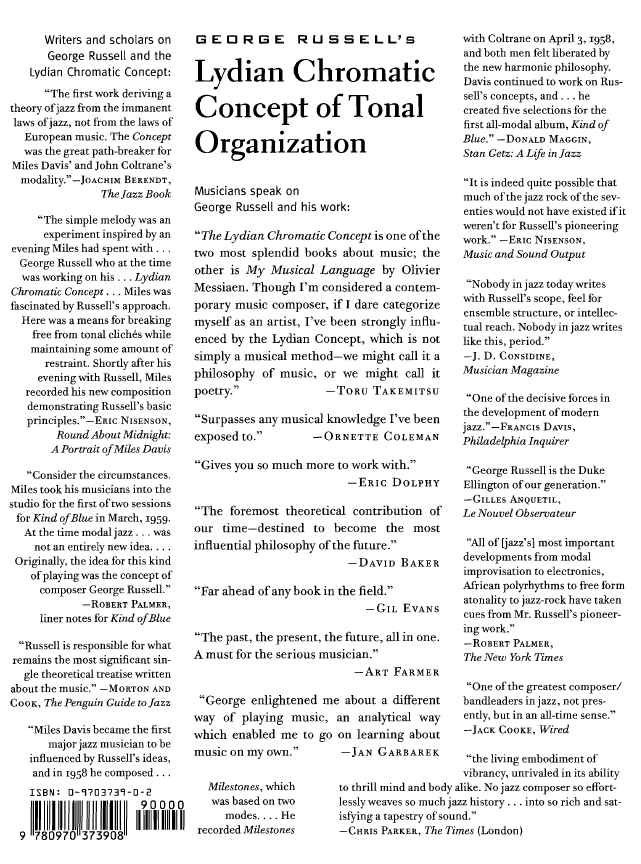
One of the deepest transformations of language that occurred during the 1950s revolves around a figure long ignored by jazz histories: George Russell (1923-2009), the greatest theorist jazz has ever produced and one of the great intellectuals and composers of American music. Having escaped tuberculosis, which did not spare his contemporary Fats Navarro, Russell developed, during his long convalescence, a theoretical system influenced by his studies with Stefan Wolpe. From this, he derived a volume, The Lydian Chromatic Concept of Tonal Organization, which in the early 1950s circulated among musicians in private editions and later saw various editions. The 1959 edition, in subsequent periods, achieved a certain spread. In reality, before the expanded 2004 edition, the book — surrounded by a legendary aura — never went beyond an initiatory circle. Despite his marginal position, George Russell succeeded in founding a new theory that, through a series of complex historical stages, changed the course of music.
In jazz, there was no formalized procedure for studying improvisation or composition. Aside from Gene Krupa's famous method for drummers, books intended for teaching, such as the one compiled by Teddy Wilson for pianists, were generally based on direct example, with transcriptions to be assimilated and emulated. All professional jazz musicians studied instrumental technique formally, but the knowledge, rules, and tricks of improvisation were learned in the field: they imitated musicians chosen as models, improvised over records, and faced more experienced improvisers in jam sessions. Everyone knew the rules of harmony, but the peculiarities of jazz were learned through improvisational practice. It was obvious that composers, as well as pianists or soloists who also played the piano (Bix Beiderbecke, Coleman Hawkins, or Dizzy Gillespie), had a superior awareness of it. From the mid-1930s, the habit of labeling chords with letter and number symbols, similar to those used in Baroque music, spread, from which soloists derived the possible notes with which to improvise. But there was no reference theoretical lexicon, and the only formalized scales were major and minor, modified and enriched during improvisational practice. In fact, jazz musicians worked on the basis of an implicit theory, whose rules were well known but unstated, except occasionally and in a non-systematic way. Russell's work transformed this widespread practice into explicit theory; it was practically a fundamental systematization of lexicon and rules, thus laying the foundations for all jazz pedagogy.
The complex articulation of the Lydian Chromatic Concept can be summarized here in only a few words. Russell recognizes that improvisation is based on a series of scales that adhere to basic chords according to various degrees of consonance; above all, the lydian scale, considered the most consonant by virtue of the augmented fourth present in natural harmonics. The system then accepts scales such as the whole-tone and the octatonic (or diminished, as it is said in jazz). The latter had long been in use in contemporary music (Stravinsky, Debussy, Messiaen), but in jazz, only occasional traces are found from late Swing. Of these scales, to which Russell attributes a singular nomenclature, their intervallic nature and their relationship with chords are studied, which in turn are inserted into a system that evaluates their harmonic "gravity." In other words, a harmonic progression can be analyzed in two ways: as a series of tonal centers connected by secondary chords, or as a set of secondary chords rotating around a single, general tonal center. In this way, Russell offers the improviser a method to harmonically deepen basic chords or, conversely, to break free from them.
Throughout the book, the distinction is also introduced, which later became common usage, between vertical and horizontal improvisation: the former is typical of the style of Coleman Hawkins and John Coltrane, who consider every chord a gravitational center to be explored; the latter characterizes the style of Lester Young and Ornette Coleman, who improvise melodies referring to a few tonal centers while ignoring intermediate chords. Since the early 1950s, Russell invited the musician to also choose these tonal centers "according to one's own aesthetic judgment," thus acting with total freedom, even to the point of ignoring harmonies and thinking in purely chromatic terms (hence the term chromatic in the title of the treatise). However, it is a reasoned chromaticism, because through the scheme"
regarding interval gravities, evidently indebted to Hindemith, the composer or improviser can grade weights, consonances and dissonances of every interval relative to an imaginary tonic. A way of proceeding that anticipates on paper what Ornette Coleman will later realize through a personal and naive approach. The flexibility of the method allows Russell to engage also in composition, counterpoint and even in the analysis of other musical genres (the 1959 edition focuses on the opening bars of Alban Berg's Violin Concerto).
At first, Russell only had the opportunity to apply his ideas occasionally. We find traces of this in Cubano Be Cubano Bop with Gillespie, A Bird in Igor's Yard by Buddy De Franco and the lesser-known Similau for Artie Shaw. In the early fifties, Russell, who was working as a clerk, is invited by musician friends to present some of his pieces for their recording sessions. The 1951 session in the name of Lee Konitz – with Miles Davis among the invited instrumentalists – documents his first masterpiece, Ezz-Thetic, a surprising masking of Love for Sale that proceeds at high speed through bop lines, crooked leaps and dissonant sobs. It is an anomalous phrasing, from which Eric Dolphy's improvisational style later descends; Dolphy would become a student and collaborator of Russell years later. The publication in 1953 of the Lydian Chromatic Concept attracts the attention of the jazz world: in reading and studying it, besides Konitz and Davis, are Art Farmer, the remarkable and underrated alto saxophonist Hal McKusick, drummer Paul Motian, and then Sonny Rollins (who recorded a version of Ezz-Thetic with Max Roach) and even more John Coltrane, who in 1957 was called by Russell for the concept album NEW YORK, NY.