

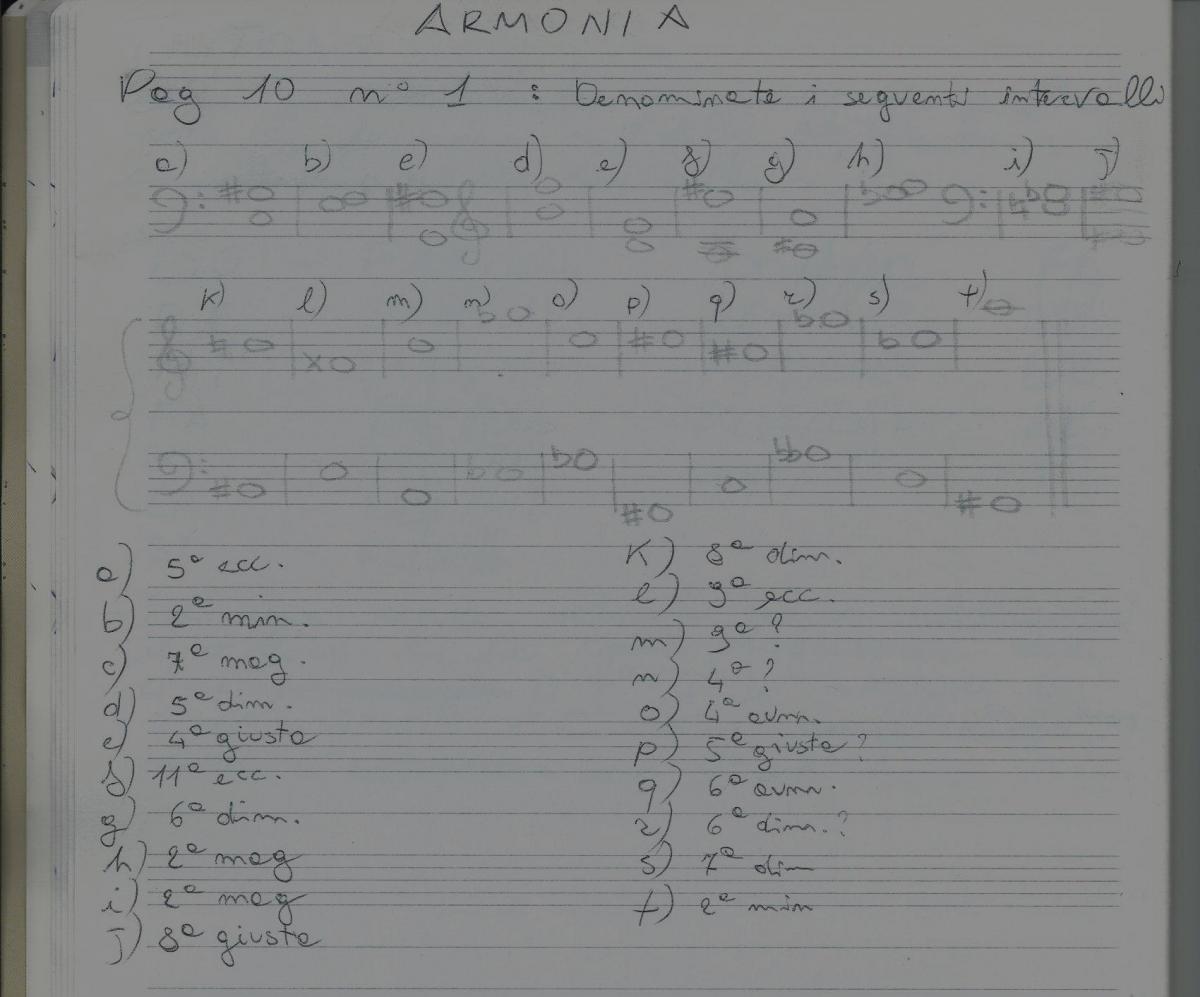
Here is the first exercise taken from Piston's Harmony book, can someone more experienced than me kindly correct my exercise??
thanks a million
Started by
Member
Member
Here is the first exercise taken from Piston's Harmony book, can someone more experienced than me kindly correct my exercise??
thanks a million
Member
Here is the file... it hadn't uploaded for me before
Member
Hello.
g) minor sixth and not diminished (Do - La is a major sixth)
i) mi - solb is a third (mi-fa-sol) and not a second: in this case, since mi-sol is a minor third, it is a diminished third
m) major ninth (the complex interval takes its name from the simple/primitive one that lies within the same octave; in this case, it is La-Si major second)
n) mib - solb is not a fourth (mi-fa-sol) but a minor third (actually it is a minor third plus 2 octaves, but it is classified as a third)
r) labb - fab is equivalent to lab - fa (removing 1 b from both notes), therefore a major sixth
Two questions.
1: sometimes you use augmented and sometimes you use excess/exceeding [eccedente], and since there are 2 classifications (if do - sol is a perfect fifth, do - sol# has one extra chromatic semitone. To me it is augmented, but for others it is exceeding), do you consider them synonyms? For example in a) the fifth do - sol#?
2: how do you handle intervals greater than an octave? Do you consider ninths and elevenths (and if desired thirteenths) because they have "chords" that contain them, whereas tenths, twelfths, etc., no?
Member
Zedef wrote:it is a diminished third
I have always wondered: "what will it ever be useful for?" ...
Member
It's like saying... what is the point of studying Italian grammar??!!...harmony is the structure of music and it is necessary to know it. Best regards
saverio
Member
saverio wrote:It's like saying... what is the point of studying Italian grammar??!!...harmony is the structure of music and it is necessary to know it. Best regards
saverio
I know well, but I have never seen the diminished third of a chord used....examples?
Member
sorry, but a diminished third of an interval is equivalent to a major second... so consisting of two semitones, i.e., a tone, i.e., a stepwise interval... so you do it yourself a bit B-C, C-D... E-F etc..etc
cordiality
saverio
Member
Dilettante wrote:but I have never seen the diminished third of a chord used...
Perhaps not in tonal harmony; I imagine that when harmony is not based on the superposition of thirds... anything goes. So it's better to know the definitions of intervals, certainly; maybe when one is at the beginning it can seem extreme ... and indeed
Member
saverio wrote:sorry, but the diminished third of an interval is equivalent to a major second...
It's true, but I fear that 'amateur' refers to tonal harmony, which is constructed by overlapping thirds, therefore... one has never seen a third treated as a second... not even when playing enharmonically.
Member
Let me explain myself better: do mibb sol is a (tonal) chord that doesn't exist ...at least I hope...
Member
I'll take a guess: "do mi sol sib", where the passing sib becomes sibb ... it creates a sol sibb interval, which perhaps is good to know is a diminished third
Member
... or more simply one day, when DanielePiano studies the Neapolitan sixth, he will see that the Neapolitan sixth resolves melodically by descending a diminished third to the leading tone (in A minor: Bb - G#)
Member
There, it was the kind of answer like the last ones I was looking for... I'm not that far along in my studies, but I had never given a concrete placement to this interval... like others, eh...
Member
Thanks to Zedef for the correction and to all of you for the comments.
I am responding to Zedef's two questions:
1) Yes.....I consider "augmented" (aumentata) and "exceeding" (eccedente) to be synonyms (correct me if I'm wrong)...I believe both mean an increase of a semitone in an interval. E.g.: D-A = perfect 5th; D-A# = augmented/exceeding 5th
2) As far as complex intervals are concerned, I don't actually know how to behave, whether it is correct to "simplify" them into simple intervals perhaps up to the 11th-12th, or if they must be considered for what they truly are, which would mean that very large intervals would also exist, such as the 20th, 21st..........
Member
Daniele, we are talking about simple intervals and compound intervals
Member
DanielePiano wrote:Thanks to Zedef for the correction and to all of you for the comments.
I am responding to Zedef's two questions:
1) Yes.....I consider 'augmented' (aumentata) and 'exceeding/augmented' (eccedente) to be synonyms (correct me if I'm wrong)...I believe both mean an increase of a semitone in an interval. E.g.: D-A = perfect 5th; D-A# = augmented 5th / exceeding 5th
2) As far as complex intervals are concerned, I don't actually know how to behave, whether it is correct to "simplify" them into simple intervals perhaps up to the 11th-12th, or if they must be considered for what they truly are, which would mean that very large intervals like the 20th, 21st........ would also exist.
1. Why correct? There are 2 ways of encoding. For me, it works like this:
perfect/major interval (e.g., C-G, perfect 5th)
+1 semitone = augmented (e.g., C-G# vs Db-G); but for others it is 'eccedente'
+2 semitones = more than augmented (e.g., Db-G#); but for others it is 'more than eccedente'
+3 semitones = exceeding/augmented (e.g., Db-Gx vs Dbb-G#); ... ? ...
+4 semitones = more than exceeding/augmented (e.g., Dbb-Gx); ... ? ...
2. Normally, intervals above the octave (compound or derived) are reported in a single octave (simple or primitive); however, in harmony, the ninth does not have the same meaning as the second (dominant ninth, not dominant second) and likewise the eleventh chords (not fourth) and thirteenth (not sixth). The Duodecim (twelfth) register on the organ does not play the fifth but the fifth + octave. The important thing is to know that they also exist beyond the limit of the octave.
Member
anyway Zedef, but Piston considers them excess, he doesn't even name the augmented interval... strange.
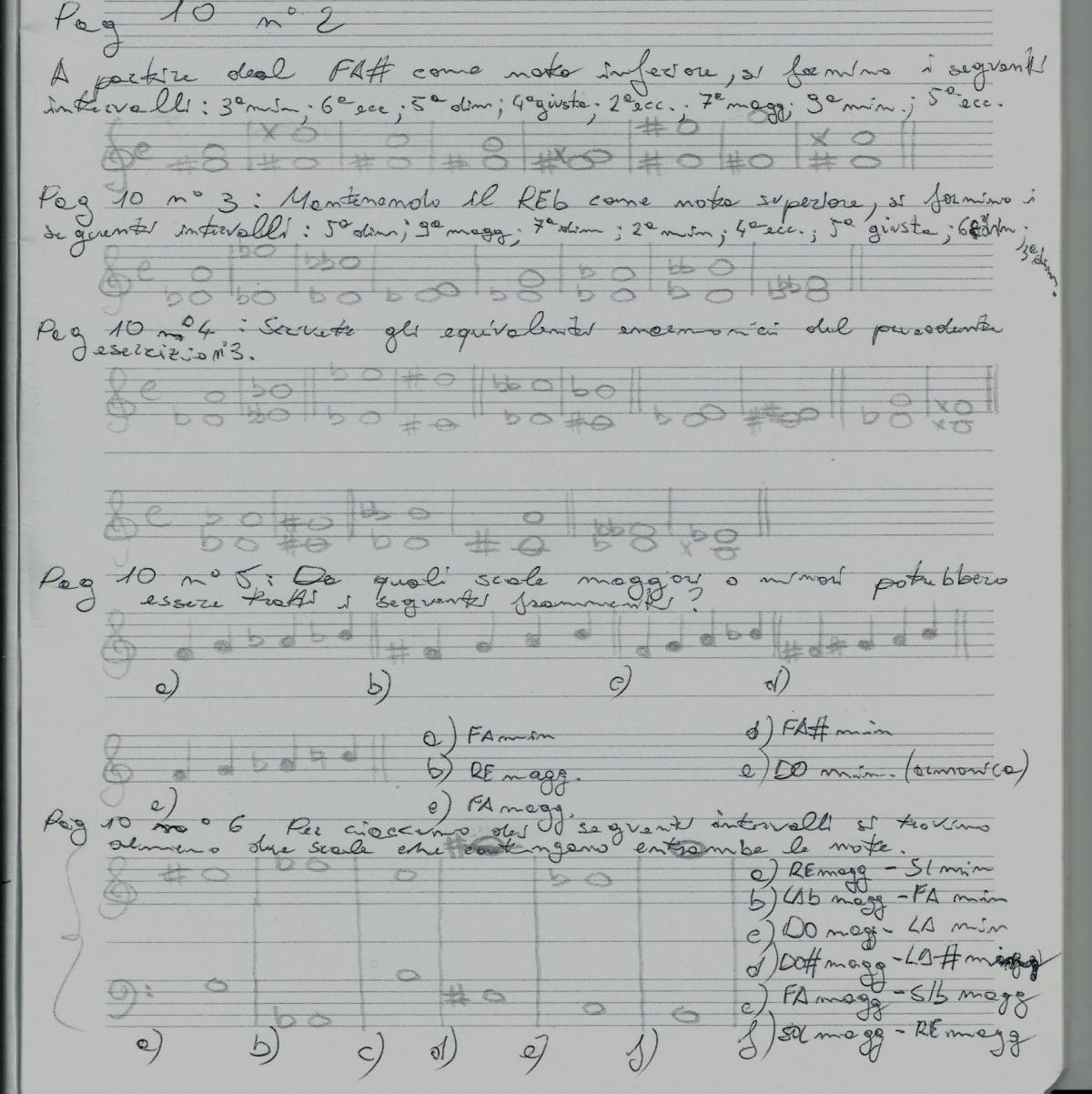
In the meantime, I am attaching other exercises.
Member
aumentati=eccedenti
They are synonyms
Member
Ludovica wrote:aumentati=augmented
They are synonyms
I wouldn't be so sure. Anyway, it's a trifle since, in practice, one doesn't find intervals that exceed the augmented/increased ones
Member
DanielePiano wrote:anyway Zedef, but Piston considers the diminished ones as excess, he doesn't even call it the augmented interval... strange.
In the meantime, I am attaching other exercises.
Piston wrote the manual in English; it is the Italian translators from EDT who chose "eccedente". In more Anglo-Saxon countries they say augmented, in France augmenté, in Spain aumentado... only in Germany do they say übermäßige (which means, approximately, augmented).