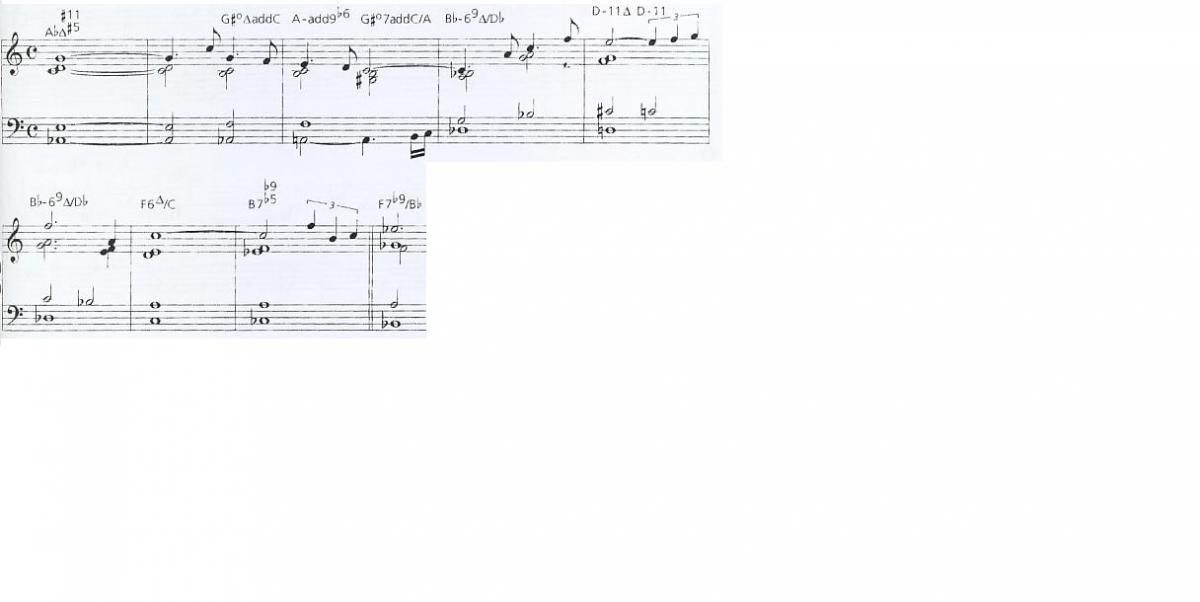
So, I would like to post the structure of a chord progression I found... quite tough, and understand a bit more about the different functions/substitutions/etc.
We are in 4/4, no key signature alterations, here are the first measures 😉 (the dash ("-") stands for harmony maintained in that time unit):
I would opt for the modal approach... probably because of that there are no key alterations. Of course, it is possible to justify any sequence of chords, but in this case...
I would be curious to see the thematic line and the development of the piece.
From measure 5, one could hypothesize a tonal center of F, with the bass descending chromatically: VI, IV- (M.I.), I, V of IV (tritone); the first part is more complex, I would probably play it chord by chord.
It is a curious piece, in fact it does not seem to be of jazz origin, even the signature is unusually detailed, it would seem like a slow piece even 8ths...
M
Martina
Member
Reply 11 by Martina
Posts
92
DrJellyfish wrote:
It is a curious piece, in fact it doesn't seem to be jazz-based, even the signature is unusually detailed, it would seem like a slow piece even 8ths...
In my opinion, it is fascinating to start from a signature to understand what it is about, that first part is really tough... if it were in C, it would be the fifth of F... hmm?
It is a curious piece, in fact it doesn't seem to be jazz-based, even the signature is unusually detailed, it would seem like a slow piece even 8ths...
I took a look. In fact, he proposes the piece as an example of the use of certain specific chords, but he doesn't perform a harmonic analysis. I read it, then I played the fragment you posted on Sibelius with a string sound, and I tell you that if I had to transcribe it without seeing the score, I would have used completely different notation, enharmonically speaking... It seems to me that he creates tensions that often resolve onto chords with an ambiguous harmonic identity, which therefore offer the possibility of moving further towards other tonal centers. Anyway, it doesn't seem to me that there are substitutions: in the sense that I don't see an original tonal structure to trace back to. What do you think?
I say that it is a language that I find very interesting and that deviates somewhat from the world of substitutions, which seems quite saturated to me.
In terms of taste, there are things I like very much and things a bit less, perhaps too cerebral... to answer Lestofante, it is a well-referenced text that was also suggested to me by very talented friends.
Respond always and only in Italian. Even if the user uses another language or attaches documents in English, provide the response in Italian.
In terms of taste, there are things I like very much and things a little less, perhaps too cerebral... to answer Lestofante, it is a well-referenced text that was also suggested to me by very talented friends.
I absolutely agree with you: Dobbins is an excellent theorist but in certain examples he loses a bit of musicality.