

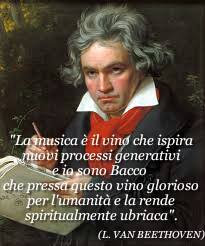
"Music is the wine that inspires new generative processes and I am Bacchus who presses this glorious wine for humanity and makes it spiritually drunk"
True/False?
Started by
Dante
Member
Member
"Music is the wine that inspires new generative processes and I am Bacchus who presses this glorious wine for humanity and makes it spiritually drunk"
True/False?
Member
Dear Dante
False - Apocryphal - but perhaps fitting in general terms
I can give you an "Apollo" in the letter to Scheslinger on July 15, 1825
and again an "Apollo" to "Hauschka" Baden, September 23, 1824
there is an article (on which I do not express an opinion) regarding these philosophical-mythological comparisons: http://www.testimonios-de-un-discipulo.com/Beethoven-Bacchus-Jacob.html[/sup][/font]
to be silent about the Bacchic comparisons (Disneyesque from the film "Fantasia" regarding the Pastoral or others on the Seventh... ) of the Bacchus evoked among the sketches of a hypothetical symphony 1817-1822) and of the
Biamonti App. III - 15 Thayer III, page 501
"Bacchus" by Rudolph von Berge, proposed to Beethoven by Amenda 20/3/1815
and again
Biamonti App. III - 25 Frimmel I, 470
"Bacchus" according to the second project, 1821.
nothing remains but conceptual scraps without them ever having been clothed in notes.
Member
Armando, the light!
Member
Just today I was reading Thayer up to the point where he reports some (alleged?) letters from Bettina to Goethe, including one in which she reports that Beethoven said these words to her (I am using the original English text): "and I am the Bacchus who presses out this glorious wine for mankind and makes them spiritually drunken".

Member
The sentence is extracted from the copious and fascinating correspondence between the poetess Elisabeth (Bettina) Brentano and the greatest German poet Goethe, with whom she was in a relationship of great friendship.
In the month of May 1810, Bettina, coming from Frankfurt am Main where she lived, came to Vienna to visit her brother Clemens and her sister-in-law Antonie—the one whom Maynard Salomon, in his Beethoven biography, identifies as the "Immortal Beloved"—and there she stayed until mid-June.
Obviously, she met Beethoven, and the chronicle of their encounters is tied exclusively to her writings; therefore, it cannot be excluded that it may suffer from an excess of fantasy but, certainly, and also for this reason, it is full of great charm.
It was she who entered Beethoven's house one day in May and, approaching him silently from behind while he was playing the piano, gently placed her hands on his shoulders and whispered in his ear: "My name is Bettina Brentano." The composer found himself facing a 25-year-old girl, petite and graceful, and played for her. The girl convinced him to go out and take a long walk. The conversation inevitably fell upon art and music. At the end of the walk, they arrived at the Brentano house where a dinner was in progress: "(...) They were astonished to see me enter, holding the somewhat unsociable Beethoven by the hand, at a reception with more than 40 people seated at the table: he took his place without ceremony, spoke little because he was deaf: twice he pulled out of his pocket the writing tablet and noted down a couple of figures. After the banquet, everyone went up to the top of the house's tower to admire the landscape from above; (...) he and I were left alone, he pulled out the tablet, looked at it, wrote something, erased something, then said 'My song is finished.' He stood in the window opening and sang the whole song into the air. Then he said: 'It sounds good, eh? The song is for you, if you like it, I made it for you, you gave me the inspiration, I read it in your gaze as if it were written there (...)'"
A high-society lady, one of the best pianists, performed a Beethoven sonata. After listening for a while, Beethoven said: "That is nothing!" He sat down at the piano himself and performed the same sonata, which can only be described as superhuman. (...)"
In the weeks that passed before Bettina's departure, the two continued to see each other almost every day, engaging in long conversations in which the composer gave free rein to all his thoughts on his own art and what it meant to be a creating artist. Bettina remained deeply fascinated by all his speaking and, in a complete transcription, reported those dialogues to Goethe.
The sentence in question was pronounced the first time they met: "When I open my eyes, I am forced to sigh, because what I see contrasts with my religion, and I am forced to despise the world that does not realize how music is a revelation superior to all wisdom and philosophy: it is the wine that gives inspiration to new creations, and I am the Bacchus who squeezes this wonderful wine for men and inebriates them in spirit. If they later come to their senses, it means they have done everything they could to grasp what helps them in their sober state. I have no friends, I must live only with myself; but I know with certainty that God in my art is closer to me than to other men; I practice it without fear, for I have always recognized and understood Him. Nor do I worry about my music, which cannot meet a bad fate. Whoever understands it must necessarily free themselves from all the miseries that others drag along with them."
Member
what a pile of rubbish Bettina has created... she is so fake, so brazenly apocryphal as to even be tender... if she hadn't done it for her own purposes... Beethoven saying such nonsense.... and even to her... Totò help me!
"Bettina, but please!"
Member
Thanks guys!
Member
OrlandiArmando wrote:what pile of rubbish Bettina has created... she is so fake, so brazenly apocryphal as to be even tender... if she hadn't done it for her own purposes... Beethoven saying such nonsense.... and even to her... Totò help me!
"Bettina, please!"
... and where does this absolute certainty come from that all of this is false?
Member
Why is it that now at the age of 51 I recognize at first sight certain things, for example apocryphal music attributed to Beethoven and other musicians, transcriptions of his works attributed to great musicians when they are actually the work of modest music peddlers, anecdotes about Beethoven that are blatantly forged like these; I also recognize at first sight fake Rolexes on people's wrists (occupational hazard?) and annoyances. Naturally, working on musical apocrypha is rewarding, whereas the other things are rather boring. Why is this writing blatantly fake? Bettina is unreliable. Unreliable because she is the only source reporting this news, because she is an imaginative writer; she combines her own fantasy with a spirit of emulation toward her husband Achim von Arnim, whom she detested. Why were these news items written or remembered many years after the death of both Beethoven (1827) as well as others attributed to his epistolary relationship with Goethe written after 1832. (What a combination!) Why does Bettina continuously engage in forgery, both in these writings and in the pseudo-biographical writings published later? Why did she also lie about her relationship with Christoph Martin Wieland? Why does she not substantiate her memories with exact names, or where exactly she was with them at that moment, precisely to prevent Thayer—who was instead an extremely attentive and analytical writer and researcher—from individually seeking out all the people who could have witnessed that scene, as he actually did for other anecdotes. (although he was permeated by that 19th-century aesthetic that would prevent him from reporting in his biography all the politically incorrect anecdotes about the Master of Bonn). Why have serious scholars now relegated all these memories, letters, etc., to the appendices of more modern research? Why do the names of Max Brentano, his wife, and his relatives appear quite infrequently in all conversation notebooks from 1817 to 1827, without Bettina's name being mentioned at all by Beethoven or his friends, neither to remember her as a friend, a beautiful woman, or even just as a simple acquaintance. Consider instead that the name of Christian (her unknown brother) is a subject of conversation. I, however, firmly believe in the letters Beethoven wrote to Goethe which are preserved in autograph at the Goethe Archive in Vienna. Here Bettina's name appears in these terms: "Bettina, introducing herself, assured me that she would welcome me benevolently". This is a novel, not a study. As for believing firmly, I do not believe firmly in anything, except strictly my family and my wife. If we are talking about Faith, then we must not prove that Christ's tomb was truly his. If we are talking instead about romanticized stylistic invention, then it is lovely to believe in everything. And once again, I have written more than the 20 words that I set for myself every time, damn these things!
Member
Armando, frankly, I was hoping that you would give me certain proof to demonstrate to me that everything Bettina Brentano reported regarding her encounters with Beethoven is fake.
But what you think and write is linked to a stance—yours and certainly that of a large part of the world of Beethoven scholars, I have no doubt—which, however, does not prove the exact opposite of what was written by Bettina.
Let us therefore start from what I believe is, above all, the absolutely banal premise on which one must begin: regardless of how things went, we were not there.
Having stated and remembered this immense obviousness and banality, speaking and writing about the biography of a figure like Beethoven means speaking and writing about the biography of one of the greatest geniuses of music who operated in a historical period where, setting aside personal writings: letters, diaries, and conversation notebooks, everything else is left to direct testimonies—and often also indirect ones—of those who were there or who will be after him, and who in turn reported testimonies of those who were there.
To speak of Beethoven also means to speak of a myth that becomes such and remained imperishable in the two centuries following his death, due to his genius, for his life and, not least, for his will, and because everything coincided with the beginning of Romanticism, that is, a historical-cultural phase that drew its lifeblood precisely also and above all from these things.
That said, I am absolutely not here to say that we must swallow the whole story that has been fed to us, but it would be equally wrong to entirely exclude testimonies that do not coincide with a certain contemporary way of ours of seeing and understanding.
Now, that Bettina Brentano may have or could have transcribed her conversations with Beethoven in a very fanciful manner—which no one else could have mentioned anyway since they were discussions made exclusively between the two of them—there is little doubt. As early as 1965, a great musicologist like Luigi Rognoni did not doubt this, but it was he himself who noted how "...how much the poetess reports certainly does not appear in contradiction with other testimonies and especially with Beethoven's own testimonies in the autographs of the notebooks and conversation books, in the latter of which one reads this epigrammatic definition of the musical theme 'The idea is a spark that flies toward the infinite'".
Well: what Beethoven would have said to Bettina is nothing but a continuous reaffirmation of this latter phrase. But not only! In the words reported by Bettina and in this phrase, how can one not read that "...psychological" definition of the bithematic dialectic of the sonata form which would end with breaking apart while chasing "the spark that flies toward the infinite"?
That Bettina Brentano has greatly romanticized and added fantasies is certainly certain; however, this does not prove that those encounters did not take place and that Beethoven did not speak to her about these things.
And yet, I want to draw attention to this: Bettina later drew herself in pencil like a drunken Bacchante holding a burning torch, while a poor lion sucks her breast to draw the vital nourishment that his (presumed) genius needs.
I wonder: was it a personal obsession of hers, or perhaps it was precisely that presumed phrase of Beethoven that made her subject the nectar of genius to Bacchus?
But finally, I tell myself: regardless of the truthfulness, partial or total, of what Bettina has written, the fact remains that the "Correspondence of Goethe with a child" is a truly fascinating reading and gives us an image of Beethoven—perhaps not real for you or for all of you, but pertinent to me—of a very complex personality of enormous charm.
And however it may be—whether he said those things or not—in that historical context, those words are not nonsense at all. Nonsense is something else entirely, and unfortunately, it can be heard and read in abundance everywhere and anywhere, and especially in this era."

Moderator
Fascinating topic but I wonder: does pressing go well with wine?
[...] that presses this wine [...]
There is a translation error involved ... but what would the original be?
Member
Frank wrote:Fascinating topic but I ask: does pressing go well with wine?
[...] that presses this wine [...]
There is a translation involved ... but what would the original be?
The phrase translated in my book is indeed: it is the wine that gives inspiration to new creations, and I am the Bacchus who squeezes this wonderful wine for men and inebriates them in spirit as I reported in my first post. Squeezes, not presses.
Moderator
danielescarpetti wrote:The phrase translated in my book is indeed: it is the wine that gives rise to new creations, and I am the Bacchus who presses this wonderful wine for men and intoxicates them in spirit as I reported in my first post. He presses, he does not press [pressa/squeeze].
Thank you Daniele, I am nonetheless curious about the original. If anyone had it....

Member
Frank wrote:Fascinating topic, but I ask: does 'pressare' go well with wine?
[...] that presses this wine [...]
There is a translation involved ... but what would the original be?
Perhaps this is a case where any synonym will do. Especially since - in concrete terms - what is usually pressed or squeezed is grapes
(In Italian, for grapes, 'pigiare' would be better). But whatever. The important thing is the idea that the sentence wants to convey.
Moderator
LucaCavaliere wrote:Perhaps this is a case where any synonym will do. Especially since - in concrete terms - what is usually pressed or squeezed is grapes
(In Italian, for grapes, it would be better to use 'pigiare'). But never mind. The important thing is the idea that the sentence wants to convey.
Of course Luca, it's clear. But how would "poetic license" fit into the general discussion? (because in fact, it is)
To the translator, to Beethoven, or to Bettina?
Member
.... extremely interesting discussion from which I withdraw with enormous, infinite pleasure, as it does not directly deal with musical matters. The floor is yours and a wish for happy holidays to everyone!.
An embrace
ps Daniele I agree The correspondence (taken for what it is, i.e., an imaginative feuilleton in the style of Louis Bertin) is indeed quite nice!
Member
OrlandiArmando wrote:.... extremely interesting discussion from which I withdraw with enormous, infinite pleasure, as it does not directly deal with musical matters. The floor is yours and best wishes for a good holiday to everyone!.
An embrace
A heartfelt exchange back to all of you.
Next Thursday I will leave for a musical journey that will take us first to Basel, then to Bonn, Leipzig, Dresden and Munich,
A journey in the spirit of Beethoven and Bach obviously, strongly desired by my son Leonardo and ... also a little bit by his dad!
Member
Lucky you, Daniele
naturally you won't let me/us down regarding your travel impressions....
@ Frank
i'll be mean but... I don't think Beethoven (if he said it himself) realized he had taken this which, rather than a poetic license, is an imprecise choice of verb. The only licenses Beethoven took (rightfully so, and knowing he was doing it) were in the musical realm.
Anyway now - on the honor of the man of San Biagio - I too withdraw from this discussion . . . extremely interesting
Member
Dani! I want a photo with all of you in front of the Beethoven pendolina that I repaired, and also one together with the caretaker of the Bodmer hall! ... she and I have a special feeling! She calls me..... "Rolando" promise?
have fun and be well together! You deserve it! A big hug!
Your A----------
Member
Armando, you can count on us for the first request.
On the second one ... um ... (you know, I am very shy) ... I'll try but I can't promise you anything.