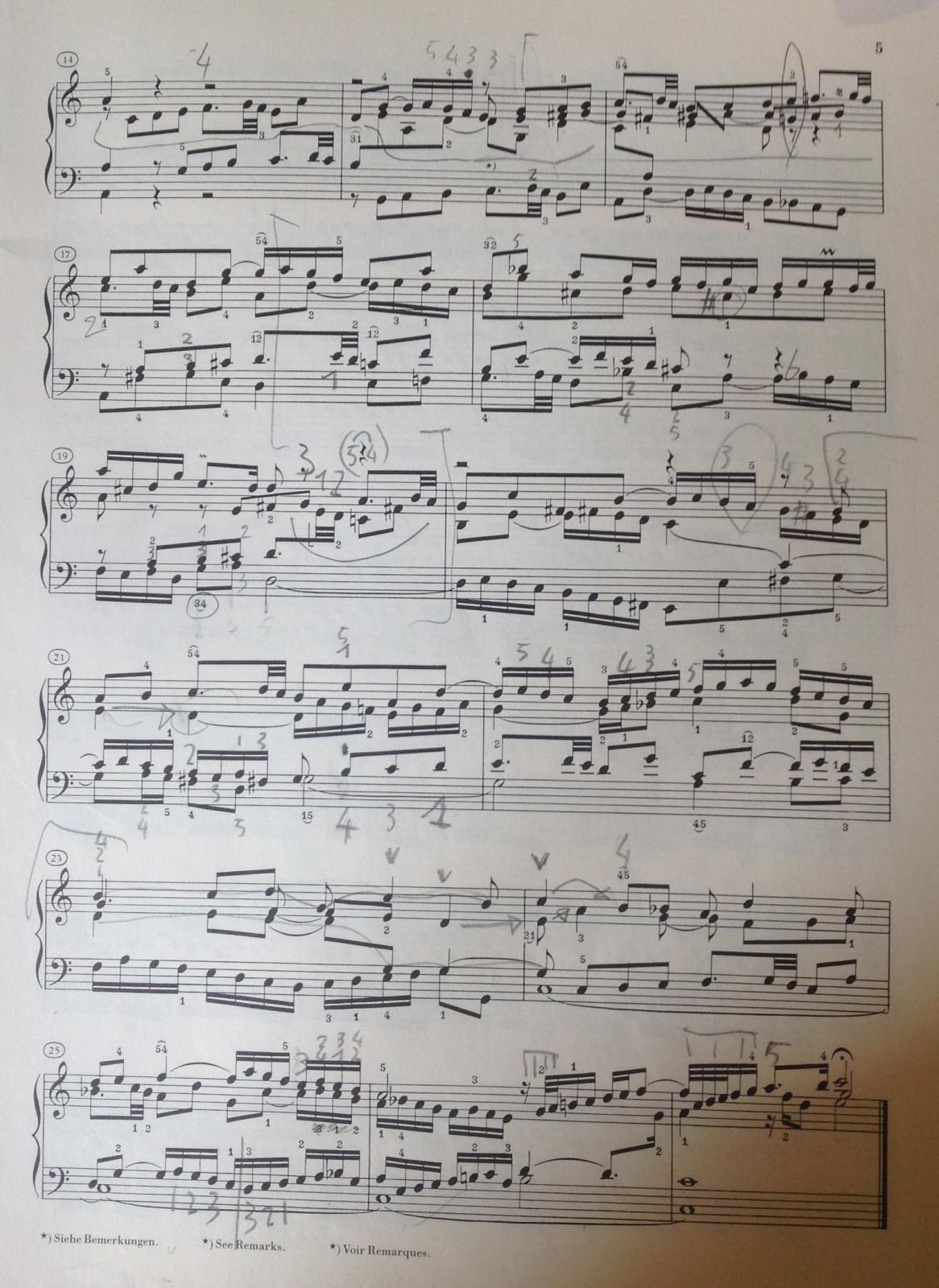
carletto wrote:How many are the Goldberg Variations? Regarding the Goldberg Variations, the various editions on the market that I have been able to find on the Internet (e.g., CdUniverse) present 32 tracks, including the initial Aria and the final one, but I have heard talk of the fact that, in reality, the existing variations are about 44.
I have never heard of the existence of 44 variations, nor do I believe there are any documents regarding this. Where did you "hear about it"?
carletto wrote:A related question: I have heard that Glenn Gould's 1982 version (which also contains 32 tracks) is different in terms of duration compared to the previous recording by the same pianist; why is there this difference between the two versions? What are any other possible differences between the two recordings?
One last thing: what are the peculiarities of Glenn Gould's 1982 Sony edition regarding the piano (it seems to me they had something to do with digital technology...)?
It is a very complex discussion, in reality. First of all, in the 1955 recording (not 1959 as Marebù wrote), Gould did not perform any ritornello, whereas in the 1981 recording (not 1982; it was released in 1982), he performs some (but not all). This in itself already distorts the duration of the two recordings. Some of the variations are slower in the 1981 recording, but others are not, and there is even one that is faster (the 5th and 26th are exactly the same, and the 25th in the 1981 recording is actually 26" shorter).
If one only looks at the tempo of individual pieces, however, one fails to grasp the true sense of the novelty of the second recording compared to the first, which lies in Gould's identification of a relationship of tactus that binds all the variations closely together, because it links them to the Aria, whereas otherwise they would be linked only by the common harmonic bass, but not by any thematic commonality. This is why it makes little sense to observe only the duration of either the cycle or the individual variations, because the differences in tempo are the consequence of a more organic musical project.
As for digital technology, certainly, the 1981 recording is digital, whereas the 1955 one certainly could not be, and the piano Gould used in 1981 was, for the first time since he had started recording discs, a Yamaha—the same one he would use for the recording of Haydn's last six sonatas.
Marebù's sarcastic comment gives me the opportunity to say one more thing (besides the fact that that comment is logically unfounded). The 1981 Goldbergs have always been considered Gould's "musical testament," but that is not the case, nor was it how he himself considered them; instead, during that period, despite having declared that at fifty he would stop playing the piano, he had begun to rethink some pieces of his repertoire and had plans to record much more. After the Goldbergs, he re-recorded the Italian Concerto, recorded the album with Brahms' Ballades op. 10 and Rhapsodies op. 79, completed the album with Strauss' Sonata op. 5 and Five Pieces op. 3, and intended to record the Well-Tempered Clavier again, to complete Beethoven's Sonatas, and many other things. He was not at all tired of being Glenn Gould. But he did not manage to be it for much longer. Unfortunately.