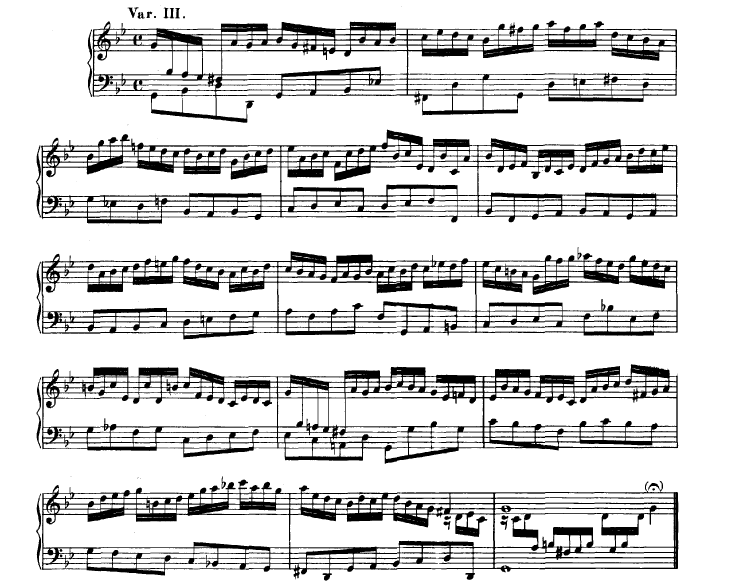
I'm having a bit of trouble analyzing this variation of BWV 768... I mean, the harmony is almost clear to me... but on a formal level? That is, it seems like a continuous development except for some evident cadences:
- measures 4/5, in B-flat+
- measure 9, in C minor
and in the finale closed in G major, I wouldn't know.
Subjects, possible countersubjects... I don't know, I have a few unhealthy ideas
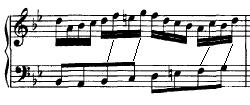
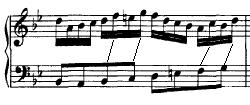
It is a seamless variation in which the chorale melody serves as the melodic pivot and is embellished by a sort of perpetual motion of eighth notes (in fact, you can recognize the original note in almost every group of 4: interestingly, it is often not the first of the four, and at some points it is transposed by an octave. Try it, it's a good exercise); there are the same cadential points as the original chorale but they are not rendered via a "fermata" on a fermata sign (which isn't actually a fermata, that's another story..).
Regarding the final G major, it is nothing other than a Picardy third, i.e., a conclusion on the tonic chord with the major third (among other things, it is also present in the chorale).
No one ever marked the “renaissance” fifths for me... Bach inherited a lot from the past, so often a single consonance was enough for him to nullify their effect... which in fact we have become accustomed to (by school rule) recognizing... but in practice it was used all the time.
You caught me off guard with this answer! The subject of the Invention in C major, which uses the same figure, I wouldn't define as modal. And neither the Chorale upon which the Partita is based, nor this third Variation, seem "modal" to me. Rather, I would have said that we find a figuration of this type in purely keyboard writing, or instrumental writing in general... but I would never have thought of modality!