

yes above I sent without attaching the file don't mind it haha

Member
Reply 21 by antares86
- Posts
- 1,414
- City
- Bologna
Started by
Member
Member
yes above I sent without attaching the file don't mind it haha

Member
I see now, I am on my phone.
Member
Measure 1: 5th relation (re#_la) on the 3rd beat, watch out for the 7th on the 3rd beat.
VI on the 4th beat, is the fa# a non-chord tone?
The si on the B II7 does not resolve, because it immediately returns to si after a "turn" note in la#.
Measure 4: the mi is missing on the V7.
Measure 5: 8th relation on the V_IV6 (fa#_mi in the bass/do#_mi in the soprano).
Measure 6: relation between si_mi on the I, also between bass and alto.
GV2 ok, but it is a third inversion, so 4_2.
Measure 7: the do on the V56 does not resolve.
Member
hooray, wait, now I'll see
Member
Yes, but I'm still for a little while.
Member
so I didn't really see the relationship and yes, I thought of it as an appoggiatura even though now that you make me think about it on a doubled note.... but the doubling is mandatory..
bar 4 ops you are right I added the seventh to the II at the end to give more color since I had removed the appoggiatura in the previous bar and I didn't see that it wasn't resolving.... my oversight
the other thing is without the seventh I didn't remove it, I'll take care of it... bar 5 but isn't the tenor descending by step at least tolerated? (asking because I'm not sure)
bar 6: relationship si-mi? on a fourth? this one never happened to me, the other one I saw was the octave
V2 is as I write it, the third inversion without the 4 is abbreviated
Member
I told you I was out of it: so at measures 5 and 6 I made a mistake, sometimes fatigue clouds your vision; in the first case the F# goes up to G instead of down to E (I dreamed it), so there is no relationship; at measure 6 instead the relationship is only between bass and tenor.
Member
ahahahaahahah it doesn't matter, one less error for me
Member
Right.
Member
so let's try again.... hoping I won't say I've reduced errors to 0.... but almost
Member
Now I am sending you "the correction", anyway it's better this time.
Member
If I'm not already standing up while sleeping, everything should be fine, but usually I forget something.
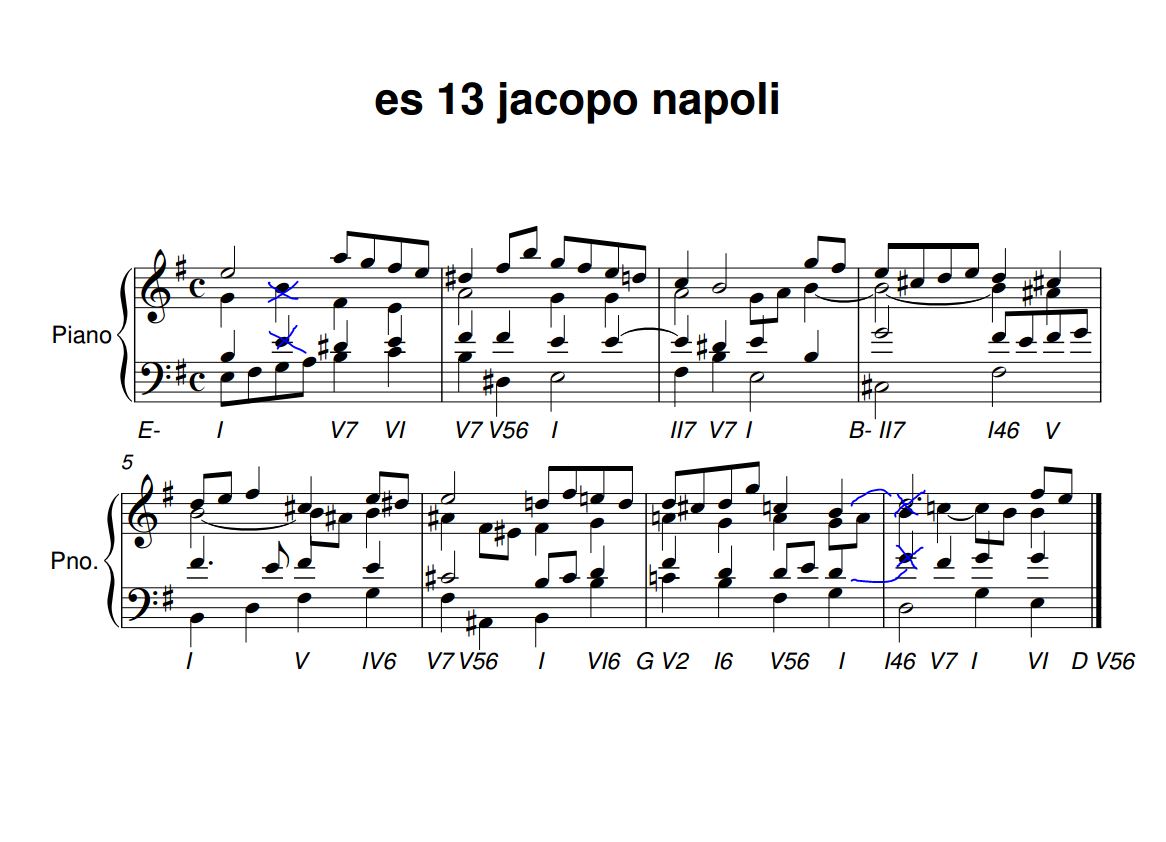
Member
Argh there is always oneeeee I set my beat to 1 to remove a relationship there is another one ahahah
Member
They must stay "close close"...:-)
Member
Ahahah okok
Member
You are improving Antares, I would start getting used to writing on 4 staves; on one hand it helps you detach from the pianistic gesture, on the other you can better control the movement of the parts, and furthermore you begin to increase the number of staves to read simultaneously, a skill that will help you when you are further along and have more instruments at your disposal.
Member
Thank you Gerardo but I fear that... At least at the beginning I will make a great mess....
Member
aluuuuuuuura we're here I should have managed to remove those 2 damn fifths..... and I added the 8 subsequent bars already revised.... exercise for you to find the hidden errors..... ahahahahahahahah
Member
At measure 6 there is an E for the sopranos against an E# for the contraltos, is this intentional?
Is it written for piano or is it a convenient reduction? I am asking because if it were intended for the classic 4 voices, it often happens that all sections sing at the upper limit of their range. The B for the soprano is demanding; in a real case, it would deserve a "solo," and even sight-reading, the second note for the sopranos is a high A, so a convenient solution would need to be found there as well. Tenors are often hanging on by the high G.
If instead it were written for piano, then that's a non-issue.
Member
It's not intended for voices no... A false relationship? I must have missed it while modifying the line, I imagine...