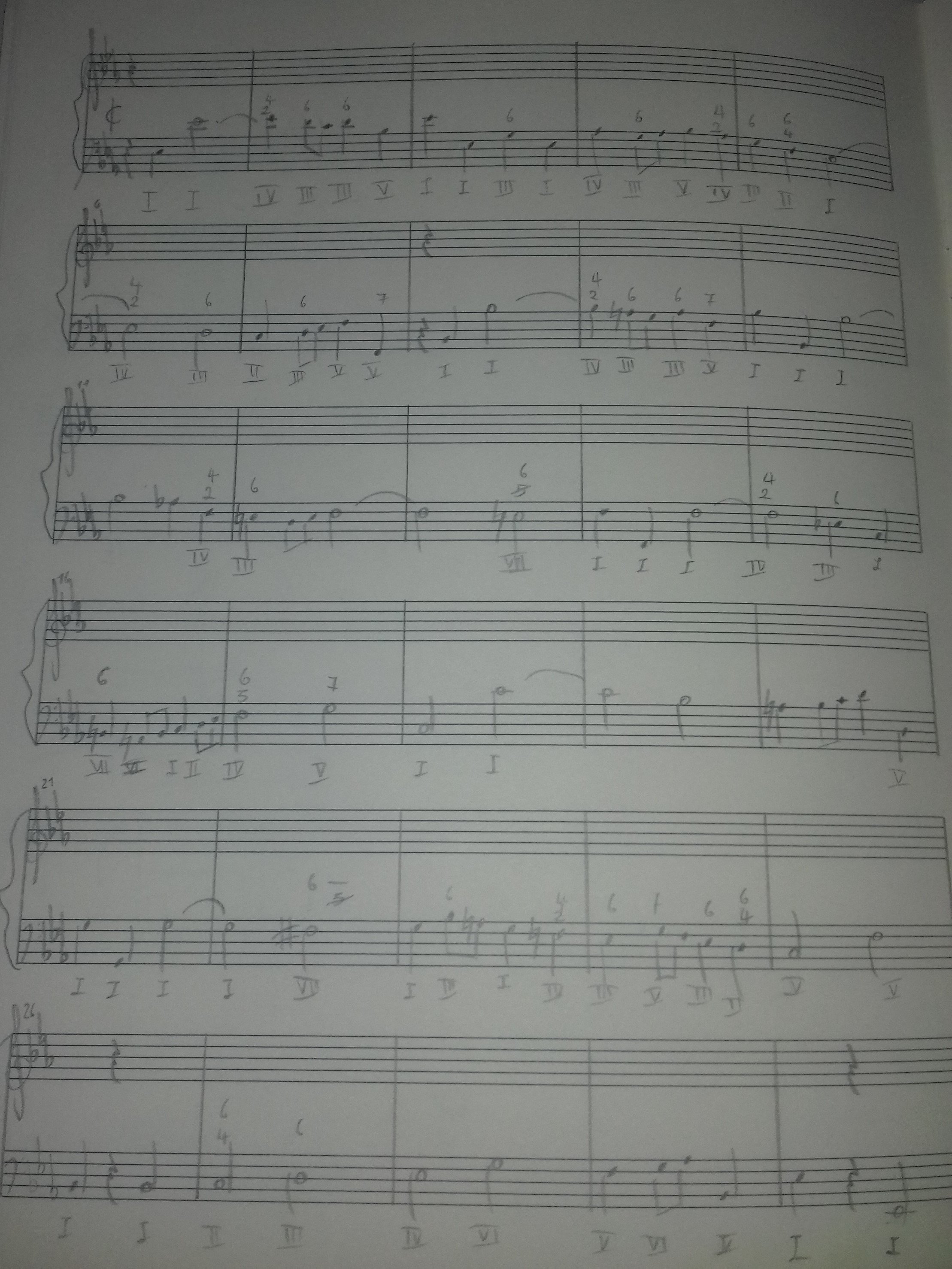
Hi everyone! I found this forum recently. I am writing to ask for your help: I am having absurd difficulties working through a bass line to harmonize (the idea that I have two to do terrifies me, and I don't have the courage to look at the second one if the first one has this effect on me). The bass line is number 21 from the small booklet "Bassi" (for the study of complementary harmony) by Jacopo Napoli. Now, the problem isn't that I can't proceed, it's at the root: I can't follow the modulations and interpret the degrees with the fluidity I had up until no. 20 of the same book. I am completely stuck...
Here is what I managed to do regarding the identification of the degrees, and I am sure that at least 50% is wrong. Where am I going wrong? Please don't give me the complete solution because I would like to work it out myself once I manage to understand the error in the degrees. Thank you so much, really
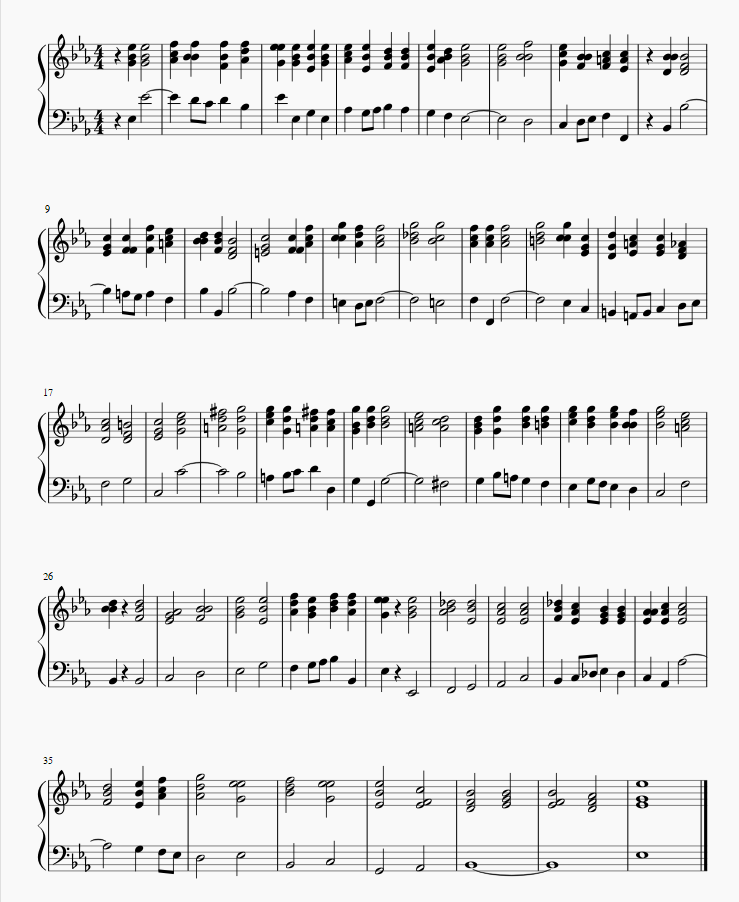
Sorry for the response, but I don't think there is an edit button for my post (or am I just not seeing it?). Anyway, I tried to create the bassline; I didn't follow the scale degrees that I indicated before. I warn you that it is still quite wrong (maybe even more than before!)... But I don't understand where I went wrong. Advice?
B
BackSpace
Member
Reply 3 by BackSpace
Posts
181
Errors aside, the worst thing is the conduct of the parts; there is no shadow of care for the cantability of the parts (especially in the first 2 lines... not even in the highest part.
If you have specific doubts about the harmony... feel free to ask.
Good evening! Thank you very much for the response
Look, I didn't pay attention to the notation... More than anything, I performed it digitally quickly, only paying attention to the interpretation of the degrees and then, if it had been correct, I would have rewritten and adjusted it in my notebook.
If it is not a problem, could you indicate where I misinterpreted the degrees? Thank you very much...
The first thing I would do is clarify exactly where you want to modulate, preparing the cadences ... resolving them properly.
Then I would pay attention to the fact that the bass is florid, so I would try to imitate the bass patterns in the other parts as well.
Harmonic syncopations, such as those you create between measures 5 and 6, tremendously weaken the harmonic language.
The situation of the bass in measure one is the same as in measure 8... I would start looking for a fragment to use as a "countersubject" or I would look for something tasty to "recycle" and develop, for example, on the coda... where the bass stops, but everything else stops too.
The rhythmic figure, also proposed in the bass at measures 26 and 30, is also interesting; if you look closely, it is different from 1 and 8. The good thing is that it is a further invitation to thin out the parts during the imitations of the other voices, making the imitative play more fluid.
Where the bass stops, everything else stops... another aspect that weakens everything.
In short, I think there is a lot of work to do.
B
BackSpace
Member
Reply 6 by BackSpace
Posts
181
Stratocaster7 wrote:
8 minutes ago, Stratocaster7 said:
Look, I didn't pay attention to the voice leading...
It is fundamental, there isn't just one harmonic version... harmony can and must also accommodate the voice leading of the parts. In fact, harmony is the result of counterpoint... not vice versa.
Stratocaster7 wrote:
8 minutes ago, Stratocaster7 said:
If it's not a problem, could you indicate to me where I misinterpreted the degrees?
More than anything, you can note down the ones you had in mind. That way we can try to understand if you have developed your own harmonic idea
D
Dante
Member
Reply 7 by Dante
Posts
275
...I would lower the bar a bit; you feel stuck because, given the outcome, you chose a bassline that is too advanced for your abilities. I would start with something (much) simpler.
Perhaps some basslines from a complementary method could help; are you being followed by a Teacher?
Thanks to everyone for the answers! Especially because on Saturday I have a test at the academy and your answers will surely be of help to me. So, as soon as I am home I will redo it (always digitally) and if you tell me that it is harmonically correct, I will fix it in my notebook. I have done all the bass lines up to 20 and a teacher at the academy is assisting me; I am having problems with 21 and 22 for some reason. I don't understand some of the bass movements, how would you harmonize a V - VII - V passage? And a V - VI - I?
D
Dante
Member
Reply 10 by Dante
Posts
275
V - VII - V?
Let's say that VII-V-I or VII V VI are good harmonic progressions; placing the V before the VII is less effective from a cadential point of view
V - VI - I?
V VI is a deceptive cadence... after a sixth there can also be a first, but perhaps a bit too weak.
Thank you all for the answers, really. I wanted to clarify that I have just started studying harmony; it's not even my first year and it is a preparatory course I am taking at the academy, so my knowledge is very limited. I only know 7th chords of first and second species respectively on the V and II degrees (third species was also introduced on the VII, but we haven't used it yet on the bass lines to be harmonized). I don't know if it is common practice, but I was told to perform V-VI with a V53 and a VI533 (doubling of the third and omission of the root). Now I wanted to know if my solution is plausible. I don't yet have the skills to perform perfect work, with suspensions, embellishments, counterpoint; I cannot harmonize eighth notes, etc... Much of what you have advised me, unfortunately, I haven't studied yet. I simply wanted to know if the modulations are correct and if I interpreted the degrees correctly (perhaps I missed some consecutive fifths and octaves; I returned home recently and reviewed it as quickly as possible to send it to you like this, so that thanks to your help, I will manage to finish my homework in time and go for the test on Saturday feeling much more relaxed). Thank you all so much for your help
Here it is:
This is the interpretation I gave to the bass lines:
I I I42 VII6 VII6 V7 I I III6 I IV III6 V IV42 III6 II43 I I - III6 II III6 V V7 I I
I42 VII6 VII6 V7 I I I - IV42 III6 I VII6 VI I I42 VII65 I I I - IV42 III6 I VII6 VI I II
IV65 V7 I I - IV42 III6 II III6 V V7 I I I I42 VII65 I III6 I - IV42 III6 V III6 - III6
II7 V7 I - V VI VII65 I III6 II III6 V V7 I - V VI VII65 I III6 II III6 V IV42
III6 I I - IV42 III6 II VII65 I V VI III6 IV6 V53/64 V54/7 I
I am also attaching the audio export following your request:
I listened to it and it doesn't seem so horrible to me; it has its harmonic pleasantness ...indeed, even upon listening, the entire contrapuntal part is missing.
Thank you for the interest! I obtained a 7/10 (in addition to the bass, I had fourth species counterpoint, a response to a given romance theme, and an orchestration for quartet of a piano piece) and I consider myself more than satisfied; the teacher clarified several points that had remained vague to me, and I am very happy about it.