

Small piece from a long series. Very interesting.
Member
Opening post by maquieto
- Posts
- 665
- City
- Massa Carrara
Started by
Member
Member
Small piece from a long series. Very interesting.
Member
Which book is it taken from as well?
Member
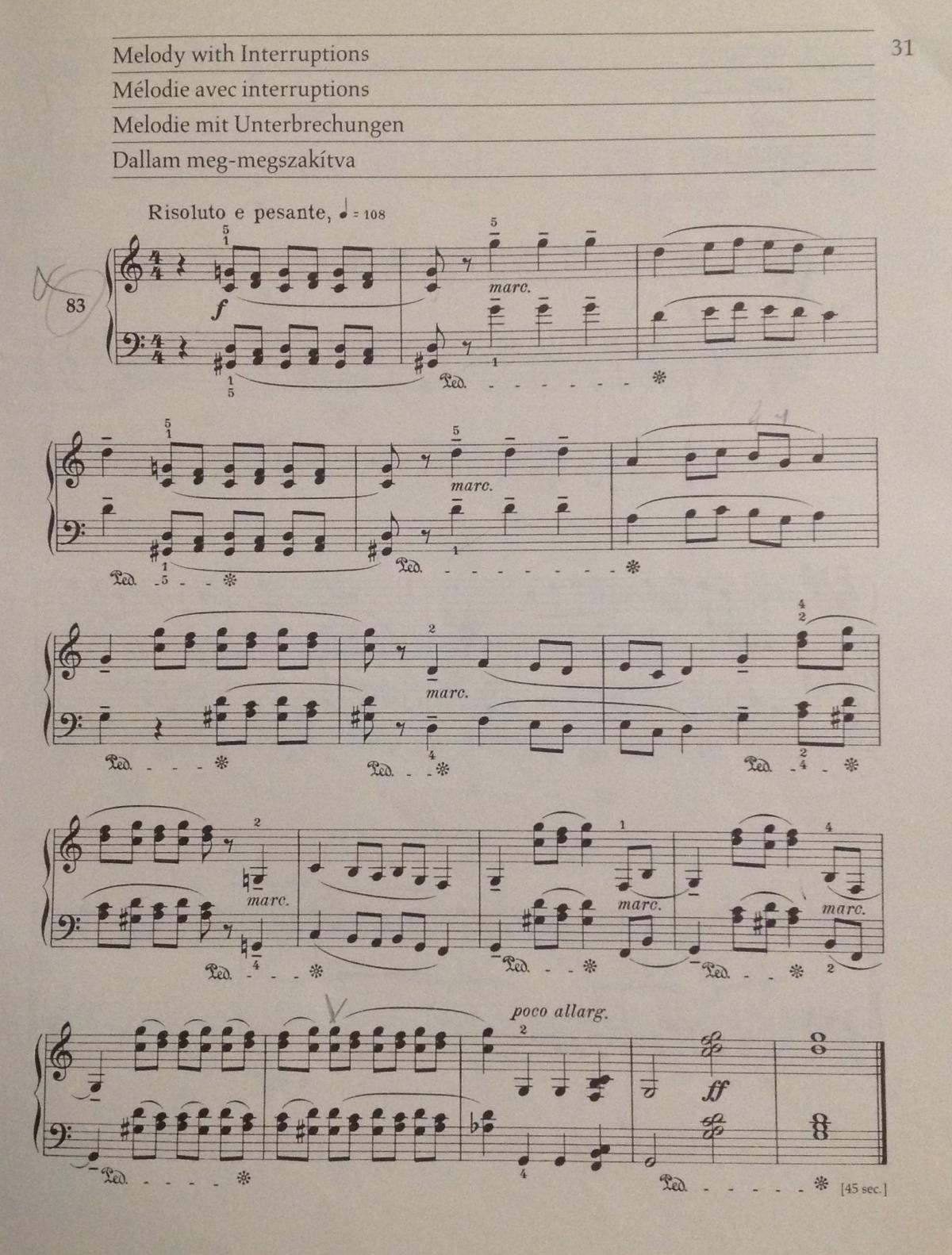
Mikrokosmos third volume page 31.
I am attaching the score.
The pieces from the 1st volume are also beautiful. Then you can have fun searching for sonorities, rhythm etc...
Bartok also indicates tempos of 45 seconds on this... I went slightly over.
In fact, I would like to succeed in staying within the time limit.
Member
I know Mikrokosmos all too well, I studied it entirely... But I don't remember all the exercises and concert pieces by heart
Member
Did I do something wrong?
Member
What are you saying in the piece? Being on my phone, I wouldn't know
Member
No no I thought I had done something wrong when uploading the sheet music... ha ha..let me know.
Member
No, everything is fine, I just didn't remember which book it was, that's all
Member
I am reviving this old thread because I was thinking of starting Mikrokosmos (vol. 1) to improve (more accurately, to start almost from scratch) my ability to read sheet music and perform on the piano. From your considerations in various discussions, I have become convinced that Bartók's work is pedagogically very valid in several aspects relating to interpretation.
I wanted to ask the experts if there are more "targeted" methods for this kind of purpose.
For some time (about a year), I took piano lessons. And I "play a little bit" of some Mozart and Chopin pieces. But it is mostly for my own pleasure.
Alongside the "playful" aspect, which I do not want to suppress since I won't be a professional pianist, I now feel the need to start from scratch with solfège, theory, harmony, and progressive exercises and studies.
Furthermore, I would like to understand the difference between piano technique exercises and so-called "studies."
Thank you
Moderator
Mikrocosmos is an excellent collection. There you can apply all the principles of technique, solfeggio, etc., without suppressing the playful aspect you are talking about. Even the first three volumes offer ample material to the pianist.
A Teacher following you is important, at least to pick up the threads of the study discourse. In my opinion, no exercise or study should be "detached" from the musical aspect. Making Music is the ultimate goal, and everything that is withered by mere and useless "training" is not part of the "game". Maria Callas used to say to singers: "even when you do a simple vocalise, think of a phrase of Love". Beautiful! It is obvious that some repetitive formulas of a little study distance us from the musical aspect and that we must favor Authors who have known how to write Music, even if teaching something or much. Bartok is one of these. An example is the wonderful collection "Le cinq doigt" (the five fingers), none other than Igor Stravinsky! Very simple pieces that can be played even in the first year, without knowing the thumb passage (only flaw: right hand and left hand in treble clef!! It refers the student to the acquisition of reading the bass clef!)
Member
Thank you Paolo,
at this moment taking lessons from a teacher is not quite possible.
Could you kindly tell me the difference between "piano technique exercises" (Hanon, Rossomandi...etc) and "studies" (Czerny, Chopin...etc)?
Why is this distinction made? Are exercises perhaps only mechanical, while studies instead have their own musicality and are therefore to be preferred?
If I wanted to approach Bach instead, what would be the most elementary pieces/studies?
Moderator
Technical books make known all the technical difficulties "extracted" from the repertoire of piano compositions. And they propose exercises that habituate one to the correct complex movement, which I call a "basic gesture," a gesture that helps us understand how to overcome the difficulty. That is, it suggests the type of "skill." Such books are sometimes misunderstood and repeated infinitely, believing that the progress of piano technique depends on muscular "training." Beyond the fact that the beginner gradually becomes increasingly skilled, also by developing a certain muscular coordination, the growth of technique is above all a process of understanding how one must overcome difficulty. Besides being a "kinetic" fact, it is a mental fact. Some distinguished Authors (Sandor, Casella) maintain precisely that, for example, the equality of the fingers is not achieved by developing uniform strength in the fingers themselves, but rather by acquiring the cerebral, mental capacity to support the weaker fingers more compared to the stronger ones. And so on for many other technical objectives. Therefore, a technical book is not a gymnastics book, but a "formula" that proposes a type of difficulty (which is naturally repeated and practiced until the proposed formula is overcome).
Studies, written by teaching composers, propose a certain difficulty throughout the entire duration of the piece, while offering an actual musical piece (e.g., arpeggio studies, repeated note studies, etc.). For example, Czerny's wonderful 50 studies op. 740 (it seems to me) are beautiful pieces, also satisfying to perform. To eventually reach the studies by Chopin or Liszt, which constitute true concert pieces of great effect.
It is difficult to suggest a path to follow from afar. I could tell you to start with small studies by Duvernoy and Pozzoli and then proceed with Czerny. Around the third year, Clementi's preludes and exercises are proposed. From the same Author, the six sonatinas are beautiful. Heller's studies "for rhythm and expression." For Bach, first the book by Magdalena Bach and then the 23 easy pieces (which are not easy at all!).
There are collections of studies: The "Czernyana" is a collection of selected studies starting from the first volume up to, I believe, the fourth or sixth.
For Bartok, I recommend at least the first three volumes of Microkosmos.
However, later on, keep in mind the guidance of a Master. It is fundamental.
Happy studying