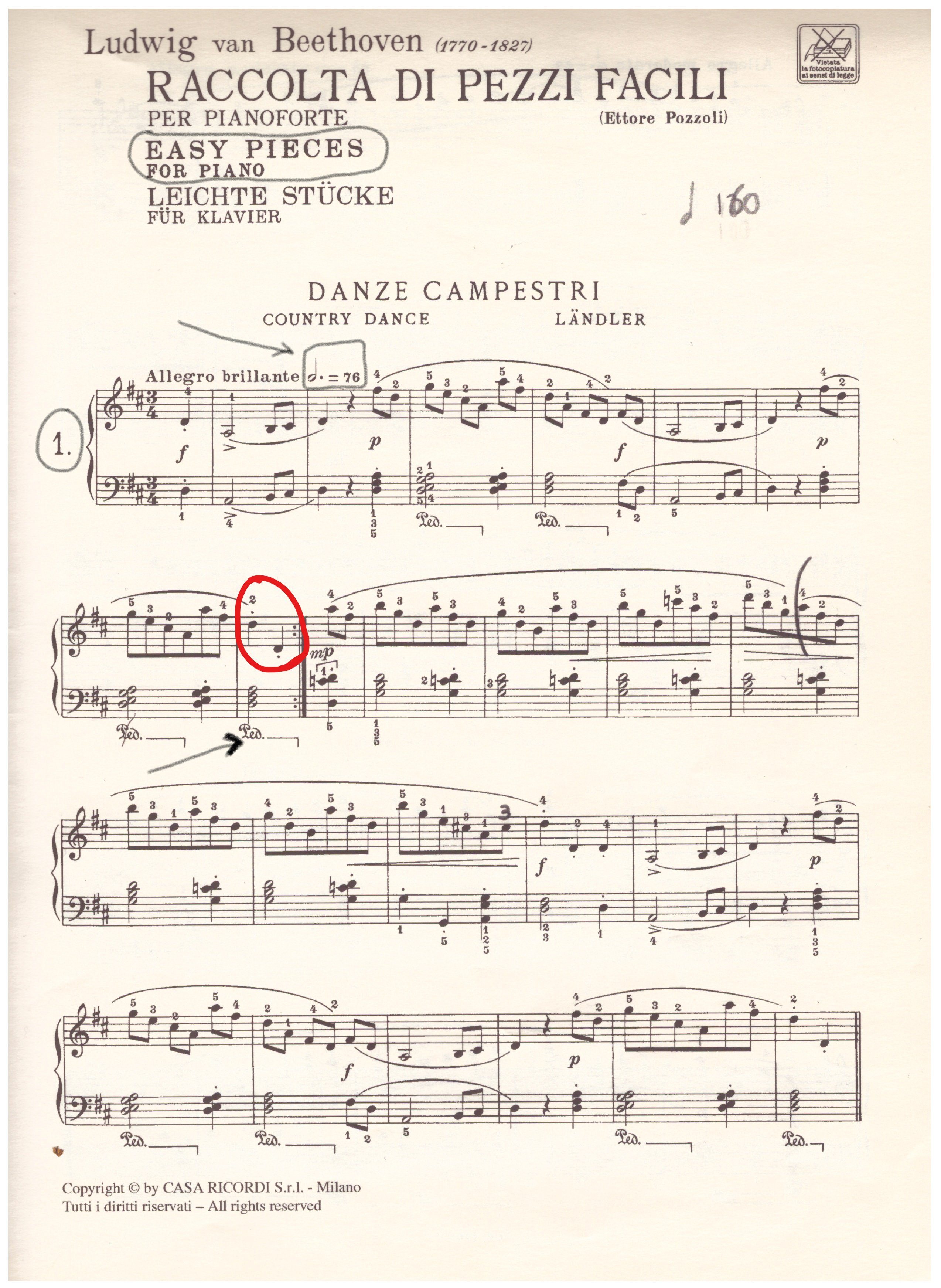
Don't you think that the tempo set at the beginning of the score is incredibly fast to be considered an "easy" piece?
Furthermore, where the staccato notes are circled in red, don't you notice a contradiction in using the pedal in that measure? How can one play those two notes staccato while using the pedal throughout the entire measure?
Metronomic tempo is always relative. Know that Bach, in his 24 preludes and fugues, never indicated the tempo speed. However, it is not fast. The indication suggests that you should not, in performance, interpret it in 3 but rather in 1. The difference? Only one accent at the beginning of each measure. When you practice, study "rallentatore" (slowing down) and not "lento" (slow), meaning: by playing slowly, one thinks in 3! With rallentatore, one thinks, as in performance, in 1, with an accent!!!! This will make things easier and will help you acquire an important musical principle.
As for the staccatos, you will find many such solutions in piano literature. Staccato refers to the hand gesture and not to the effect which is under pedal. Go look at the beginning of Chopin's Scherzo in B-flat minor, Op. 31, which I have performed many times: after the interrogative triplets, there is a staccato note and a chord on the opposite part of the keyboard. All under pedal (written by Chopin!). It means "release the note immediately to move towards the chord" (gesture). Under pedal (it must result in legato). Furthermore, I do not know if the pedal instruction is from Beethoven or Pozzoli (who was nonetheless a great teacher!)