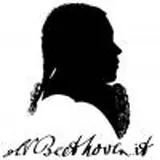
L. V. Beethoven

Beethoven's Tenth Symphony

13 replies 9,440 views

Started by

Elfo

Member

Member

Opening post by Elfo

Posts
25

Beethoven Symphony No.10 in E flat major, Unfinished (1)

http://www.youtube.com/watch?v=x-P7ksDrv9k

I am sharing this along with other similar comments; it is more Mendelssohn than Beethoven, but anyway, after the 9th Symphony, it was difficult to surpass oneself.

What do you all think?

Member

Reply 2 by OrlandiArmando

Posts
234
City
San Biagio di Valpolcevera (Genova)

And here we enter my field! So: the fundamental questions are: has a Tenth ever existed, even in the form of a sketch? Why would B. have thought of a new symphony in 1824-1827? What are the sources? When was it eventually conceived? What remains today of this composition? First of all, let us give the floor to Luigi Della Croce (Della and not Dalla, otherwise the old man gets really angry, as I have been able to experience firsthand!)

The "phantom" of the tenth symphony-----

The project to compose a tenth symphony emerges from a letter by Beethoven dated March 18, 1827, eight days before his death, addressed to Moscheles. It is a response to the latter's letter, which had announced the happy news of the sending of one hundred pounds by the Philharmonic Society, the recipient of the Ninth Symphony. Beethoven asks Moscheles to communicate to the English institution that he will reciprocate the generous grant, considering it as an advance on the earnings from a much-anticipated concert in London for his benefit, with a "new symphony, which is already sketched in my desk, or a new overture or anything else the Society might like".

There are also direct testimonies from Anton Schindler and the amateur violinist Karl Holz, both of which were made many years after the events. According to the former, Beethoven, on February 27, after his fourth operation, still deluding himself that he could recover (whereas the doctors had lost all hope), expressed the desire to resume work on the tenth symphony, the structure of which he had described to him on another occasion. For his part, Holz recounted that Beethoven had played the complete tenth symphony to him on the piano, based on sketches indecipherable to everyone except the author, and, according to a second version, that he had heard him perform the tenth from memory limited only to the first movement, consisting of "a gentle introduction in E-flat major followed by a powerful allegro in C minor". In the notebooks of notes relating to the years 1825-27 and all of which ended up in Schindler's possession, the latter underlined in pencil some themes that should be identified with the "raw" material of the tenth. In an exhaustive article on the subject, published in the Beethoven-Jahrbuch, 1977, Robert Winter points out how meager and vague these melodic ideas are, whose destination for a symphony remains to be proven. The sketches of what Schiudici claims to be an andante in A-flat major and a scherzo in C minor with a trio in C major would not coincide with Holz's descriptions and, in any case, Beethoven did not mark anything in the margin that could suggest their belonging to the plan of a symphony. On the other hand, at the bottom of a fragment in D minor, which Schindler did not take particular consideration of, Beethoven wrote the words "finale of the first piece-orchestra". This would be, according to Winter, the only indisputable [fragment known of the tenth, the only surviving trace of a design that Beethoven certainly cherished for years and which, on his deathbed, still occupied his mind.

For the skeptical Winter, his epistolary declarations to Moscheles are not decisive, as he was prone, partly for commercial reasons and partly due to innate optimism, to proclaim almost ready or completed compositions that might not even be "in the works". As for the accounts, retroactive and partly contradictory, of the two cited contemporaries, they should be taken with the widest benefit of the doubt.

To conclude his investigation into the supposed existence of a more or less advanced scheme of a symphony after the Ninth, Winter condenses his perplexities into a picturesque simile, which can be summarized as follows: if Beethoven were to appear before a court under accusation of having followed through with a project for a tenth symphony, the verdict would surely be an acquittal, at least for insufficiency of evidence.

This restrictive conception was however refuted in no. 1 of "Music & Letters" in 1985 by another Anglo-Saxon scholar, Barry Cooper, for whom the received sketches offer elements of information that have hitherto escaped analysis: if correctly interpreted, they can support the hypothesis of a tenth symphony project already reasonably advanced, at least regarding the first movement. In particular, there would be no apparent contradiction between the "accounts" of Schindler-Holz and the fragments in question, which would almost entirely refer to an allegro in C minor with an introduction in E-flat major. Many of the arguments put forward by Cooper seem solid. However, it remains a stretch to derive from an evident sketch of a scherzo and trio the main subject of the allegro, as well as to deny this theme any relationship with an equally phantom and only"

prospective overture on the name Bach. For Cooper, the so-called "secure" fragment would feature three flats in the key signature instead of one and would therefore be perfectly compatible with a piece in C minor.

Long post. Let's divide it. I will respond personally in the evening-------------

Member

Reply 3 by Carlos

Posts
759

A small observation, somewhat polemical, but friendly. Isn't it you, Elfo, who maintains that classical harmony should not even be dealt with anymore? And how could you have made the (correct) observations on Beethoven's 10th and its similarity to Mendelssohnian language, if you hadn't known it?

Member

Reply 4 by Elfo

Posts
25

I will read Armando calmly, but I must give a quick reply to Carlos immediately. Or rather, I'll ask a question: who tells you that it is the composer speaking in this instance?

It could be the musicologist noticing stylistic errors... the composer has other things to do; it's unlikely they would go nitpicking the "reconstructors."

Does a musicologist have to write? No. Therefore, it is important that they are extremely knowledgeable about this sound system... as in others...

I find, for example, that an interpreter who must also play this repertoire must take an interest in a cognitive path of tonal harmonic language (if he doesn't understand a thing, what can he play?)... a composer, after 4 introductory hints, is better off doing something else for 10 years... and not the contrary, which is what normally happens.

If they are then interested in a particular field, they will deepen their knowledge downstream, but their training must take place in the present and not in the past

Member

Reply 5 by Tiger

Posts
447
Elfo wrote:

I share with other similar comments, it is more Mendelssohn than Beethoven but anyway, after the 9th Symphony it was difficult to surpass oneself.

What do you all think?

It could be that Beethoven's post-Ninth is Mendelssohn... besides, his friend Felice was not a man of great innovations, even though his music is sublime

So, maybe he surpassed himself... although after Armando's post, let's just say it pour parlé"

Member

Reply 6 by OrlandiArmando

Posts
234
City
San Biagio di Valpolcevera (Genova)

Here I am. After Della Croce has said his piece (correctly reporting the anecdote regarding the Tenth, moreover), let us return to the origin. Let us answer in order. Did a Tenth ever exist? The answer is yes, although in the form of sketches. (attention: dispersed, not lost; I will explain this further). Second question: Why would the B. [Beethoven] of 1824-1827 have thought of a new symphony? Beethoven did not think of a new symphony at all; from 1817 onwards, Beethoven simply worked on TWO symphonies, and one phagocytized the other. (he was working simultaneously on a "German" symphony and an "English" one specifically for the Philharmonic Society. Here lies the secret of the Ninth-Tenth. Here are the sources. First and not negligible: in a conversation notebook from 1923, Karl (the nephew) says verbatim "I am glad that you managed to insert the beautiful Andante" (obviously addressed to his uncle). The first two movements of the ninth were sketched with a certain speed. The third, adagio, at one point coincides with an "andante" that had been conceived for the other symphony, the one defined as "English". Thus, with a beautiful, entirely Beethovenian harmonic bridge, the tenth's andante appears in the Ninth's Adagio. (for those who want to educate themselves on its genesis, one can buy, among the numerous books on the subject, the fine book by Misch "Wo sind Beethovens-skizzen zur zehnten Symphonie? Contenuto in Neue Zeitschrift fur Musik, dicembre 1955.") Is it possible that Cooper is so far from reality? Certainly.... perhaps. The material used comes precisely from the preparatory work for the ninth, as well as from a fine group of notebooks (Nottebohm, Neue Beethoveniana, 1890 pagg 341 et seq.) which contain "The B.A.C.H. overture, Biamonti 832, Un Veni, Creator Spiritus Biamonti 837 and some sketches for the Oratorio 'La Vittoria della Croce' (Regarding the result, as with the Mendelssohn issue, I do not wish to go into detail, although I think Cooper has gambled away his credibility----- and it is a real pity!! He is an excellent musicologist --- However, it is one thing to "pepper" harmonics or some "Beethovenian" triads, and quite another to deal with development or invent a recapitulation etc.... furthermore, he used some sketches that might have nothing to do with the Tenth, and this is a mortal sin). As for structure, I believe the symphony was orthodox, divided into four movements, probably introduced by a slow movement, let's say exactly the Cooper andante, followed by an allegro con brio. The second movement was the Andante contained within the ninth's adagio (think: at the beginning, the Ninth's adagio was marked as "Minuetto", I have seen the sketches!). The third movement was that Biamonti 838 sketch which you can listen to on the site. (the only sketch from the third notebook of 1825 not referable to the late quartets). And the finale? Formidable: in the same notebook, Beethoven begins working on the Quartet Opus 132, whose Finale is marked in the first pages of the same - with orchestral interventions. The beautiful theme is reused only with tonal transposition, but it already appears sketched even before the sketches of the quartet opus 127, which occupy the notebook defined "De Roda". This was the "Finale" of the Tenth. (or the Ninth? At one point it is reported that "Beethoven was not satisfied with the choral finale, and thought of rewriting one without a choir". Usually friends are very imaginative, but here we have no reason to doubt this statement). Ultimately, could it have been Galitzin (or Golitzin - Голи́цын, I have never managed to write it correctly) who killed the "Tenth"? certainly not, however such an important commission, with a B. weakened by his nephew's family situation and afflicted by chronic health problems, could have induced him to use ideas sketched for vast projects toward his final quartet creations. Let us make an effort and mentally rethink the music of the four movements one after another: 1) Andante - Allegro 2) Andante 3) Scherzo - Allegro 4) Finale - Presto (Or allegro molto). It's not bad, it's not bad at all.....

Member

Reply 7 by Carlos

Posts
759

Aside from the schizophrenia of this message ("who tells you it is the composer speaking?" is a question worthy of ending up on Freud's couch: you are the same person, period), but, as I was saying, aside from that, what surprises me are the "four introductory notes," or rather, it surprises me that someone who thinks they can write something believes that the history of composition, of compositional techniques, or whatever you want to call it, is reducible to "four introductory notes." It is a period that, in the narrowest of hypotheses, can span more or less the last 500 years (Palestrina was born in 1524 or thereabouts...) and since time immemorial, true composers have studied the Masters who preceded them with dedication and respect. How far should these "notes" go? Verdi had Haydn's quartets on his nightstand, along with those of Mozart and Beethoven, and on the piano music stand, he had a well-tempered harpsichord; Schönberg knew counterpoint inside out (and he would never have written what he wrote if it hadn't been so). And do we want to talk about Prokofiev? Shostakovich? Mahler? Poulenc? Britten? If they had all made your argument, who knows if we would ever have considered them the composers they became. Furthermore, you say what you say, but you have studied those things and you know them, therefore you consider them superfluous AFTER having studied them. Can you state with absolute certainty that none of those things affects your compositional style? No. Because you would need another "you" who writes without having studied them to make the comparison. So, I repeat, your argument seems frankly like an amateur's argument: since I no longer use that particular cadence, why delve deeper into it...? Oh yes, indeed, but it is a bit like saying that a contemporary writer should not study Foscolo. There are those who haven't studied him... and it shows. Knowing does not mean "reconstructing" at all (what do "stylistic blunders" have to do with it???). Reconstruction happens in a school setting to acquire practical knowledge, and on the other hand, musicians like Keith Jarrett (to name one...) emerge from wide-ranging studies, but there are few of them, because perhaps too many people consider an argument like yours to be legitimate...

Elfo wrote:

I will reread Armando calmly, but I must give a quick reply to Carlos immediately. Or rather, I'll ask a question: who tells you that it is the composer speaking in this instance?

It could be the musicologist noticing stylistic blunders... the composer has other things to do; it's unlikely they would go nitpicking at the "reconstructors."

Must the musicologist write? No. Therefore, it is good that they are extremely well-versed in this sound system... as in others...

I find, for example, that an interpreter who must also play this repertoire must be interested in a cognitive path of tonal harmonic language (if he doesn't understand a damn thing, what can he play?)... a composer, after 4 introductory notes, is better off doing something else for 10 years... and not the contrary, which is what normally happens.

If they are then interested in a particular field, they will deepen their knowledge at the end of the process, but their training must take place in the present and not in the past.

Member

Reply 9 by Rotore

Posts
337
City
-

Carlos. maybe Elfo is a composer and musicologist and, without personality disorders, believes he can express himself in the shoes of one or the other ...not that he is right... but it could be, even Thallo sometimes speaks in these terms when referring to Thallo the Singer or Thallo the musicologist.

It turns out that it's a disease among musicologists ...

Member

Reply 10 by Carlos

Posts
759
Rotore wrote:

Carlos. maybe Elfo is a composer and musicologist and, without personality disorders, believes he can express himself in the shoes of one or the other ...not that he is right...

Dico solo che Elfo postula l'inutilità dello studio di cose che lui stesso ha studiato e che quindi non può sapere se veramente siano inutili. O meglio: si può sapere se una cosa è inutile - o fino a che punto sia più o meno utile - solo quando la si conosce, come sostengo da tempo... Che lui parli da musicologo o da compositore poco cambia: il compositore attinge alle conoscenze del musicologo anche quando sostiene che queste conoscenze non servono.

Member

Reply 11 by OrlandiArmando

Posts
234
City
San Biagio di Valpolcevera (Genova)

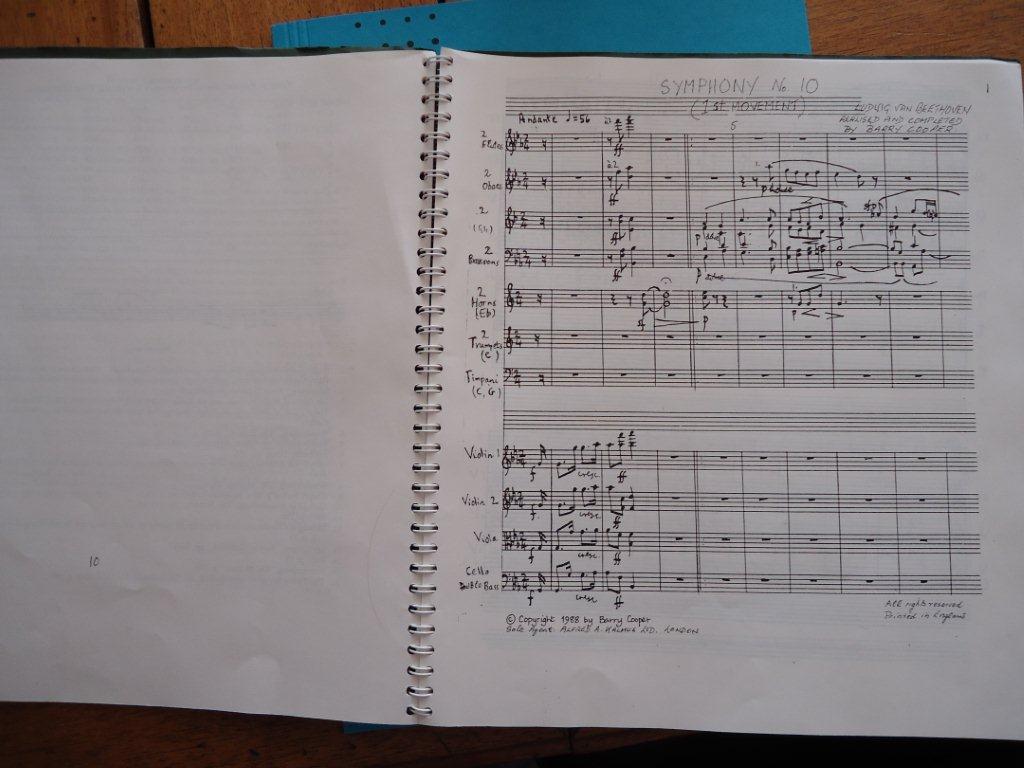
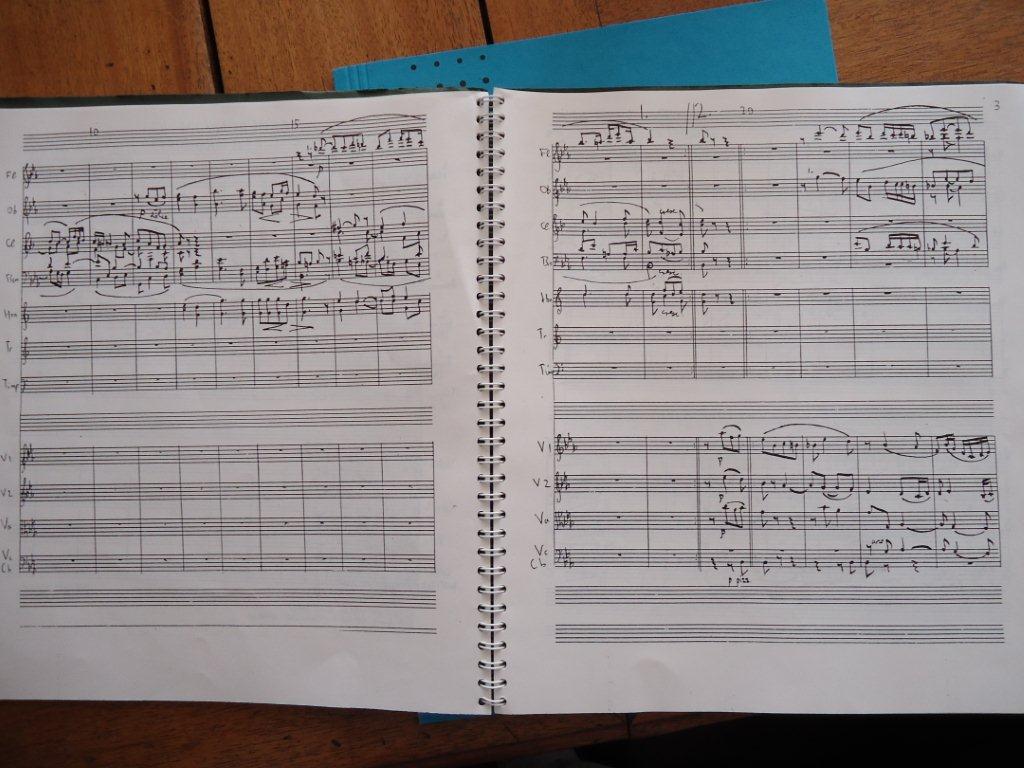
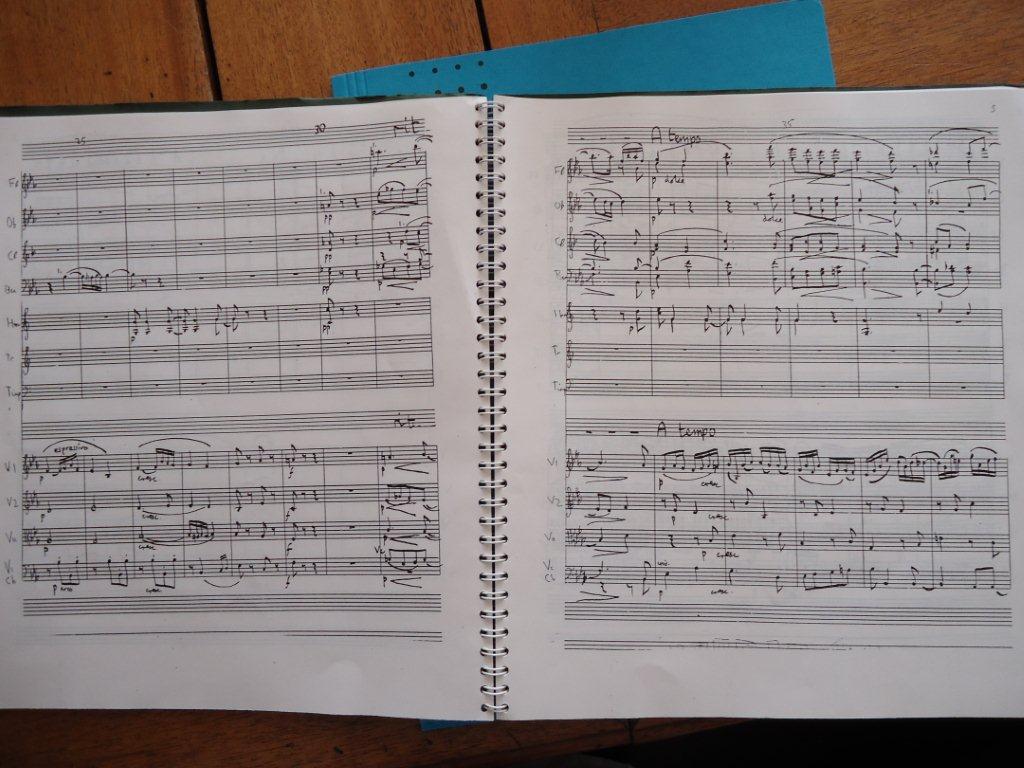
Just to distract you from your reasoning, here is the manuscript of the reconstruction that good old Barry did in 1985 (the first pages).

I am a man full of surprises.......

AttachmentAttachmentAttachment

Member

Reply 12 by Dino

Posts
277

If I'm not mistaken, Carlos once pointed out a really cool site to recover fragments ... it's just that I hadn't saved the link. If it was him, can you repost it... thanks.

Member

Reply 13 by OrlandiArmando

Posts
234
City
San Biagio di Valpolcevera (Genova)

In the meantime, I am pointing out the website of a dear Germanic friend of mine: http://www.gerdprengel.de/symphony-c-minor.html

And then, from http://www.unheardbeethoven.com to the page http://www.unheardbeethoven.org/search/search.pl?criteria=biamonti you go to Biamonti 838.

But beware! they are friends and very dear friends, but I do not share anything (except for Prengel's third movement, limited to the piano version)

Here, for only 29 American dollars, you can download the article http://www.jstor.org/discover/10.2307/855432?uid=3738296&uid=2129&uid=2&uid=70&uid=4&sid=21101575326377

Here you can follow an old post on the subject http://www.gyrix.com/forums/showthread.php?t=3367

http://www.gerdprengel.de/symphony-c-minor.htmlhttp://www.unheardbeethoven.comhttp://www.unheardbeethoven.org/search/search.pl?criteria=biamontihttp://www.gyrix.com/forums/showthread.php?t=3367
Log in to participate