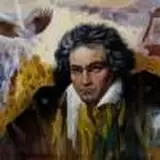
L. V. Beethoven

Bernstein about Beethoven's music

11 replies 3,869 views

Started by

Lestofante

Member

Member

Opening post by Lestofante

Posts
107

Bernstein about Beethoven's music

I would really like to understand more about Bernstein's vision, it's a pity I understand little English.

Can someone tell me something salient that one must inevitably understand from what he says?

Thanks in advance

Administrator

Reply 2 by Thesimon

Posts
4,504
City
Ariccia, RM

Translation:

"Well, for much of the last 3 months, I have lived in terms of Beethoven, thinking about his life, visiting his homes, reading his letters, but above all living with his music.

I have studied and re-studied it, prepared and performed it again and again. And I must say that I never grew tired even for a moment; the music remains always satisfying, interesting, touching, and it has remained so for almost 2 centuries, and for all types of people.

In other words, this music is not only infinitely enduring, but it is perhaps the closest music coming from the universe out there. This cliché doubt about music as a universal language becomes almost true with Beethoven.

No composer has ever lived who spoke so directly to so many people: to the small, to the great, the educated and the ignorant, amateurs and professionals, sophisticated, naive, and, to all these people of all social classes, nationalities, races, this music speaks of universal brotherhood, freedom and love.

In this ninth symphony, for example, in which Beethoven has put the (cold? - it seems to me he says chill but it seems strange given the context), hymn to joy in the finale, the music goes so far beyond the poem, it gives much greater dimensions, vital energy and artistic sparks to these old characteristic lines of Schiller."

.... (He speaks over the music I cannot understand what he is saying... and subsequently pronounces some words that seem German... I resume from 'in other words...'

"In other words, this music is also successful for those people for whom organized religions fail, because it conveys a sublime spirit in the freest doctrinal form that is typical of Beethoven. It has a purity and an immediacy that never becomes banal; it is accessible without being ordinary—this is the magic that nothing greater can explain, but perhaps it was in Beethoven the Man, a child inside who never grew up, who until the end of his life remained a creature of grace, innocence and faith, even in his moments of great suffering. And this innocent spirit speaks to us of hope, of the future and of immortality, and it is for this reason that we still love his music today, more than we ever have; in this time of world agony, of lack of hope, we love his music and feel its need, and no matter how desperate we may be, we cannot listen to this ninth symphony without emerging from it changed, enriched, encouraged, and as a human being who has been able to give the world such a precious gift; no praise and no joyful celebration would be enough, almost as if celebrating the birthday of music itself."


Member

Reply 4 by danielescarpetti

Posts
1,032
City
Castel San Pietro Terme

Warm greetings to everyone and especially to those I already know, albeit virtually.

I think that Bernstein's thought on Beethoven is even more explicitly stated in this assertion of his:

“What comes to everyone's mind when talking about serious music is Beethoven. When a new concert season opens, it is normally a program consisting entirely of Beethoven's music. If you enter a concert hall, the names of the greats are always there around the frieze, but right in the center, more prominent than the others, in gold letters: Beethoven. When a symphonic festival program is prepared, almost always a Beethoven-festival results from it. What is the highlight of any piano recital? A Beethoven sonata. Or of a string quartet program? Op. 132. What is performed for a commemoration of the fallen? The Eroica. And to commemorate a victory? The Fifth. What is played at every United Nations concert? The Ninth. Beethoven, Beethoven everywhere. Why not Bach, or Mozart, or Schumann? Because, let's say it once and for all: Beethoven is the greatest composer who has ever existed.”

Debatable like all points of view naturally, but it is nonetheless the opinion of a very great conductor, as well as a composer.

Warm greetings again and....as dear Armando, the irreplaceable Beethovenian, says: friendship!

Member

Reply 5 by zadra

Posts
84
City
Torino

In the confused part it says "Schiller's ode to joy" and then quotes the text in German and translates it, specifically the verses that speak of universal brotherhood and something regarding perceiving the Creator in the world. I believe.

Administrator

Reply 6 by Thesimon

Posts
4,504
City
Ariccia, RM
zadra wrote:

In the confused part it says "Schiller's ode to joy" and then quotes the text in German and translates it, specifically the verses that speak of universal brotherhood and something regarding perceiving the Creator in the world. I believe.

Yes, I translated the part about Schiller's ode to joy; then I had a hunch that what he cited was German, but I couldn't understand what it said... I don't speak German at all

Member

Reply 7 by zadra

Posts
84
City
Torino

Neither do I, but once I knew the lyrics by heart (learned when this wonderful composition became the European anthem). ^^

Anyway, Bernstein's point is entirely shareable

Member

Reply 9 by maquieto

Posts
665
City
Massa Carrara

Thanks Simone and Zara for your commitment to the translation.

Great words and... great truth.. Beethoven is still Beethoven.. I don't know why but.. he is always close to the heart and natural like his sonatas.. a Schubert with more structure?

Member

Reply 10 by danielescarpetti

Posts
1,032
City
Castel San Pietro Terme
fabio73 wrote:

Big words and... great truth.. Beethoven is still Beethoven.. I don't know why but.. he is always close to the heart and natural like his sonatas.. a Schubert with more structure?

In reality, these are completely opposing musical structures, even if the two composers are contemporaries.

Schubert, although being of a younger generation, unfortunately died the year after Beethoven's death and thus his compositions are substantially contemporary to what is usually defined—from my point of view, somewhat improperly—as the "third Beethovenian style."

However, if we place Beethoven's works alongside Schubert's at first glance, we might say that the Austrian belongs to a previous era, namely essentially the 18th century. But if we do not stop at a superficial examination, we soon discover that it is not quite exactly like that.

Beethoven destroys the emotional balance of classical forms and strongly exaggerates their elements of contrast that were already present within them: the two opposing themes, the opposition of tonality but then, in his late works in particular—but even earlier—he almost completely abandons the dynamics of contrasts, performing a complex work of rethinking the sonata form, reshaping it time and again according to his expressive needs and enriching it extensively with counterpoint and variations until reaching Opus 111, where he dissolves it, as Thomas Mann reminds us in "Doktor Faust."

Schubert, on the contrary, totally accepts the sonata form but paradoxically, while doing this, he also works towards its dissolution, but does so in a more subtle and nuanced way: if a timbral effect pleases him, he insists on it, thereby destroying that element of tension caused by the balanced opposition of two different ideas; if a certain modulation fascinates him, he does not renounce it, even if doing so takes him off the classical path.

Schubert, in other words, is truly the bridge between Classicism and Romanticism, and not Beethoven, as I often read and hear stated.

Beethoven, in reality, with his late works looks far beyond Romanticism; he looks directly toward the 20th century and thus bypasses practically a century of music, and it is also here that his infinite greatness lies."} ,

Member

Reply 12 by maquieto

Posts
665
City
Massa Carrara

Beautiful reflection on sonata form... I agree, and also the idea that Schubert "insists" on certain melodic lines, themes, etc... letting himself be flattered and carried away... I am in total agreement.. Schubert then had such a natural musicality... scholars say there are very few corrections in his scores..

Beethoven also loved Mozart very much and in many themes points of intersection appear... in B. Naturally denser and more distorted but still profound, placid. Heartfelt... what a beautiful composer..

Every time I have played something of his, I have always felt at home, so to speak... Mozart has also always been familiar to me, but B. Moreover... being also closer to the piano (even if the instruments of the era were not comparable to ours) makes our modern instruments sing in a different way..

As a bridge between the two eras, perhaps he was one a little bit, but... I fully agree on the fact that we are on another planet..

Log in to participate