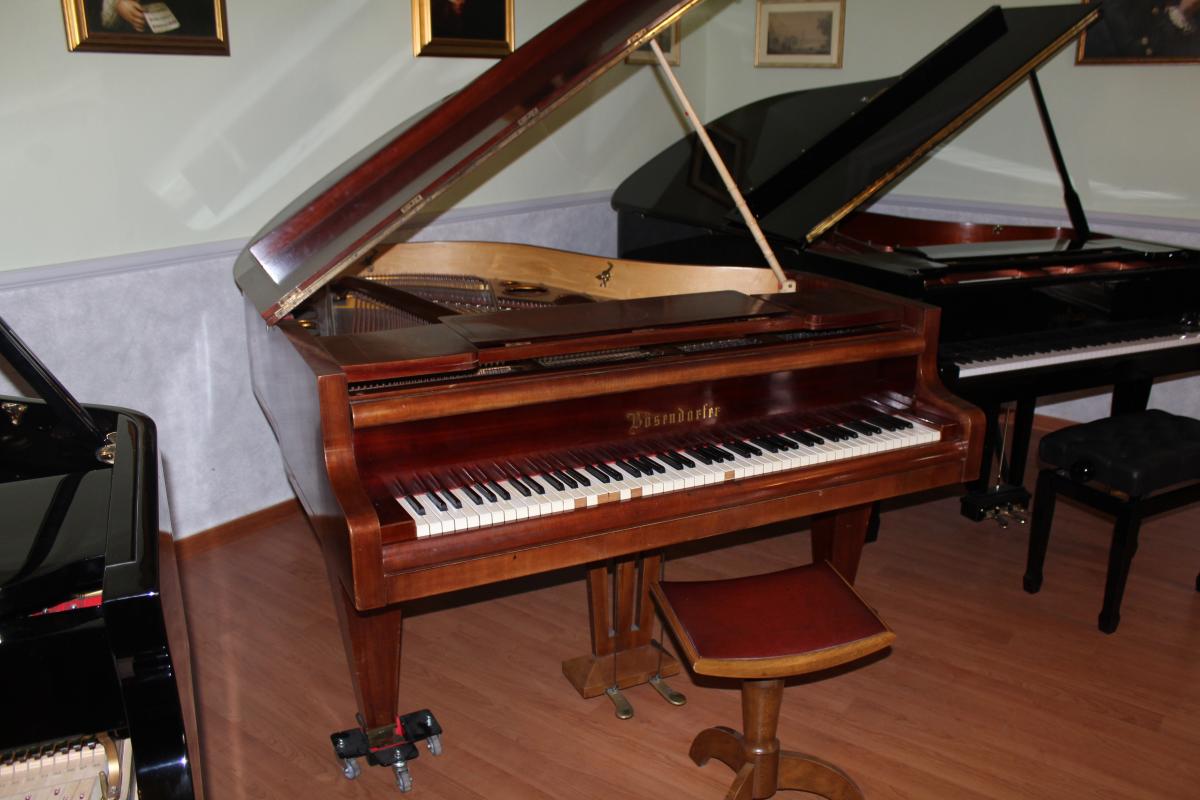
Good morning everyone, I am new and I would need some opinions regarding the potential purchase of a Bösendorfer that I saw at a piano restoration company.
I have only tried the piano once and I intend to try it again: it sounds wonderful.
They tell me: "Regarding the Bösendorfer grand piano, it features a Swander action with double escapement; the keyboard touch is slightly lighter compared to the actions of modern pianos. The instrument's serial number is 20437 and dates to approximately 1914."
They guarantee me that it is in excellent condition and will require little intervention.
The price will be no less than 10,000, but I wonder if it is worth it? Given that with that amount I could buy a new baby grand? Is the action very different from that of current pianos?
Not that it matters much, but is a warranty offered? And for how many years? Is a list of the work performed and what needs to be done in the future provided?
A restored piano brings great satisfaction, but a poorly or partially restored piano produces very unpleasant sensations after a few years. So, first of all, no rush, and then out of curiosity, go see what they are offering you within that price range, both among new pianos and used ones. The Bösendorfer is a piano that is very much liked because it has this keyboard, which to me personally seems buttery, soft in a positive sense; others like it because they find it consistent—the fact remains that a good photo of the action would be necessary. I don't want to say something stupid, but Bösendorfer, like Blüthner and others, preferred different actions, pin-style or patented by the company, compared to the one you mentioned... Anyway, let's face it, if you aren't starting from scratch, a pianist must know how to choose the piano they prefer: play it and let it resonate within you!
I agree with Andry. We have to see. But we are always in the presence of a high-quality piano. One must start by evaluating the sound quality and the condition of the soundboard and the bridges. Then everything can be restored. A quick piece of off-the-cuff advice: play a chord in various registers of the keyboard and evaluate the decay time. You can also watch my video Tutorial with tips in case of purchasing a piano. Let me know. Bye Paolo
HA
Historical author
Reply 5 by Historical author
Hello,
we are talking about a high-end brand piano.
However, it is an old instrument: 1914.
Pianos have an average lifespan of about 80, 90 years.
It is possible that everything has been well preserved but, I advise you to check the soundboard tension; you can find everything in the video "guide to buying a used piano" by Pianoexpert.
Alright, now don't get offended, but we can't do much with a photo like this... having the action removed and photographed might be a utopia, but at least removing the music desk and checking the string hitch pins would be more interesting in order to have a discussion.
P.S. My piano, which is contemporary to yours, was beautiful on the outside even 10 years ago; however, it is only now, after careful regulation work, that it has returned to flowing under the fingers like never before. It took 8 years of study (relative wear and maturation of felts in relation to the room's humidity), a restoration that was too rushed, and 2 tuning technicians. Despite this, if our piano expert Paolo hadn't arrived, I would still have a grand piano with the efficiency of a mediocre digital one—that is the risk!