I would like to compare notes with you on this topic.
What is the right choice for the trills in the opening Aria? Given that the theme is by Handel, but the opera is by Brahms... which performance practice for ornaments is more correct to follow?
Among performers, there are illustrious ones who start from the upper note and others from the principal note.
What do you think?
M
Marta23
Member
Reply 2 by Marta23
Posts
153
The date of the changes is what matters
C
Carlos
Member
Reply 3 by Carlos
Posts
759
ttw wrote:
I would like to discuss this topic with you.
What is the right choice for the trills in the opening Aria? Given that the theme is by Handel, but the opera is by Brahms... which performance practice for ornaments is more correct to follow?
Among performers, there are illustrious ones who start from the upper note and others from the principal note.
What do you think?
Upper note all my life! Because it is more beautiful, not because it is more correct
G
gianni22
Member
Reply 4 by gianni22
Posts
159
So Handel is uglier? ... mmmhmm
L
Lestofante
Member
Reply 5 by Lestofante
Posts
107
Carlos wrote:
Upper note all life! Because it is more beautiful, not because it is more correct
In the past, I had understood that it was important for the performer to seek and respect the composer's thought; I think this is the tenor of the question... perhaps I am wrong.
C
Carlos
Member
Reply 6 by Carlos
Posts
759
Lestofante wrote:
In the past, I had understood that it was important for the performer to seek and respect the composer's thought; I think this is the tenor of the question... perhaps I am wrong.
Exactly: whose? Brahms or Handel? (But then again: you know that the theme doesn't seem to be his, right?) That was ttw's question, if I recall correctly. In any case, and responding to Gianni22, if anything "uglier Brahms" - to put it in your words: trills in the Baroque are played from the upper note; it is in the 1800s that they are played from the principal note, which is why I prefer (preferred, really) to play that trill from the upper note, because that Baroque theme sounds more beautiful when played with the trill in style. In my opinion, obviously.
I am also in favor of the higher note. I believe that the phrase "it is more beautiful" is sovereign. In embellishments, precise rules exist, as in harmony and the rest....but beauty commands. My Teacher gave Celebidache a composition assignment where there were parallel "fifths"...intended, naturally. The Maestro marked them with a red pencil. The student made a gesture as if to say.." ..I know.. but I put them there deliberately".
The Maestro (of my Teacher) caught this disappointment and without raising his gaze, but with a beautiful smile that illuminated his lovely expression, said: "...I am marking these fifths for you... not because they are an error... but because here... they do not fit":
C
Carlos
Member
Reply 9 by Carlos
Posts
759
pianoexpert wrote:
I believe that the phrase "is more beautiful" is supreme.
Bravo. My teacher, a student of the great Zecchi and Casella, used to say: Ornamentation is like makeup for women. A beautiful woman with bad makeup can even become ugly and/or more vulgar; and that is not good......(well....except for exceptions!!!)
Z
Zazza
Member
Reply 11 by Zazza
Posts
250
I think that H. could have written the embellishment in full and Brahms would have taken it the same way for his variations. Ergo, the original version is valid, which as already stated by others is beautiful. The theme is written taking into account that version of the embellishment... and Brahms knew it, of course
And it is also true that as TTW says
ttw wrote:
Among the performers there are illustrious ones who start from the upper note and others from the real note.
Who knows why something that seems so obvious in this topic ... for people who have little to envy is not so? Maybe just for the pleasure of proposing something different? ...more original?
M
Marta23
Member
Reply 12 by Marta23
Posts
153
Zazza wrote:
I think that H. could have written the embellishment even in full, and Brahms would have taken it for his variations nonetheless.
I found this quotation, which I propose
"Of solid dimensions, his overpowering mastery of pianistic technique is surpassed only by the Variations on a Theme of Paganini, written shortly thereafter. Wagner, after hearing Brahms play the Handel Variations in 1864, made the famous comment: 'This demonstrates what he can still do with the old forms if one knows how to use them,' thus revealing that he considered the work as a rigorous statement of artistic principle. The Handel Variations are a systematic consolidation of the mastery acquired by Brahms – the result of his intense studies in the fifties. The choice of a Baroque theme, the rigor of the variations, the purity of his pianistic conception, and the generous profusion of contrapuntal doctrine in the final fugue – all conspire to assign to Brahms the role of conservator and reviver of a long and illustrious musical tradition.
The theme comes from the Aria with variations from Handel's Suite for harpsichord in B-flat major – a lovely and lively short melody which, due to its balanced periods and harmonic frankness, represents an ideal subject for variations. Starting from this melody, Brahms writes twenty-five variations that, while preserving the proportions and tonality of the original theme, explore atmospheres and characters set in lively contrast, and a sequence of styles ranging from 'neo-Baroque' to contemporary chromaticism. The concluding fugue – a broad and majestic structure that opens up new musical horizons – proceeds in a polyphonic style indebted both to Beethoven's late piano works and to Baroque-era fugues. The majestic vehemence of the conclusion surely embodies the pride of a composer conscious of having achieved through his work extreme mastery over the chosen form." (Malcolm MacDonald)
C
Carlos
Member
Reply 13 by Carlos
Posts
759
Marta23 wrote:
The theme comes from the Aria with variations from Handel's Suite for harpsichord in B-flat major
The problem posed in the discussion by ttw is not of simple solution because, even if I share the answers of the other friends, in any case it must be remembered that in Brahms' era, the execution of the trill starting from the upper note prevailed and, in general, the relationship with Baroque tradition was totally independent of a discussion on performance practice.
In any case, if we think of the great pianists, we find both solutions elegantly presented: for example, Arrau from the upper note, with wonderful trills:
http://www.youtube.com/watch?v=T1zDr2fPA-8
Sokolov, on the other hand, plays the trill from the real note, but his phrasing is undoubtedly worthy of appreciation:
Even Sokolov is, apparently, not dogmatic about this. The last trill of the first part is taken from the upper note (to accommodate the melodic design) and the same goes for the trill on D in the second part (the first one) which is taken from the upper note the "first time" and even from the lower note (!) the "second time".
T
ttw
Member
Reply 16 by ttw
Posts
277
I thank everyone for the brilliant contributions
Carlos wrote:
I never found it...
You?
And that is precisely the point; since it was "derived," the hypothesis becomes increasingly strong that romantic aesthetics apply more than baroque ones. Brahms added his own touch and did not take an entire section of a piece by Handel completely, which means he also revised the structure of the embellishments.
Anyway, the discussion remains open.
PS
Händel is written with the "ä"; something has changed the subject of the topic, it would be better if it became an "ae"
C
Carlos
Member
Reply 17 by Carlos
Posts
759
ttw wrote:
Brahms put his own touch on it and did not take a complete portion of a piece by Handel (...)
But did you manage to find Handel's theme somewhere? I couldn't...
T
ttw
Member
Reply 18 by ttw
Posts
277
Carlos wrote:
But did you manage to find Handel's theme somewhere? I didn't...
Exactly, I was writing
"Brahms put his own touch on it and did not take a complete portion of a piece by Handel"
So since it is practically his, or he took inspiration from it, it wouldn't count as Baroque... and yet... so much diversity ....
C
Carlos
Member
Reply 19 by Carlos
Posts
759
ttw wrote:
Exactly, I was writing
"Brahms put his own touch on it and did not take a complete portion of a piece by Handel"
So since it is practically his, or he took inspiration from it, it wouldn't count as Baroque... and yet... so much diversity ....
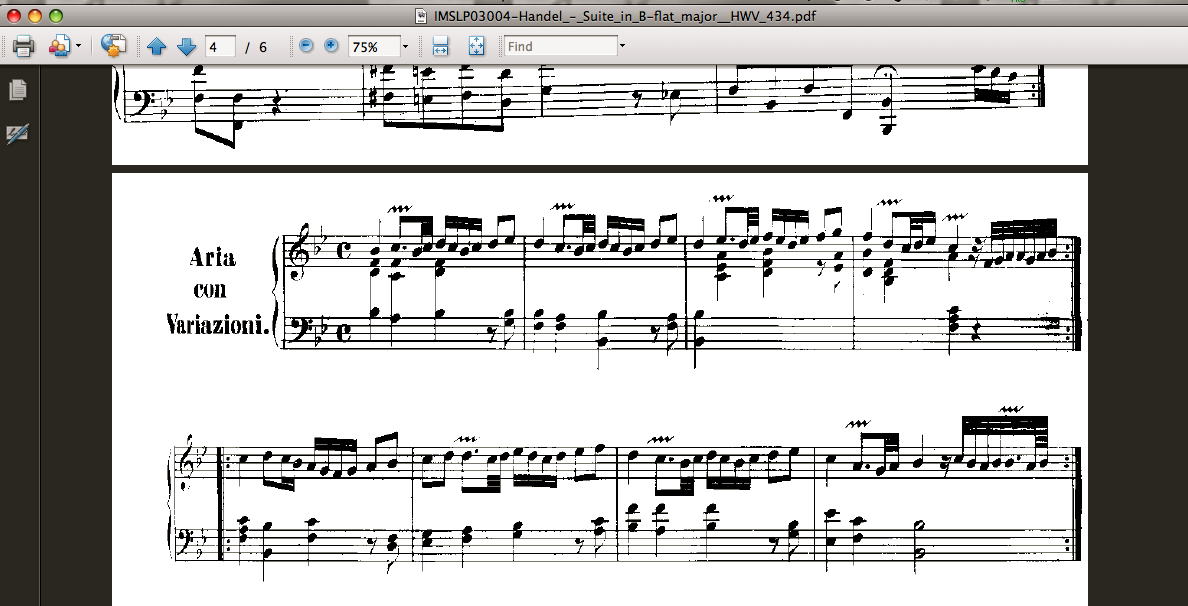
Well, I finally found it instead. It is found in the Suite in B-flat HWV 434, which changes numbering depending on who writes about it; anyway, it can be found on IMSLP, here http://imslp.org/wik...rge_Frideric%29
For convenience, I am attaching the theme of the Aria with variations, taken identically by Brahms.
And here, at minute 4:07 you can finally hear it, within Handel's Suite.
Thanks to everyone and in particular to Carlos for this last post, now I certainly have more elements to reason about, including the precious reflection of Maestro Fredda.