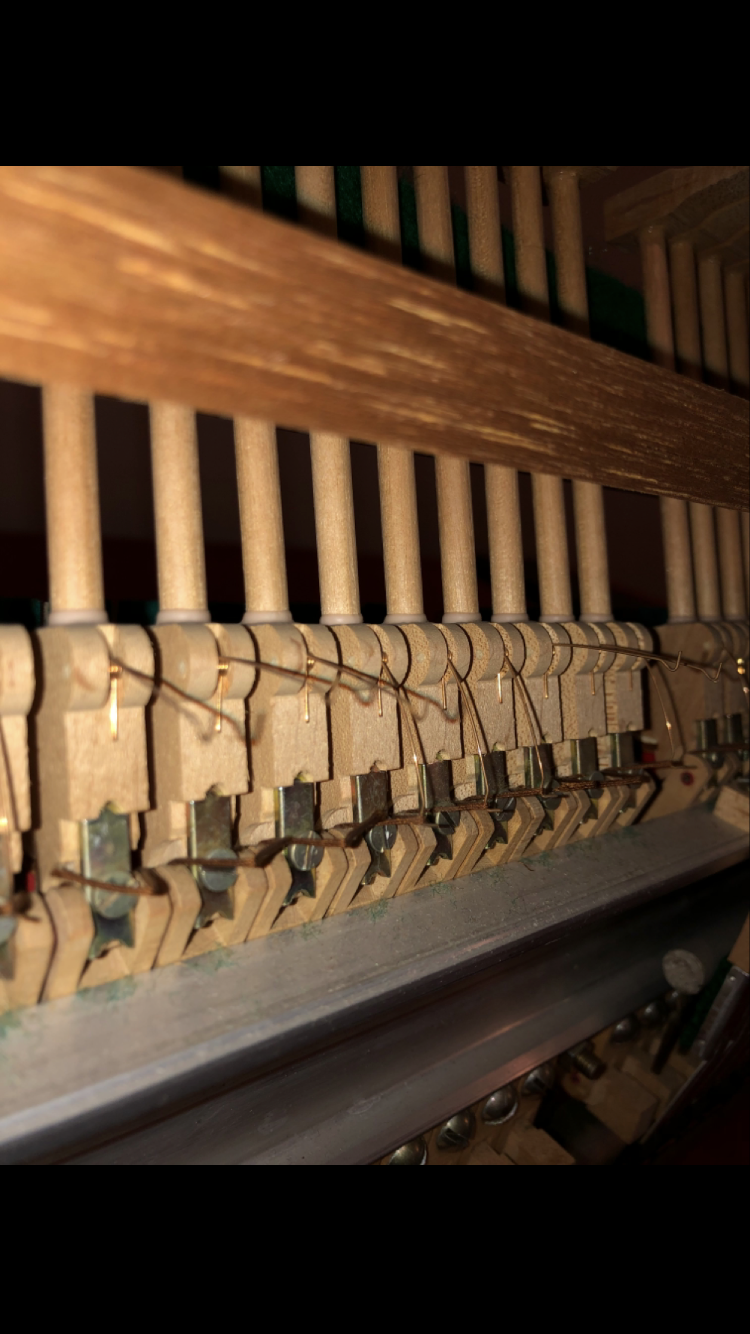
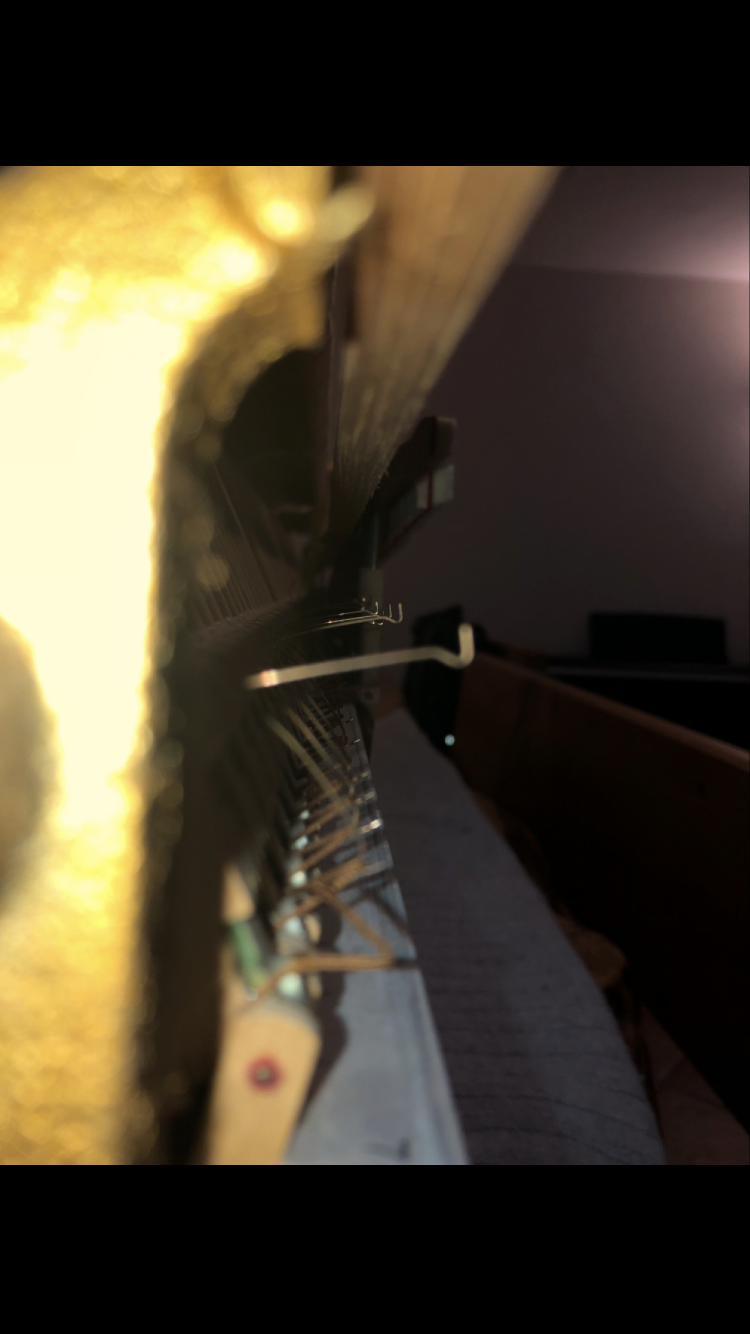
I am here because, over the past few days, while taking a look at my piano's action, I noticed something strange in the lower part: many strings that have the task of tensioning the return spring have broken, likely due to wear. I am attaching photographs. First of all, I wanted to ask if anyone could explain clearly and specifically their function within the action. Secondly, I wanted to ask your opinion regarding the possibility of replacing all these strings by hand (using the appropriate tools, materials, and spare parts). Watching some videos on YouTube, it seems that it is not an extremely difficult job and is also quite repetitive. Calling a piano technician, the price for the complete job is around 600/900 euros. Do you think this could be a reasonable price? Is it worth spending that money for a technician's work, or can one succeed alone at home with care and willpower? Thank you in advance for your help, good evening to everyone. Tommaso
The photos are not visible. I assume these are the pull cords for the hammer rail jacks of an upright piano. If so, the price seems quite excessive to me. If it is a grand piano, i.e., the pull cords for the action rail jacks, the request might be a bit more justified by the fact that the tension of these pull springs greatly influences the keyboard weight (both downward weight and key return weight) and therefore all spring tensions must be rechecked relative to the length of the cord loops. In both cases, a special cord must be used which, as mentioned, is not subject to easy wear over time. In both the upright and grand piano cases, one must be capable of dismantling, removing the old ones, and replacing them with new ones of strictly identical length. When reassembling, centering must be respected. In an upright, loading the springs a little is not a bad thing. This contributes to a greater and quicker return of the hammers. In both cases, the cords are fundamental (It is recommended to use Renner green cotton cord rather than synthetic. Otherwise, over time, in contact with the spring tension, the latter could produce a "whistling" noise).
I had the same problem; I should preface that I am not a piano technician, but with a bit of precision and manual dexterity, I managed to replace them.
What kind of piano do you have? Perhaps my post about the work performed "It's all because of those little strings!" might be useful to you.