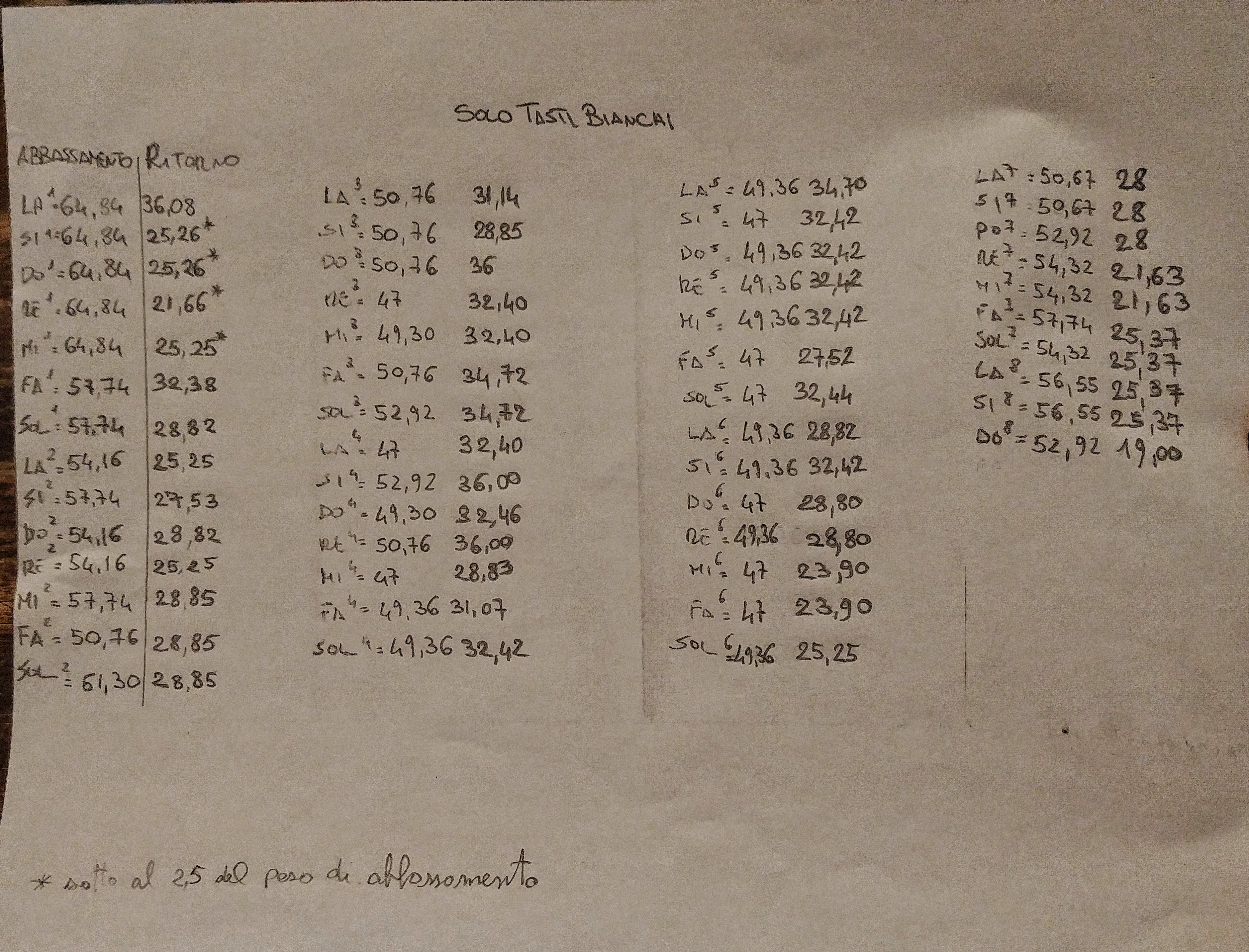
I would like some correct indications regarding the method for measuring the down weight and return weight in order to then calculate the friction coefficient. Therefore, I have a few doubts to resolve:
. Should the measurement be carried out with the dampers raised? That is, with the sustain pedal depressed?
. Should the depth be measured up to the escapement point?
. The coefficient is obtained by subtracting the return weight from half of the down weight, correct?
it is not sinking, but rather the downward weight. However, let us not be trapped by mathematical values. Every mechanism is designed with its own downward and return weight. The subsequent observation is the ratio between the two. But it is also true that the normal mass of the parts and the keyboard weighting comes into play. It is not enough to increase the weighting, for example, to reach certain values. The values might be respected but with excessive inertia. The problem of friction can be found by observing how the mechanism levers fall under the weight of their own screw. Once the correct frictions are established, one will observe if the downward weight is excessive (for example, due to having replaced a hammer rail with a heavier one) and how much this affects the inertia. A pianist's test is also important to have them describe the sensations regarding the response of the mechanism.
The problem of friction can be found by observing how the mechanical levers fall under the weight of their own screw. Once the correct frictions are established, one will observe if the downward weight is excessive (for example, due to having replaced a hammer rail with a heavier one) and how much this affects inertia. A pianist's test is also important to have them describe their sensations regarding the response of the action.
I have always complained about the stiffness and heaviness of the action and, as you suggested, I placed two sheets of bristol board under the felt, reaching a dip of 9.8; now it works much better! Having recently changed some white key coverings, I also had the chance to test the fall of the levers onto the mortises, and I did not notice any friction.
I believed that calculating the downward and return weight would help me identify keys with friction problems caused by other levers.
FIRST: we need to see how they were measured. SECOND: the values seem very discontinuous to me. THIRD: we need to observe the uniformity of the keyboard leveling and whether there could be other excessive frictions (such as between the key lever and the heel). FOURTH: check if the hammer rail (perhaps if replaced) is too heavy. The last one could be because I see that the let-offs are quite high, as are the returns. How is the repetition performing? It should be difficult. With what vivacity does the key return?
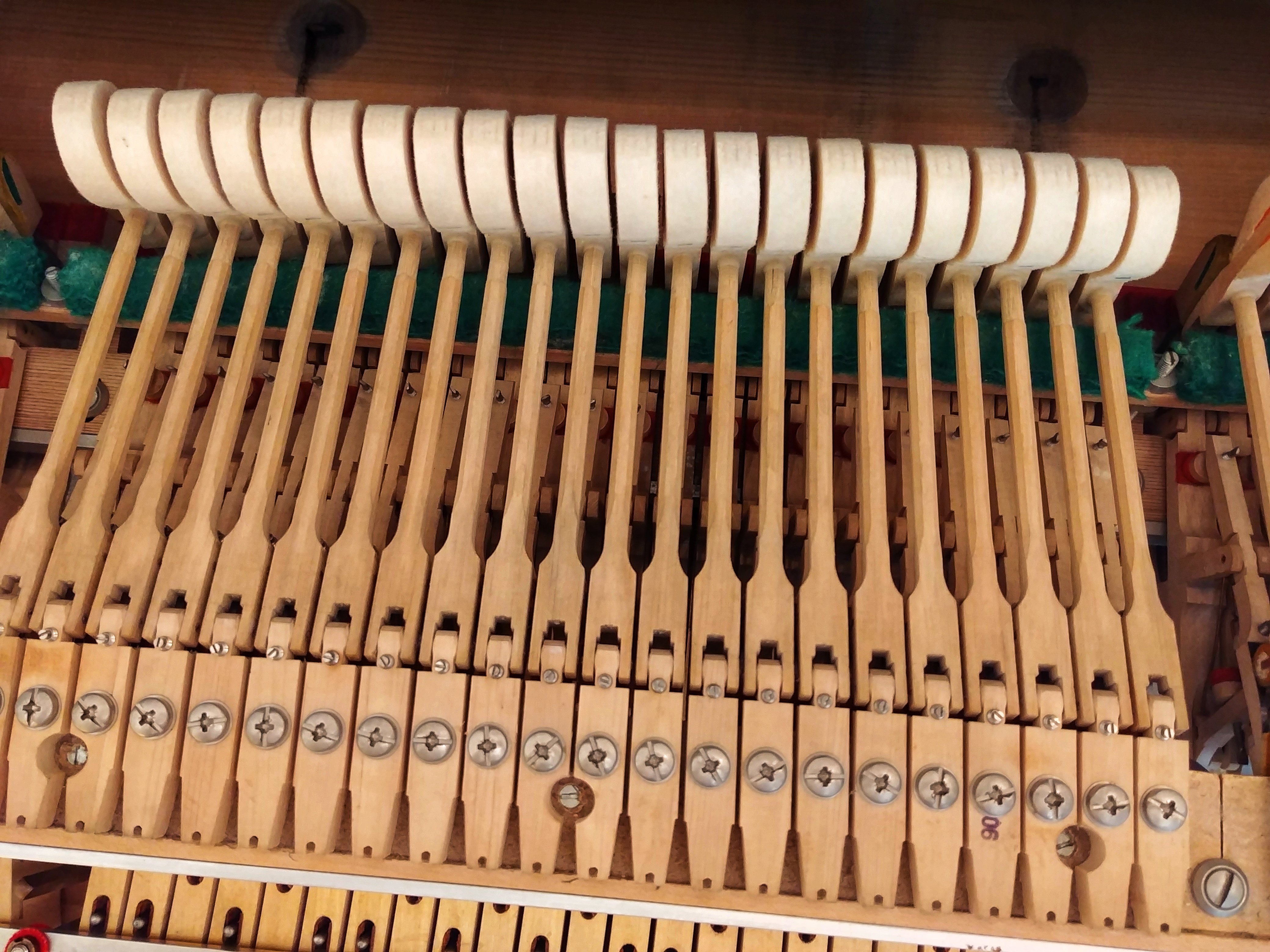
Can the friction between the hammer and the escapement generate such high values?! The heel felts are fine. On some hammers there is still some white powder, I think talcum or micro-teflon, I wouldn't know.
Regarding the action, having purchased the piano as new at the time, I doubt it has undergone any replacements, at least that's what I hope!
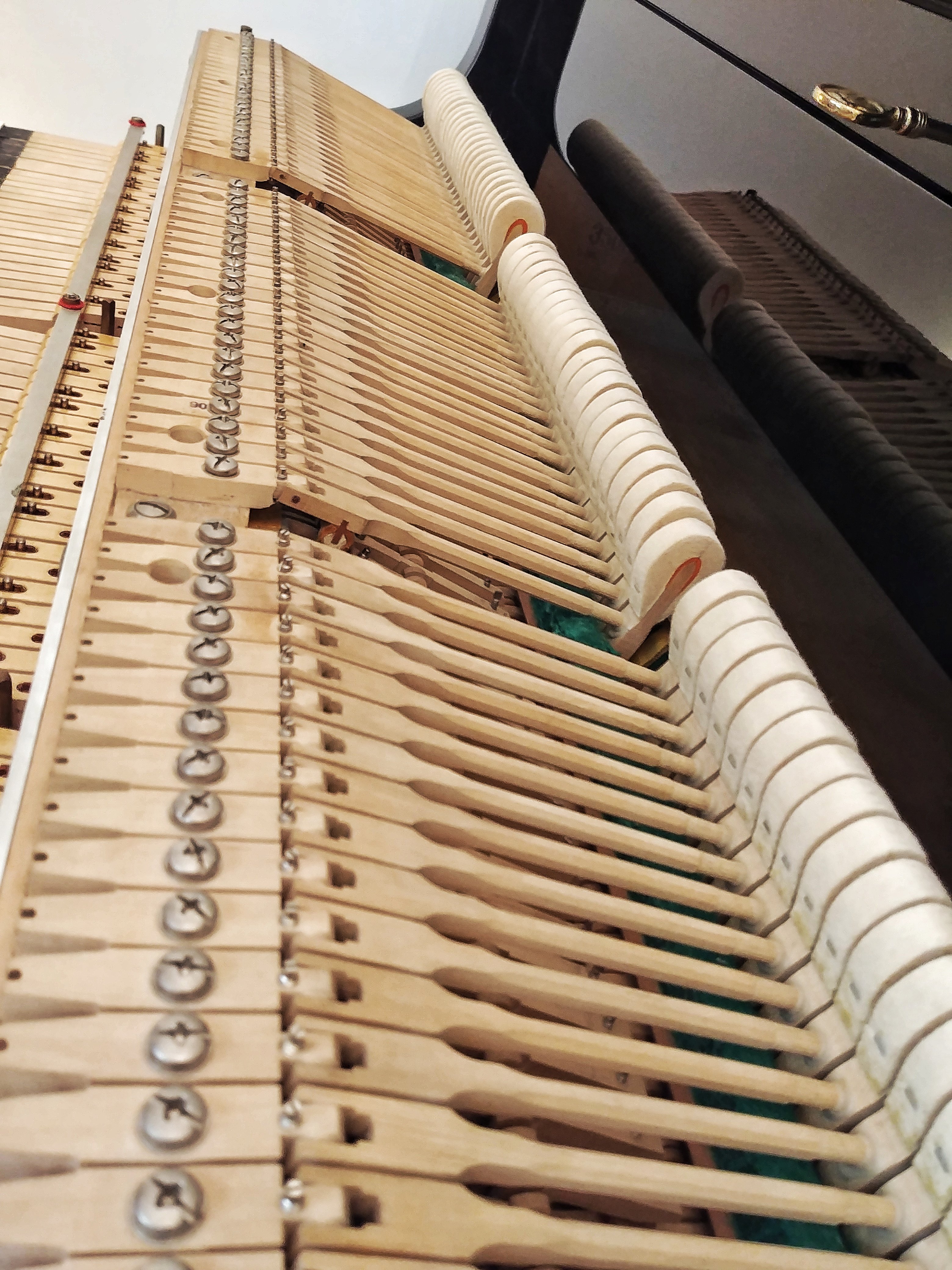
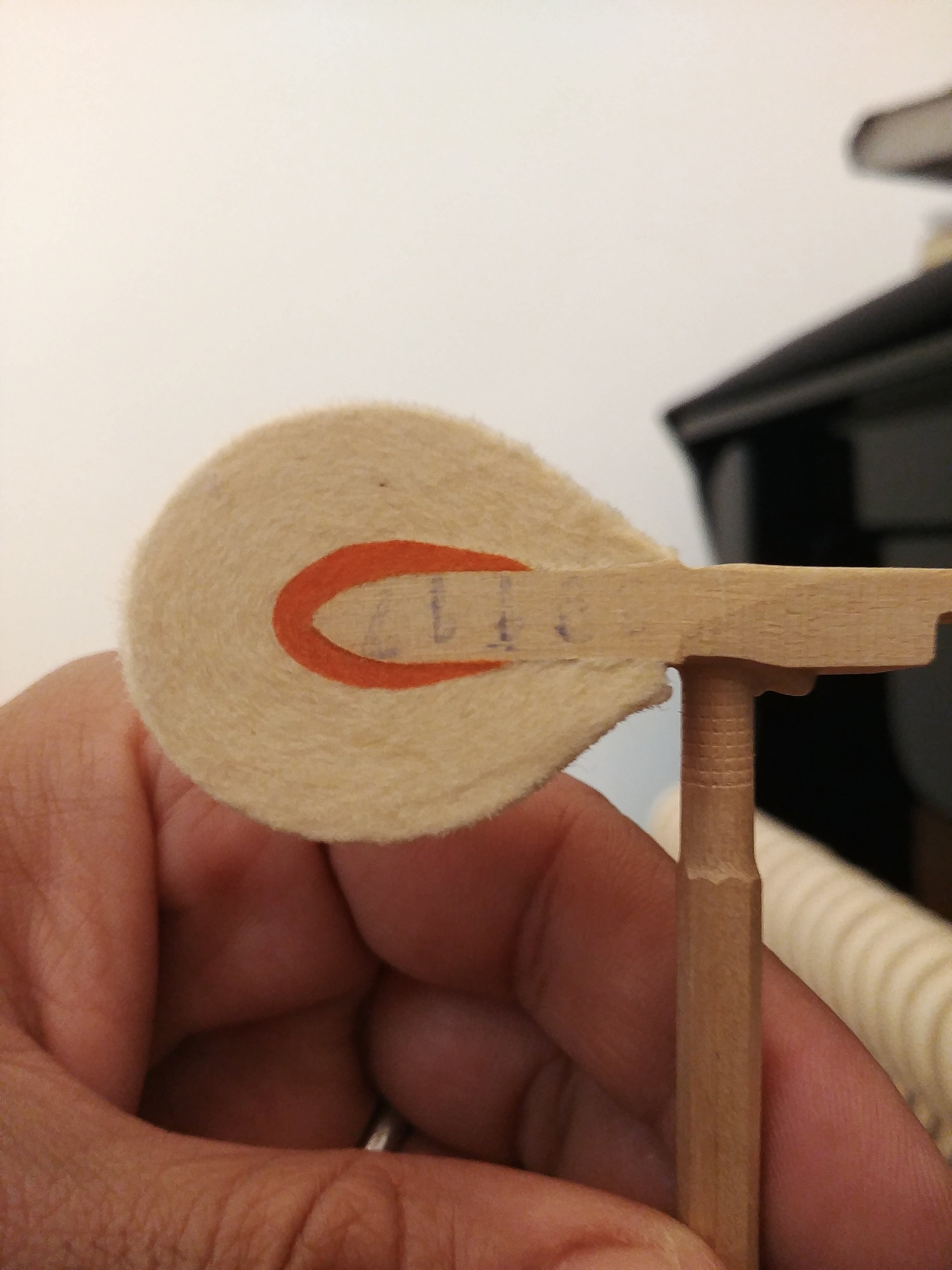
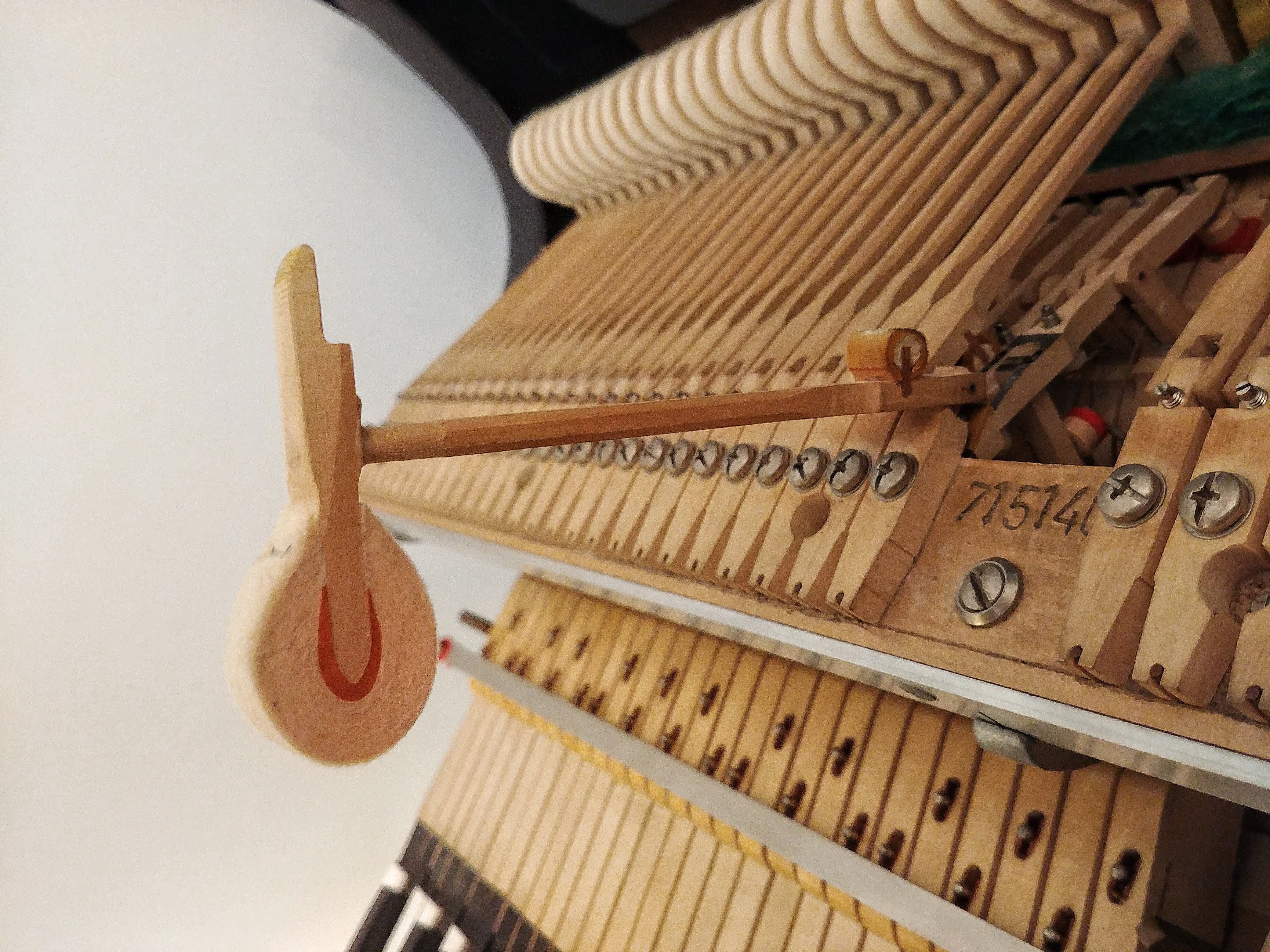
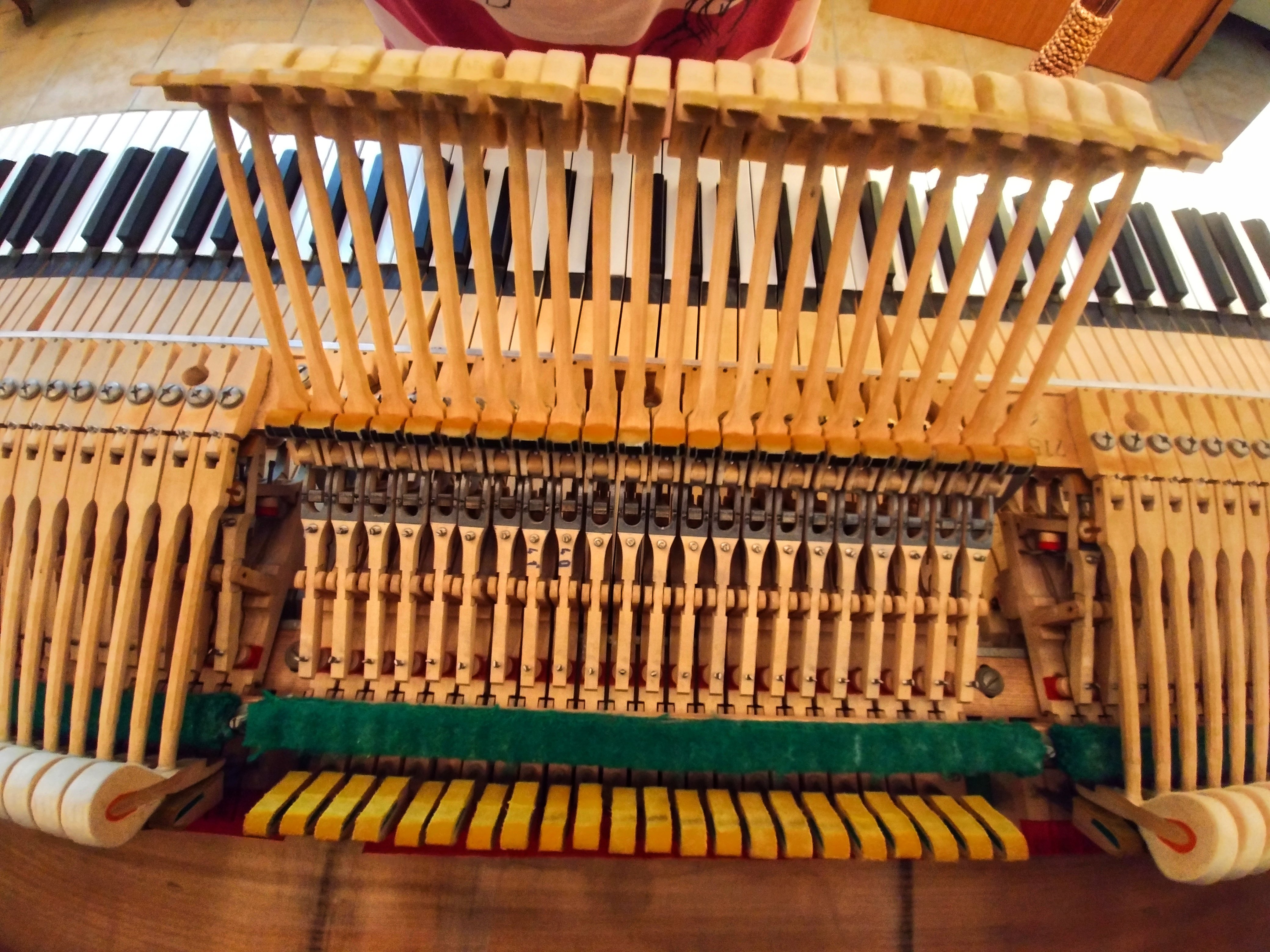
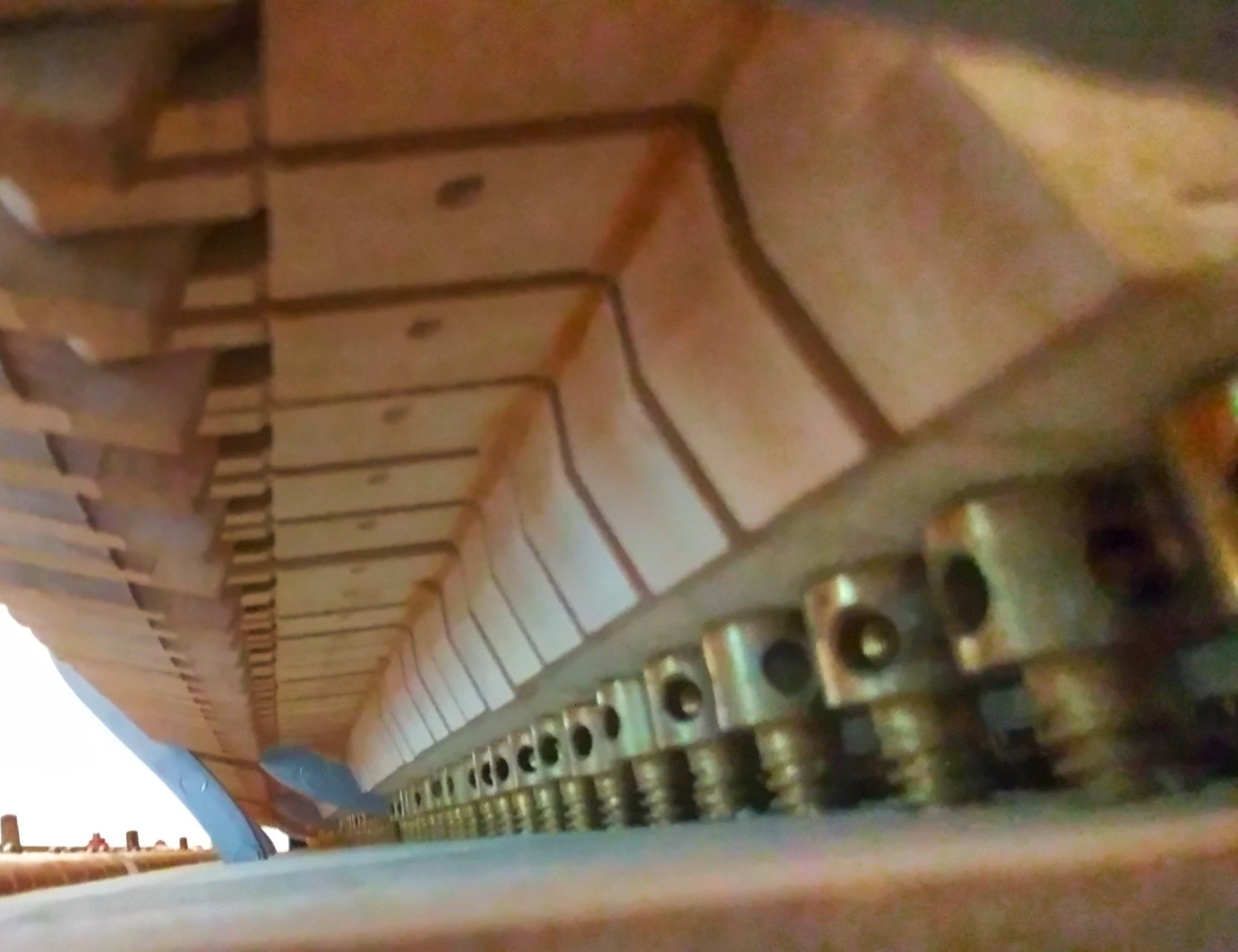
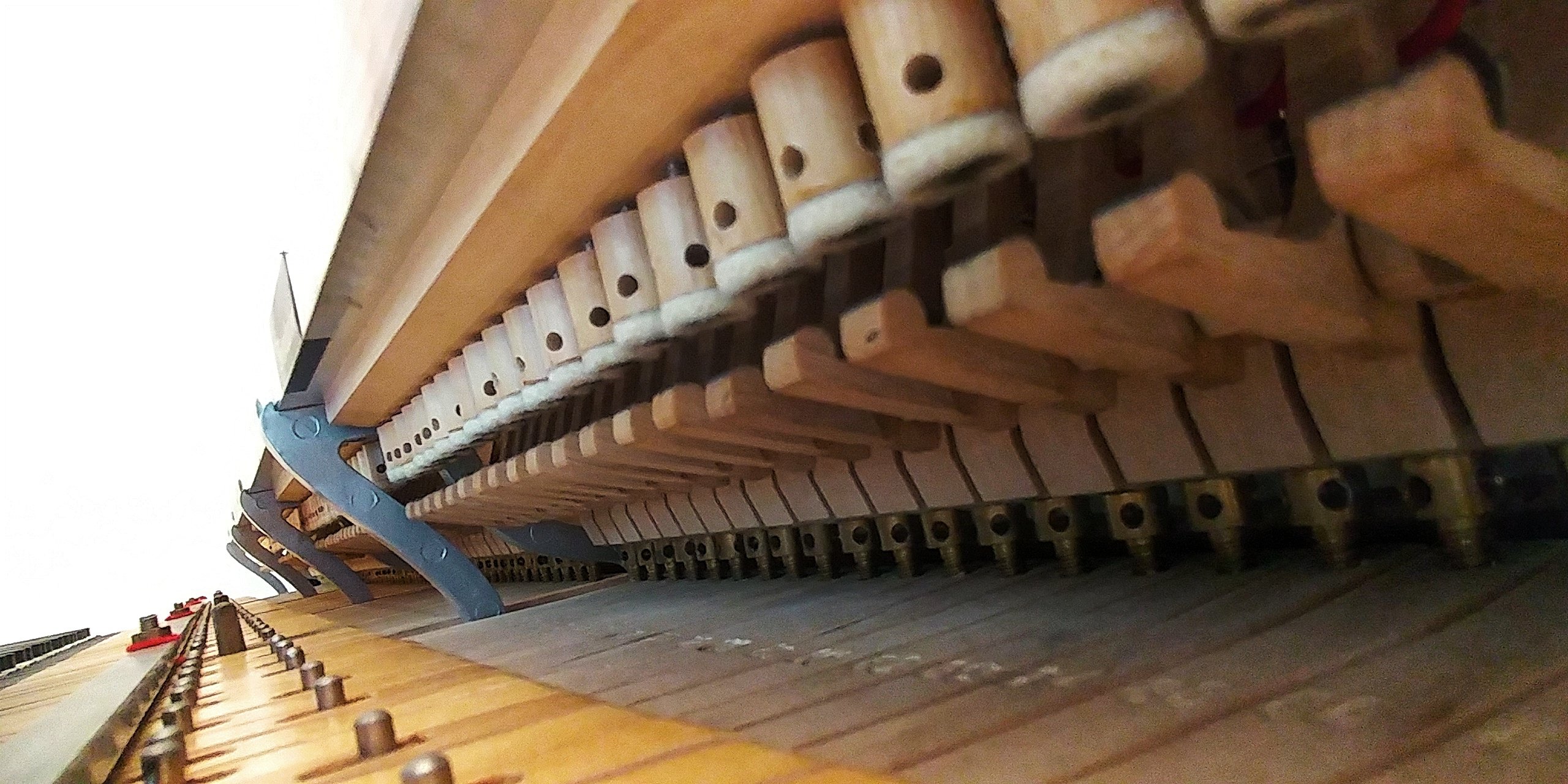
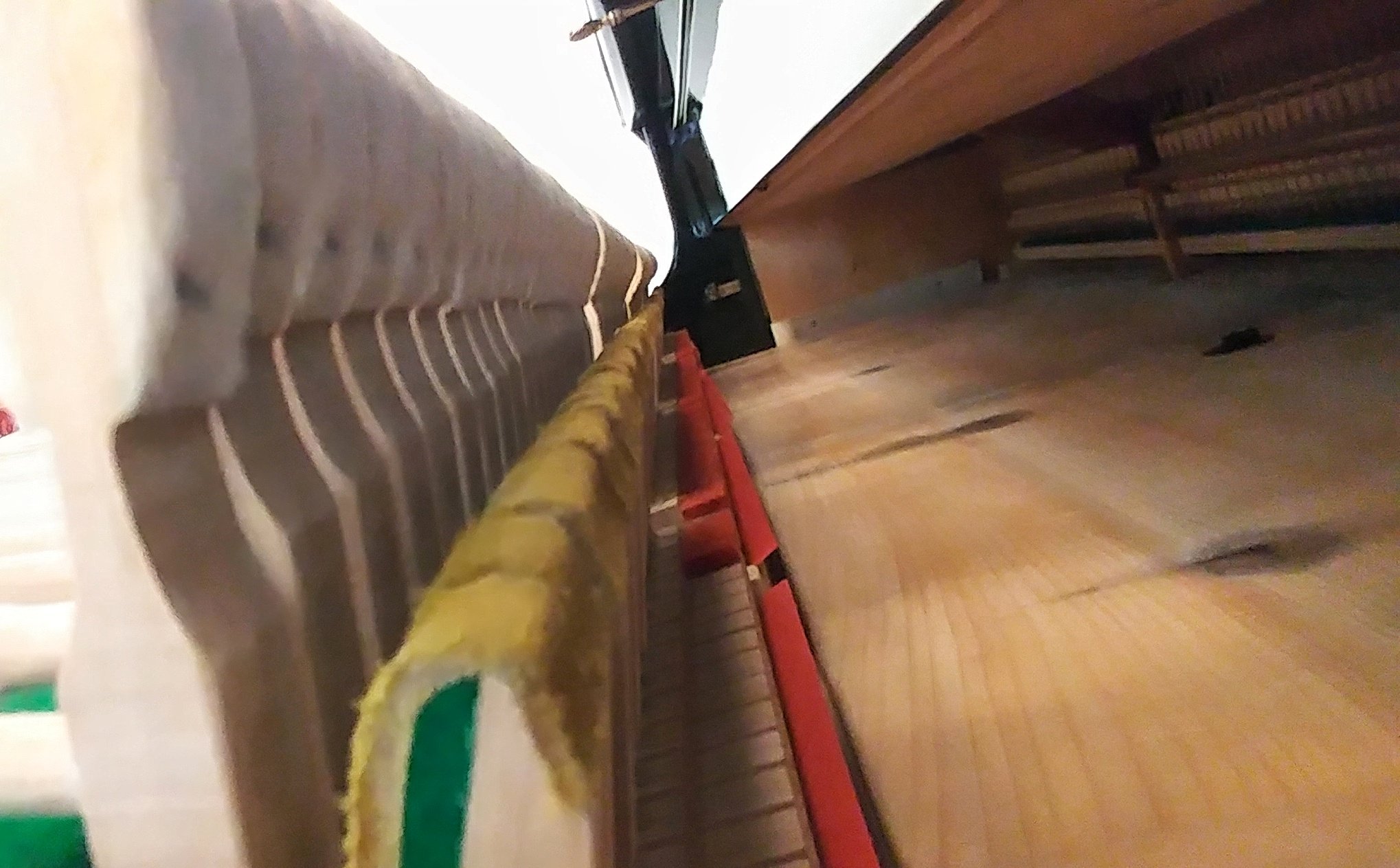
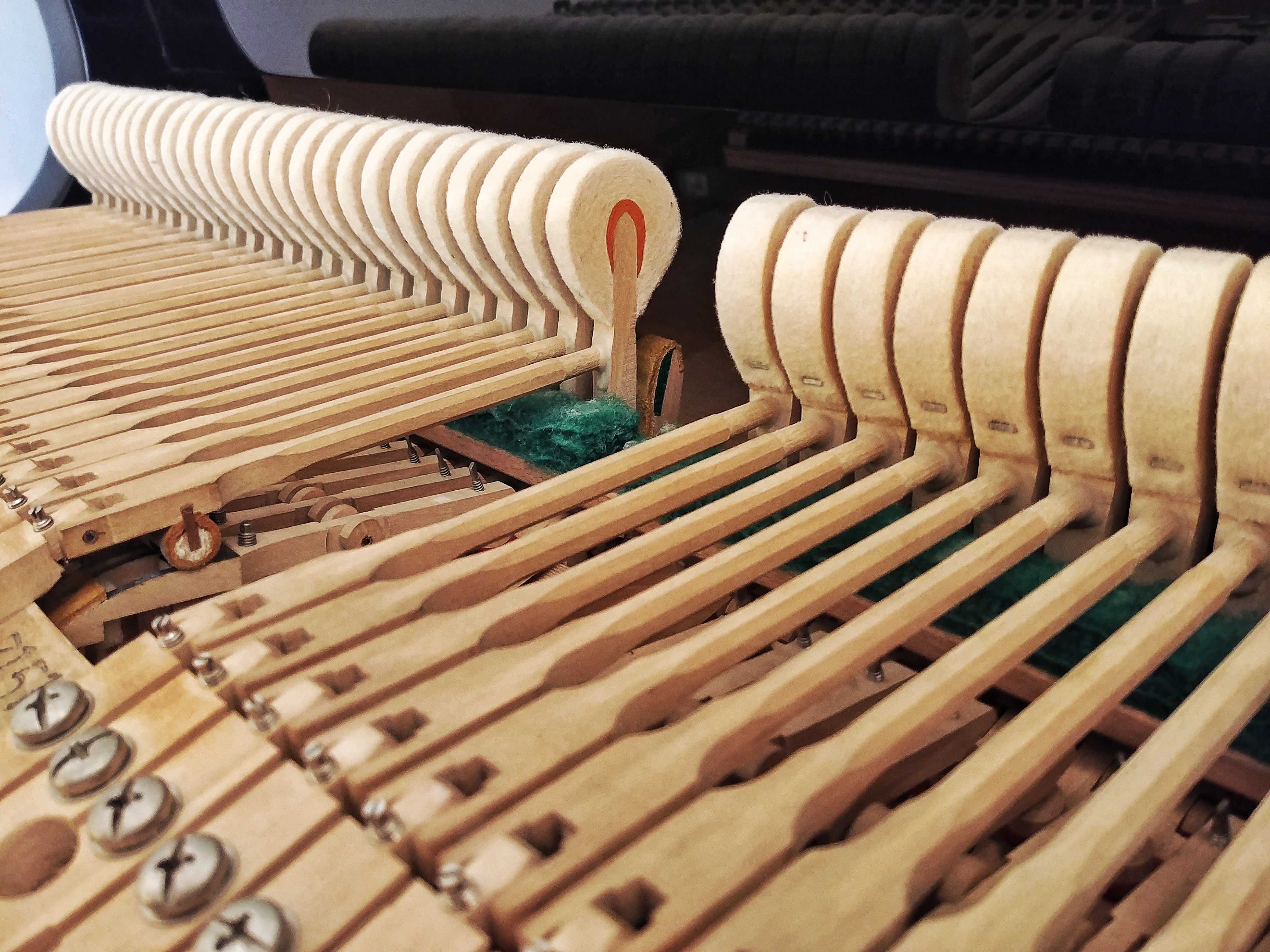
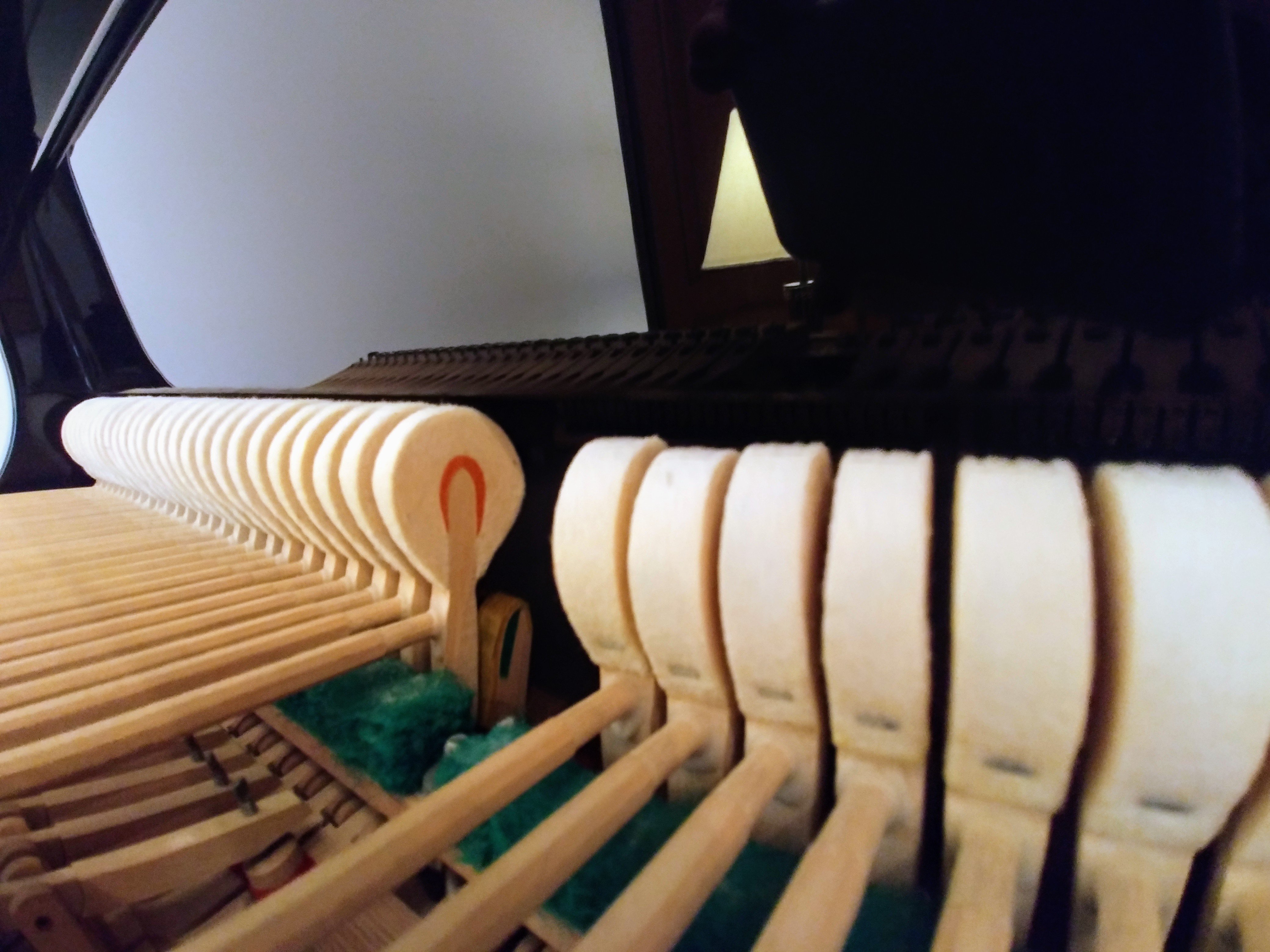
Visually, it looks like a piano in good condition. The only thing I see is that the hammer shank bushing felts are blackened. Could a penetrating oil like Ballistol or other false lubricants have been used in the past? If so, things might get worse after a while. But this is just a hypothesis. The three shanks must be disassembled to check under what weight they fall (friction). Then, re-check the key heels and bushings (front and center), which, if dirty, worn, or falsely lubricated, can cause the key descent to be very discontinuous. Then, check the original regulation and leveling of the keyboard. Cleaning and Teflon on the rollers. Measure again with appropriate weights. The action seems to be original to me.
Then I see the thickness on the key rest felt. This is an emergency procedure, but it distorts the regulation (even if before a concert it can make the keyboard easier to play). In fact, I notice that the alignment of the escapement lever with the wooden core of the roller is very distorted. This inhibits the forte and gives a sense of little power in the key. In short, many things must be checked and in an interdependent manner
The pallet stones must fall gently under the weight of their own screw. The escape wheel arbor must fall on its own after being released by the spring. Replacing the center pivots is an expert task and it is necessary to take the movement away for a few days.