Reading the topic opened by Daniele, a suspicion occurred to me: could Chopin be defined as a pessimist?
Member
Opening post by Marcello
- Posts
- 112
- City
- -
Started by
Member
Member
Reading the topic opened by Daniele, a suspicion occurred to me: could Chopin be defined as a pessimist?
Member
I would say no.
Member
They say he had depression....but it's not certain. There are those who say one thing, and others who say another, but I also agree with Carlos that he was not a pessimist. Isn't a pessimist someone who sees everything as black even when things are going well? Chopin was truly tormented: He was sick with tuberculosis, he understood that he wouldn't live long and always felt close to the grave, far from home, from his family whom he would never see again, and from his homeland; not to mention his love life. The first woman he loved was Constanze (a singer) to whom he could never manage to say anything except run into the middle of the street when she once looked at him, waiting a good 15 minutes to recover from the emotion. The second, Maria, with whom he became engaged hoping for a future, but it went badly with her too because her family eventually gave her in marriage to another and he was so upset that on the bundle of letters they wrote to each other, he wrote "My ruin" over them. The third, George Sand, with whom he was together for 8 years... regarding this, it's better if I say nothing because I cannot stand her because of how she made him suffer....it is enough to know that while he was in agony, Gutmann (one of his students) heard him whisper.... "-she always said that I would die in her arms"....George Sand never went to visit him when he was at the end of his life, nor even to his funeral, and two months after his death she was already living with another....while in Chopin's jacket pocket they found a lock of her hair.....when I think about it, I feel like crying. I say that he was truly unfortunate but not a pessimist. Certainly, he only had music and a few friends who loved him.
Member
I don't know if a parallelism with Leopardi can work
Member
GILDA wrote:They say he had depression....but it is not certain. There are those who say one thing, and others who say another, but I also agree with Carlos that he was not a pessimist. Isn't a pessimist someone who sees everything as black even when things are going well? Chopin was truly tormented: He was sick with tuberculosis, he understood that he would not live long and always felt close to the grave, far from home, from his family whom he would never see again, and from his homeland; not to mention his love life. The first woman he loved was Konstancja (a singer) to whom he could never say anything except run into the middle of the street when she once looked at him, waiting a good 15 minutes to recover from the emotion. The second, Maria, with whom he became engaged hoping for a future, but it went badly with her too because her family eventually gave her in marriage to another, and he was so upset that on the bundle of letters they wrote to each other, he wrote "My ruin" over them. The third, George Sand, with whom he was together for 8 years... regarding this, it is better if I say nothing because I cannot stand her because of how she made him suffer.... it is enough to know that while he was in agony, Gutmann (one of his students) heard him whisper.... "-she always said that I would die in her arms".... George Sand never went to visit him when he was at the end of his life, nor even to his funeral, and two months after his death she was already living with another.... while in Chopin's jacket pocket they found a lock of her hair..... when I think about it, I feel like crying. I say that he was truly unfortunate but not a pessimist. Certainly, he only had music and a few friends who loved him.
Genius is automatically an artist, because they transform even the simplest thing into a miracle of nature. Chopin had this gift. Unfortunately, people of this stature have a soul and an intelligence that make them live in a world different from ours, and it is difficult to understand them. Look even today, at the envy there is toward those whom we recognize in our hearts to be above our own potential... Instead of drawing close to them to extract as much as possible from these minds, we push them away because we feel attacked; we cannot understand, and Chopin's case, all the more so, pushes in this direction. I am not here to justify George Sand, but certainly Chopin had a very pure soul and a genius of incredible height. It is difficult for us mere mortals to manage to grasp and understand these supernatural beings deeply...
Member
.....it's true Lory, what you said. Chopin was a particular person. He was not only a musical genius and therefore an artist, but also a beautiful person in every respect. Everyone who knew him left wonderful things written about him. He had a kind, refined, polite, sensitive soul.....so sensitive. They say that his kindness was exaggerated, he never reacted to wrongs suffered, always remaining composed and reserved even while suffering internally. His music is nothing other than the expression of his person. And it's also true about envy.....there was envy back then too, and towards Chopin as well......
Member
GILDA wrote:his kindness was exaggerated, he never reacted to the wrongs suffered, always remaining composed and reserved even while suffering internally.
... and it was Chopin
Member
GILDA wrote:... George Sand, with whom he was together for 8 years... regarding her, it is better if I say nothing because I cannot stand her due to how she made him suffer.... it is enough to know that while he was in agony, Gutmann (one of his students) heard him whisper ...." -she always said that I would die in her arms "....George Sand never went to visit him when he was at the end of his life, nor even to his funeral, and two months after his death she was already living with someone else.... while in Chopin's jacket pocket they found a lock of her hair .....when I think about it, I feel like crying....
In reality, Sand was an extraordinary personality. Non-conformist, "feminist", politically engaged, involved in art... A prolific writer, a woman with a thousand lovers and numerous husbands... difficult for the bourgeois society of the time to digest... hence the slanders (lesbian, tyrant....) that are still passed down today.
I also don't think Chopin was so unlucky... he shouldn't have had much trouble finding women, if he had wanted to, given the success of his music especially among the fairer sex... and nor from an economic point of view did he have to be doing so badly (extravagances, real or alleged, aside)... I believe that both were deeply attracted to each other. They were two artists, both extraordinary (hence also the slanders and clichés about their history)... And Sand too, at least in her writings, reports moments of absolute affection and care.
If you find it, read "A Winter in Majorca", a beautiful novel-diary which, besides criticizing the Majorcans, tells of the stay spent on the Spanish island with Frederich and their two young children... the birth of the preludes, the illness, the moments of crisis, the rainbows, and the cloister of the Valdemossa convent that filled with poetry when music was played... unfortunately I haven't found the book, but some time ago I heard the reading of some excerpts on Swiss radio.
Member
Hi Pestatasi....but yes, but yes, but yes, you are right about many things....yes, it's true...George Sand was a particular woman with a marked nonconformist character trait....an artist...nothing to say about her profession as a writer. In the beginning she might have loved him...but then? Feelings are another thing. Love is "one" and that's it...it's not like we have to start a revolution on this too, it seems to me. Playing with other people's feelings, not caring about the wounds we can cause a partner just because we feel entitled to follow our every whim at the expense of the pain we cause is always wrong, in any era....each of us in love needs to feel important and Chopin also felt this need. The great harm that George Sand did to Chopin can be read in his letters to his family and to some of his friends after their breakup. Sand was cheating on him; in the end, she ignored him. After she grew tired of him, she threw him away like a little object....as she also did with others...Two months after his death, she was already living with someone else... she never went to visit him during his illness....nor even to his funeral. And yet at the beginning, he didn't like her at all; in fact, after they were introduced, he said to a friend with his usual irony: "-are we sure she is a woman?...". But when she saw him, she fell in love immediately and did everything to win him over....imagine that one day in a salon where he was present, she appeared dressed in the colors of Poland (red and white); he noticed it, but it didn't work because Chopin hated everything that was ostentatiously extravagant. It took a year to make Chopin surrender....in the end, she succeeded. I had a certain impression regarding the two of them....they were so different from one another that it is truly strange they could continue this relationship. She hated the Church; Chopin, despite not practicing, nonetheless came from a believing family and respected faith and believed in God. In salons, when she spoke ill of religion, he would leave because he couldn't stand it. Regarding love too, Sand was a libertine, convinced that all the desires her instinct felt were right and that one should never repress what nature desires......Chopin did not agree and they often found themselves discussing and arguing about this. She would give hallucinating examples like: if I desire to betray you, in reality I have already done so in my heart, and therefore I see no reason why I shouldn't put it into practice. But this is absurd; you cannot reason like that because while it is true that I have betrayed you already in my heart with the thought, it is also true that the honesty and respect I have for you must push me not to betray you, or at least to be loyal and sincere in breaking up a relationship that is already over. Not doing so is making fun of the other person. These sharp differences between him and her came to light very soon and the relationship ended.....but it ended in a stupid way, with a pretext to eliminate him from her life because Chopin unfortunately loved her...he loved her because he had a noble heart, a pure heart, a heart capable of attaching itself to another to the very end with that fidelity that true love requires, something she, on the other hand, did not have. According to Liszt, it was precisely this "incapacity" of George Sand that unleashed in her the desire to conquer Chopin, because she saw in him what she could not be; a clear and limpid mirror in which, once she had possessed him, she could, through reflected love, make her own the purity, loyalty, love, nobility, fidelity, sincerity, along with passion and pain.... all virtues that she did not have and that she saw in him and in his music.... . No....I don't like a woman like that.

Member
Gilda... if only love were just "one" thing and that's it, you know how many problems, depressions, harm to others and to ourselves... we could spare ourselves.
The reality - unfortunately - is very different!
While I was reading this latest piece of yours, I was thinking about how many times it becomes difficult for you - and often incorrectly - to judge - but is it right to judge people in their romantic behaviors? - people beside us whom we think we know everything or almost everything about.
But if it is difficult, - and wrong - fallacious to judge those we know - or think we know well - it is thousands of times more so to do so toward people who lived a long time ago, in other historical contexts and about whom we only know reported or biased things and who, regardless, can no longer defend themselves.
What do we know about what truly happened between Chopin and Sand, if not what someone witnessed or biased versions? Would you be willing to put your hand on the fire that Chopin did not do something unforgivable or that, in any case, appeared so in Sand's eyes?
Being an emancipated woman is difficult even today; think how it would have been in the times of Chopin and Sand. Think about how Sand might have lived within her own psyche and skin, the enormous contradiction of her need to be a free woman and having to live in a world where female freedom wasn't even understood.
I am not here to defend Sand, but I note, in your discourse, unfortunately how true it is what is often said, namely that all too frequently the worst enemies of women are women themselves.
Forgive me for this frankness of mine which is nonetheless steeped in great esteem for you!
Member
Hi Daniele, I respect your point of view....but I do not agree with you. What I wrote about Chopin and the relationship he had with Sand is not my judgment or my opinion, but Chopin's own point of view regarding his relationship with her, which you can all acknowledge by reading the letters he wrote to his closest family and friends after their breakup. It is based on what he said, complaining to his loved ones, that led me to write the above....then obviously, based on historical critics and knowledge of George Sand's character, I drew my conclusions, feeling free to choose to be more inclined to believe what Chopin said compared to what Sand wrote. So you are very wrong to consider me an enemy of a woman who is actually completely indifferent to me. You should take it up with Chopin and not with me regarding the matter of Sand. Even historically, there were those who were on Chopin's side and those for Sand. I believe him more..... forgive me if I feel more on Fryderyk's side.
Member
No, Gilda, here it is not a matter of forgiving or not! You, rightly so, are taking the side of those you believe are better; it is the tone with which you address Sand that leaves me a bit perplexed.
You say that this is what Chopin said and therefore it is "biased" as I have already said. It would be interesting to know what Sand would have said in this regard and how much the two of them—because believe me, it is almost always so—never said! Anyway, I repeat: beyond real or presumed motivations, there is also little to be done here; when a love ends, it ends. That is how it was for everyone and that is how it will always be.
I remain of the opinion that it is not up to us to judge the feelings of others. We are all human beings, after all, right?
Member
I share what Daniele observes. For goodness' sake, a romanticized reading of the sentimental affairs of a great artist of the past, perhaps built on the emotions evoked by his works, is not unacceptable in itself. There should also be at least a couple of films about the Chopin-Sand story that (I haven't seen them but I presume) follow this type of approach.
I believe, however, that if one wants to have a correct idea of the biography, it is more right to maintain the detachment characteristic of a "historical" approach.
Sand, perhaps precisely because of her free personality, must have been very sought after (even judging by her many male "victims"; if we reason this way, we should say that Chopin was neither the first nor the worst "victim"...). I think therefore that having made such a woman fall in love with him, and having lived a decade-long story with her, proves that Chopin was equally sought after...
I confess I haven't read the letters in which Chopin speaks of Sand (I will get to it) which anyway, from what I can see, should date back to after their breakup, and therefore should be read with the awareness that the judgments contained therein are affected by the suffering or resentment regarding the end of a relationship.
However, I repeat that Sand's writings are not at all disrespectful nor lacking in affection for the figure of Chopin:
"Chopin's genius is the deepest and most intense in feelings and emotions that has ever existed. He made a single instrument speak: the language of the infinite. He often succeeded in summarizing in ten lines that even a child could play, poems of immense spirituality, dramas of unparalleled energy. He never needed great material means to convey the word of his genius; he needed neither saxophones nor ophicleides to invade the soul with terror, nor church organs, nor human voices to fill it with faith and enthusiasm" (G. Sand "Stories of my life").
I also attach this link where excerpts of the work I cited can be read:
Member
Errata corrige:
listening again to the radio reading at the link I indicated, I realized that my reference to the story of the stay in Majorca was contained precisely in "Stories of my life" and not in "A winter in Majorca".
There you can also find (min. 8:50) Sand's famous account of the composition of the so-called "water drop" prelude (if I am not mistaken, it is also remembered by the reviewer of a Curci edition of the preludes).
I am very sorry, but my mind sometimes makes strange overlaps...
Member
I return to reiterate that what I have written is not biased, it is not my opinion nor a romanticized reading, but testimonies from those who were present, saw, and lived alongside Chopin and decided to leave for history careful information about Chopin's life. Whether it be Rattalino, Bellotti, Tomaszewski, Liszt, Chopin's letters, the letters of friends, family, etc., they clearly outline the figures of Sand and Chopin. If it seems to you, Daniele, that I have been harsh in speaking about George Sand, I can guarantee you that mine is gold compared to what Franz Liszt left written about her in his book on Chopin's life. If you do not believe me, you are completely free to do so. Instead, I invite you to read Liszt's book on Chopin's life, as well as the letters and even those of his closest friends, who were present throughout his journey. It is absolutely not a novel but a careful chronicle by someone who lived alongside this most famous artist and was also present during the relationship with Sand; in fact, Liszt was bound to both of them by friendship. Then everyone can continue to believe whatever they want, it's just that history cannot be changed or invented simply because one person finds one guy more likable than another, or deny injustices and wrongs that truly occurred and are even historically documented under the pretext of unfair judgment... it is instead unfair to justify injustice when it exists, because it does not do justice to what was harmed. It is wanting to deny history as it truly happened despite the evidence and testimonies. As far as Chopin's letters are concerned, they are not "poisonous" letters against Sand as Pestatasti believes, because Chopin had a good, patient, and mild nature and never, ever, ever was he heard being venomous toward anyone... but they nonetheless convey an entire series of sufferings. To have a careful historical evaluation (on everything, obviously) we must not stop at documenting ourselves through only one source, because this makes one seem truly biased, but rather read the diaries, the writings left behind, consult the writings even of those who knew the character, listen to and read literary critical works by those who knew him and were present during the events. These manuscripts and texts are pure gold for those who want to deepen their understanding and know the personality of an artist, and we must thank these people who have left us these treasures that help us understand Fryderyk deeply. And now I close this discussion because everyone is free to think as they wish; after all, things as they actually happened cannot be changed.
Member
Greetings to all of you.
I am a passionate fan of Chopin's life as well as his music....in my opinion, music of the soul.
It is certainly pleasant to see with how much passion Gilda defends Chopin against Sand, who surely had questionable behavior towards Fryderyk.
It is a pleasure reading you.
Anto
Member
Gilda, it wouldn't be bad if you shared some letters, as you did with the diary
Member
Hi Adema 1 and Ludovica, it's true, I love Chopin very much, but I can assure you that I am not trying to defend him unjustly. As soon as I encountered this musician, I immediately loved his music and thus became curious to know about his life, perhaps in the hope of finding confirmation of such high talent. Listening to his music, it seemed impossible to me that pieces of such sublime beauty could be written without being endowed with a great soul and a great sense of ethics and morality (as I believe you understood too, Adema 1). And indeed, I began to research extensively and discovered a personality of indescribable beauty. I also received confirmation that many of his pieces were written in a burst of inspiration, confirming that he very often used the piano to vent and express through it his feelings, his being, and all his pain. And it was precisely this so beautiful, so high soul that made George Sand fall in love, and who knows how many other women... Look, I don't have a grudge against her; I would be a fool, and besides, he loved her very much. So we must respect her. The most beautiful and sublime pieces were written precisely during their relationship. However, reading around, it emerged sometimes quite blatantly (like Liszt) and other times a bit more veiledly but still understandable, that Sand did not exit this story in a completely innocent manner... no one can know the intimate details and they shouldn't even interest us, but we know with historical and documented certainty that the breakup occurred due to an unjust accusation by Sand against Chopin for family reasons (documented by letters from both Sand and Chopin). We are even aware of a venomous letter she wrote him that reduced Chopin to a wreck, to the point where he ran to his friend Delacroix to vent, who read it. The atrocity and malice of this letter is confirmed by Delacroix himself, who in his diary cites it as an atrocious letter full of malice in which Sand was raving. Sand's raving also contributed to the abandonment by some of her friends, who stopped frequenting her salon, scandalized by the unjust behavior towards Chopin, who, however, was always extremely respectful toward her and even responded to that letter with a gallantry and exquisite politeness that would make the greatest gentleman ashamed. The reasons for the separation from Chopin seemed more like a pretext to get rid of him, since there were misunderstandings that were never clarified, nor did George seem to want to clarify them. George gave her daughter Solange in marriage to a certain sculptor, Clesinger, whom Chopin disliked because he was considered not a very recommendable person. Chopin advised George not to do it and to oppose it, but she would not listen... and okay, fine. Chopin surrendered and eventually accepted as well. But over time, the two newlyweds quarreled with George Sand bitterly because they showed up at Nohant (Sand's residence) demanding a share of the inheritance for Solange, as the two were broke and needed money. George opposed this, a deadly quarrel broke out, so much so that Maurice (George Sand's son) took a pistol and threatened to kill Clesinger and fortunately was stopped. Clesinger, for his part, landed a punch in George Sand's stomach, and an infuriated George drove them away from her house, ordering them never to return. Chopin's advice proved true, but he was not present at the events as he was in Paris at that time and was therefore unaware of everything. Solange, having been refused by her mother, wrote to Chopin asking him to lend her his carriage because she didn't know how to get home (without telling him anything about the quarrel), and since he saw no reason to prevent giving her his carriage, he lent it to her. When George Sand found out that Chopin had done this favor for Solange, she flew into a rage, accusing Fryderyk of being against her and not being supportive... in vain he tried to explain to her that he was not aware of the quarrels and therefore could not have known that he should not help Solange, whom he obviously loved as she was her daughter and he had seen her grow up. All in vain. Chopin did not take a step after that last venomous letter from George Sand because it seems she wrote that to her he had always been considered just a friend and nothing more, and that their friendship had ended.
Member
Marcello wrote:Can Chopin be defined as a pessimist?
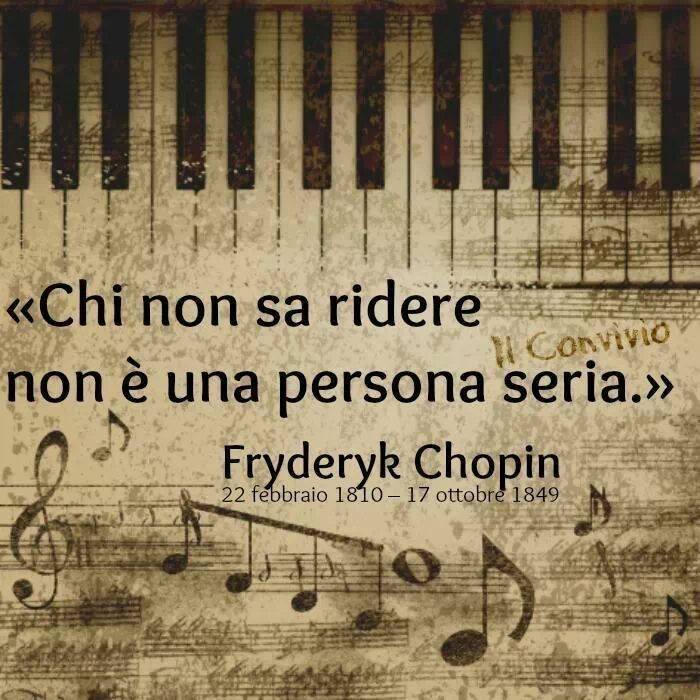
Aside from the very rich interventions, I would like to report this quote:
"He who never laughs is not a serious person." F. F. Chopin
He contemplates "laughing" in his imagery; I don't know if this is not indicative of pessimism
Member
Ray1 wrote:"He who never laughs is not a serious person." F. F. Chopin