

Member
Reply 21 by Viola
- Posts
- 191
Started by
Kappa
Member
Member
Member
...


Member
I am "a bit" in agreement with Celibidache (I mean Celibidache.... Herr Direktor)
Biography as an aid to understanding music is a great temptation.
In part, knowing the composer's life during the specific period of a composition is interesting.
But...
music - the musical work - is always something "more", a bit "beyond", or "below", the twists and turns and messes of life.
The composed and finished musical work (but also every poem and every work of any art) is that product where the best of its creator resides.
This "the best" is not, however, falsehood or a lie just because the artist has their human, psychological, social, behavioral flaws (alcoholism, avarice, misogyny, asociality, opportunism...)
In my view, this strange dynamic is the miracle of Art: good water coming from an impure spring.
[ personally I also see it as an encouragement... as if to say: even if you are not the best person, you will manage to achieve something good ]
Member
From some passages known here and there, this point of view on potential behavioral disorders or the bad habits of authors.
In practice, it is as if being asocial, misanthropic, or depressed and alcoholic, or spitting everywhere one finds oneself, could make a person "impure."
I understand that here in our country, in Italy, starting from developmental age, the knowledge of one's own person and one's own being is the new taboo, the new thing to hide and to ridicule on occasion (as sex once was), but I believe that levels and meanings of being are being seriously confused without managing to grasp the profound sense of events.
Member
Celibidache wrote:In practice, it is as if being asocial, misanthropic, or depressed and alcoholic, or spitting everywhere one goes, can make a person "impure."
How much beauty, sensitivity, and honesty in your words, dear Celibidache.
So it was for Van Gogh, for Tesla, for Bruckner, just to mention a few examples.
Member
Celibidache wrote:From some passages noted here and there, this point of view regarding potential behavioral disorders or the bad habits of authors.
In practice, it is as if being asocial, misanthropic, or depressed and alcoholic, or spitting everywhere one finds oneself, could make a person "impure."
I understand that here in our country, in Italy, starting from developmental age, the knowledge of one's own person and one's own being is the new taboo, the new thing to hide and to ridicule on occasion (as sex once was), but I believe that levels and meanings of being are being gravely confused without managing to grasp the profound sense of events.
"In practice it is as if..."
In practice yes, and in practice no.
In practice yes because being asocial, misanthropic, etc... are certainly not things that do good (they do not do good - first of all - to the person directly concerned).
In practice no because having these human flaws does not entail any scolding or moralizing judgment (at least on my part).
Regarding the "here in our country, in Italy," I do not know which places or which target group of people (acquaintances or friends) you are referring to in order to formulate this evaluation. But if, even in the slightest degree, you said this in reference to my intervention... In that case, exclude the undersigned from "here in our country, in Italy."
Know that I have the utmost consideration for the human sciences: psychological first and social subsequently. And - for me as well - attempting to know myself deeply without trying to hide anything (as much as possible) does not constitute any taboo.
Finally, I ask you (when you have time) to clarify better what you mean by saying that you believe "levels and meanings of being are being gravely confused without managing to grasp the profound sense of events" . . . I didn't understand a damn thing.
Member
This is the point.
Psychological, behavioral, social, and philosophical sciences can be respected as much as we want, but it is completely useless if what has been studied and achieved in these fields remains stuck on the pages.
Knowledge must be consumed and used.
Member
No, that is not the point.
I agree that «Psychological, behavioral, social and philosophical sciences can be respected as long as we want, but it is completely useless if what has been studied and achieved in these fields remains stuck on the pages. And I also agree that «Knowledge must be consumed and used» (I assure you that mine is not a "superficial" respect).
What I was asking you to clarify was the last point. My request is still there... perhaps by spending a few more words, and perhaps not immediately if you don't have time.
Member
Of course, time is what it is and one does what is possible... sometimes misunderstanding arises from the impossibility of exhausting "big things" in two words.
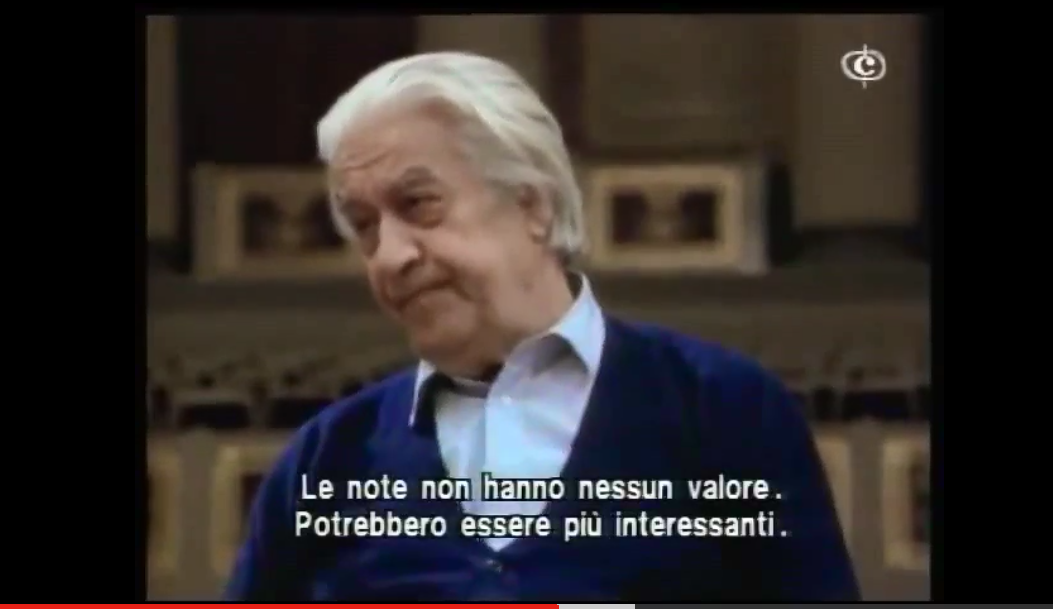
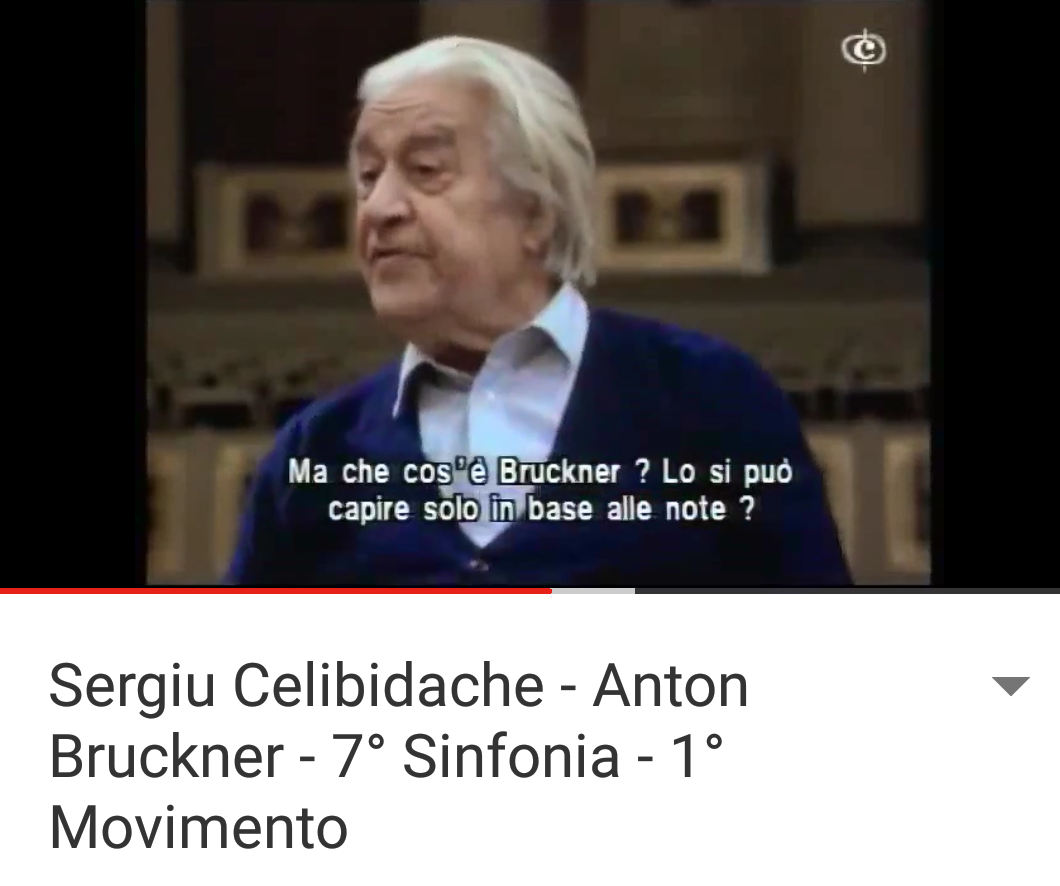
In essence, what I wanted to say can be deduced, for example, from the rehearsal video posted by Viola:
an orchestra without a conductor would create pure cacophony and would lose its way every two bars, even while knowing the score in question by heart for years, even being the best of the moment, even with a great Central European tradition behind them.
It is necessary for someone with clear ideas to arrive to restore the physiology and psychology of a hundred highly prepared musicians.
This should provoke more reflection than purely musical interpretative choices.
Regarding body language, those rehearsals would suffice for a psychoanalysis essay.
Member
Ah ok.
But it seemed obvious to me that an orchestra needs a conductor to have a unified interpretive vision (whatever that may be).
If they are also a good conductor, all the better.
Behind «planes and meanings of being» I thought there were who knows what difficult concepts hidden.... thanks.

Moderator
a few days ago I tried with Muti who maintained the opposite, namely that a well-prepared orchestra does not need a conductor.
Besides, music history brought about the figure of the "pure" conductor very late and even now many repertoires still prefer not to use one.
But I limit myself to expressing my views on this single subject; I have never been passionate about the figure of Sergiu Celibidache nor his aesthetic theories.
Member
With Riccardo Muti, one cannot even manage the opening bars of Beethoven's Ninth, with a world-class orchestra,
without there being problems that are, to say the least, embarrassing in every respect.
Problems that are not noticeable by my cleaning lady, obviously.
Moderator
How much beauty and sensitivity and honesty in your words, dear Celibidache (cit.)
Member
Do we absolutely have to like or approve of something that we find sincerely and honestly poorly made and inappropriate?
Member
thallo wrote:Besides, the history of music has brought about the figure of the "pure" conductor very late, and even now many repertoires prefer not to make use of one.
And that is also true.
But many repertoires that prefer not to make use of one... which ones are they?
Aparte this, although it is someone like Muti who maintains it, I find it very difficult to believe that a coherent interpretation (of a single interpretive vision) can arise without it being that of just one person.... If only it were also that of the first violin saying "this time we do as I say!"
Member
And even the "unique interpretive visions" are subject to the most diverse degrees of integrity and quality, as is the orchestra itself.
Moderator
To Celibidache: you wrote what you wanted to write, you were free to do so in the excessive and arrogant terms that I do not like, and I made my opinion on your judgment clear. As I have written elsewhere, I respected your freedom of opinion but not your opinion, which I consider needlessly contemptuous.
To Luca: small chamber groups do not use a conductor, also because the "direction" of their music is given by the result of the interaction. Therefore, it is the interaction that is developed. The same thing happens in many choral groups and ensembles specializing in early music. Sharpen your hearing by trying to understand and do what is right for everyone. I played for years in a marching band and, like many other pop, rock, and folk formations, bands have a very important rhythm section that resolves the problems of rhythmic stability and leaves the rest to soloistic or sectional dynamics. Identifying a single person responsible for a group's musical interpretation is typical of a certain repertoire, a certain period, a certain geographical area, or a certain aesthetic need

Member
LucaCavaliere wrote:In my view, this strange dynamic is the miracle of Art: good water coming from an impure source.
I was wondering: can a writer - let's say - make a character think something more intelligent than they themselves would be capable of thinking? Can a character be more evil or more good than their creator could ever be?
Of course, music is something else ... but ...
Member
We must close all philosophy faculties and burn their productions: they are uselessly contemptuous, arrogant, and undeserving of respect.
Member
thallo wrote:How much beauty and sensitivity and honesty in your words, dear Celibidache (cit.)
I would add MIRABILE quotation.

