Jakob Ludwig Felix Mendelssohn Bartholdy was certainly the greatest musician of all time, with an innate talent that no one has ever been able to boast, not even Mozart.
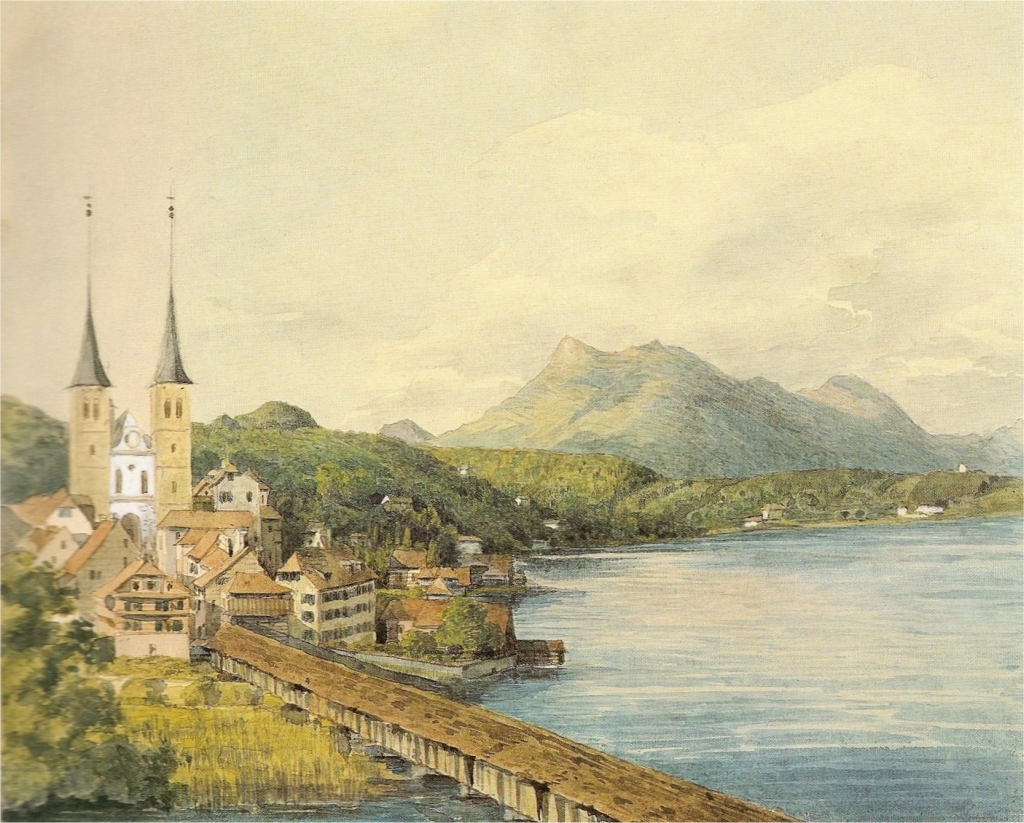
Like Mozart, he knew how to do everything, not only in music, but also, for example, in painting (he produced some watercolors of absolute significance). Here is one.
Unfortunately, in his maturity, he did not keep the creative promises of his adolescence, as he was enormously limited by the characteristics of the environment from which he came.
Mendelssohn was indeed born in Hamburg to an aristocratic family of Jewish origin; father a banker, mother a member of the notable Itzig family, grandson of the philosopher Moses. The family, a true Jewish economic power (the Mendelssohn bank played a significant role in breaking Napoleon's continental blockade), had renounced Judaism to embrace Lutheranism and had added, at the suggestion of his maternal grandfather who had done the same, the surname Bartholdy, enthusiastically adhering to the cultural model of the dominant German bourgeoisie.
As you can easily guess, this bourgeoisie was characterized by an extreme conservatism and, despite the fertile and effervescent musical and cultural fabric in which Felix was born, the fundamental characteristics of the education received soon imposed themselves, partly due to Felix's overly submissive character regarding family logic.
This situation, I believe, deprived us of much beautiful music, because the wings of Felix's creativity were irremediably clipped by conservatism (to create is to innovate, which is different from perfecting) and, therefore, today we are left only with works of great formal perfection, but with many repressed inspirations.
Not by chance, Mendelssohn was always suspicious of the innovative musical developments undertaken by his contemporaries. He didn't just shun Chopin, but also Berlioz, Liszt, and Meyerbeer, with whom he nevertheless had (tepid) friendly relations. It is no coincidence that, among musicians, he remained on excellent terms only with Ignaz Moscheles, who belonged to the previous generation and was equally conservative.
But I do not believe it was a matter of envy (to be clear, for example, Felix's piano skills were far superior to those of any of his contemporaries!), but rather a political and ideological struggle pushed to extreme consequences.
Rather, do not think he was the only one to use such words! Staying on topic, while Mendelssohn speaks well of Sand—which seems very strange, considering Sand's rebellious character and her revolt against the customs of the upper bourgeoisie to which both belonged (which highlights an unresolved side of Felix!)—Baudelaire speaks of Sand as a stupid whiner, whose ideas have the depth and delicacy of a street sweeper, and points to the moral abyss of men by the fact that they fall in love with such a slut!
Felix (as Baudelaire put it) ignored that there is something called History, which does justice to ideas and puts things (almost all of them) back in their place on the shelf.
A pity, because from what can be glimpsed of Mendelssohn when he was still a boy searching for his way, we have lost an angel!
Bye