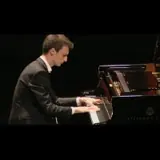
A week ago I finished studying this dear étude, the 12 op. 25...
Tonight I tried to record it and despite there being some mistakes, I remembered this quote from dear old Beethoven: "Playing a wrong note is insignificant. Playing without passion is unforgivable."
So I didn't give a damn about the mistakes and uploaded it anyway. Obviously, the more time passes, the more fluid it will be.
This is the first recorded version and it was made more to listen to whether the piece actually comes out as I had imagined it, then the second version will be without errors, I hope
Dear Giacomo, I possess a rare record of the late Great Dino Ciani, recorded thanks to a recording made by a friend who went to his house to listen to him. He played Chopin's studies all in a row, not without errors, but with great "passion" and personality. Even the clarity is not the best, but in my opinion, that record is a precious example of great Music. So what you are saying, in my opinion, is correct. This is the path to follow. Do not put on a show with the right notes, but present above all the Music. Then, of course, perfect the "diction" as much as possible. You have done it and you are doing it. I really liked how you phrased and how you emphasized the melodic line of the study, which risks disappearing and/or taking a backseat to the octave repeated notes that last throughout the piece. Furthermore, you managed well the "fatigue" that this type of repetitive passage can generate. It is clear that you know how to use the participating muscles well and how to properly measure the movement across the entire keyboard. You have found the right "resting points" to then "restart." Well done. A few "dirty" notes did not bother me. Instead, I very much appreciated your words and the humble journey you are taking to perfect this study and I believe more than that. Congratulations
Bravo Pianothor. I join in what Paolo has already said. Certainly, cleaning up is necessary because they are studies after all, but it's very good, and I admire your humility in comparing yourself to these milestones. The advice I can give you, which helped me immensely with Chopin's studies, is to study the positions and jumps well hands separately, learning the left hand very thoroughly by heart, because especially in the studies for parallel motions, great control of uniformity between the two hands is required and, unless one is ambidextrous, one of the two hands is never at the same level as the other (you must be able to do with one hand exactly what you are able to do with the other). In jumps, slow down excessively and even make stops if necessary, but the important thing is that you memorize the gesture; immediately after a few repetitions with this system, play only a fragment of these passages at speed. This way, everything will become automatic for you. This study technique is also very important for fixing the phrasing and technical solutions in your head.
Reconsidering, it is incredible how after only 3 weeks I deem this execution of mine unworthy; I remember being happy with this recording but... already after a few weeks of the work being finished, the result has improved greatly... music is truly strange
Soon I will arrange to record the definitive version
Here I am with the "definitive" version of the study
https://www.youtube.com/watch?v=iPhEOGB6yyI
Unfortunately, I still won't be able to record on an acoustic piano, but these are (and will be) recordings from my digital piano (it is no joke making this piece sound all clean from a digital one, I assure you).
Coming soon: a Rachmaninov prelude and the first movement of Beethoven's Pathétique, along with a dusting of Chopin preludes to reach a few other "academic" pieces (dear old Johann Sebastian Bach...)
PS: Although many prefer Pollini, Sokolov, Richter... or even Dino Ciani, but perhaps because of my youth, I adore Cziffra's vision of Chopin's studies, which I recommend you listen to! Here it is: