antares86 wrote:Hello everyone, I have done my first harmonic analysis of a Bachian chorale...
I am not an expert in harmonic analysis, but I would not consider passing notes on weak beats to be chords; in detail:
2nd measure: the note SI is a passing note and I would not mark the VI chord
3rd measure: I V (the SI is a suspension)
6th measure: the 2nd quarter can be considered passing notes
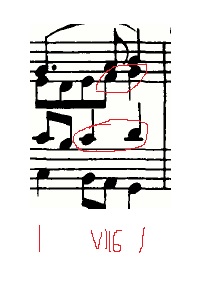
9th measure: for me, the 2nd quarter is more VII6 (not II) and the 3rd quarter is I6 (not V6)
10th measure: here too, the V doesn't make much sense on a weak beat; it is more correct to consider it a passing note
bottom staff
1st measure: V (not I)
3rd measure: III I6 V7 (with a suspension of the 4th)
5th measure: temporary modulation (veeeery temporary!) to C major and therefore I of C major (the G7 in the last quarter of the previous measure is therefore the V7 of C major)
6th measure: V6 I VII6
8th measure: VI (because 4 3?) IV I
penultimate measure: no 7s, they are all passing notes
How and when to consider a chord versus passing notes? In my opinion, besides the discussion regarding weak beats and trying to understand the composer's "intentions," it is in principle always better to simplify the harmony
dactually, you placed the 2 question marks exactly where we have a suspension (the SOL descending to the FA# leading tone) and an appoggiatura (the LA descending to the SOL (tonic) in the bass)
It is interesting to note how Bach easily performs fifths (penultimate bar above, even if the first is a diminished 5th) and how he performs harmonic syncopations between the last 2 bars in the upper part
naturally IMHO