Classical Music

CLASSICAL MUSIC AND COMPUTER SCIENCE

32 replies 5,159 views

Started by

Oliviero

Member

Member

Opening post by Oliviero

Posts
14
City
Ravenna

Besides being a classical music enthusiast, I also delight in computer science, a tool that I thought I would exploit in the service of music. The result is two programs that I would like to make available to anyone interested, which I will briefly illustrate:

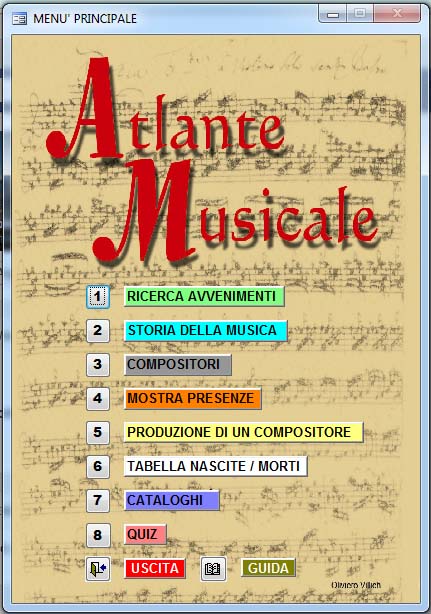
MUSICAL ATLAS: it is a database in which I have been collecting data (for about twenty years now) relating to music history, containing to date over 80,000 events relating to more than 2,000 composers, events of both a biographical and, above all, productive nature (i.e., the music composed by them). The most interesting thing for me is that every event is accompanied by spatio-temporal coordinates, making it possible to perform searches and obtain results that (to my knowledge) no other product is able to offer. For example, one can have tables indicating what happened or what was composed in a certain place (State or City) and in a certain period (in years), also indicating the desired type of music (genre, instrumentation, or category). For each composer, there is also a portrait and a critical biography in text form. Furthermore, the complete version contains about 10,000 musical examples that can be listened to. I would like to receive collaboration from those who would want to use it to further enrich it with data (my sources have primarily been DEUMM, the major Italian music encyclopedia, but obviously also the Internet, where much is found, though obviously not everything).

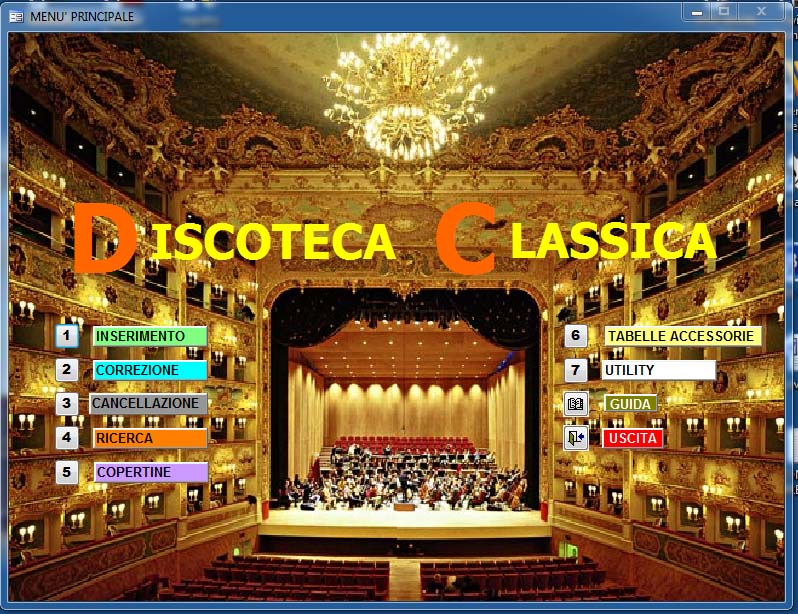
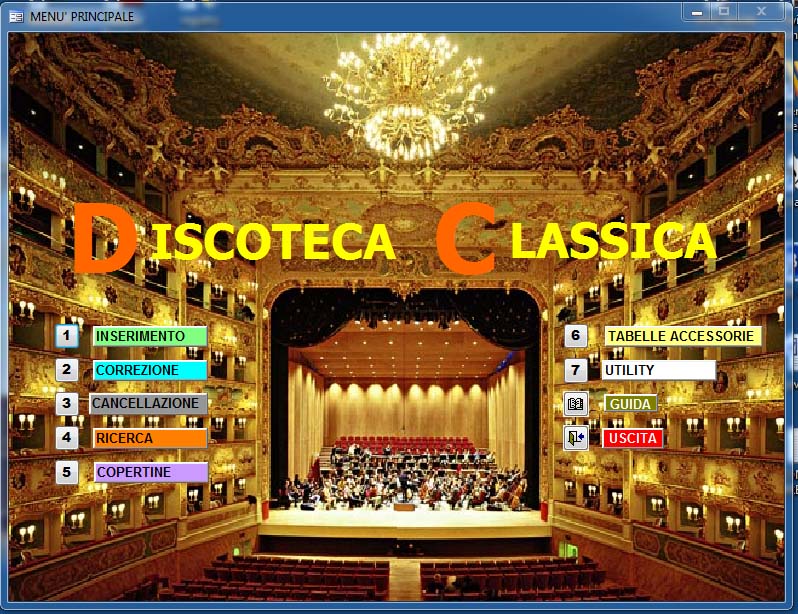
CLASSICAL DISCOGRAPHY: this is a less ambitious program than the previous one but particularly useful for those who have an extensive record collection and want to archive it to have a tool for retrieving the various pieces of music they possess. The software also allows for archiving record images and can be linked to the previous program in order to retrieve data from it.
AttachmentAttachment

Member

Reply 3 by Oliviero

Posts
14
City
Ravenna

Regarding the ATLANTE MUSICALE program, if anyone wishes to realize its potential, they can make a request to me and I can post the search results on the site (for example, in an Excel spreadsheet format).

I will give a few examples to explain myself better:

- Which Symphonies were composed in the first decade of the 1900s (in this case, the resulting voices can be organized by the program by grouping them by various States).

- Which musical events occurred in London in 1723? (obviously place and year are optional)

- Which chamber music was composed in Czechoslovakia in the 1800s?

- Which operas were performed in their premiere in Venice?

- Which composers were present in Berlin during the decade 1930-1940?

And so on....

Member

Reply 4 by Terenzio

Posts
212
City
Roma

The Musical Atlas quite intrigues me. How can I go about seeing it?

I am always on the hunt for news to add to my website.

Currently, for composers' chronologies, I make extensive use of the Almanac found on the Amadeus magazine website, which contains about 150,000 entries.

Unfortunately, however, it hasn't been updated for a few years due to the age limits reached by its author, Prof. Casaglia (he is well over 80).

http://www.amadeusonline.net/almanacco

http://www.amadeusonline.net/almanacco

Member

Reply 5 by Oliviero

Posts
14
City
Ravenna

I am happy to respond to Mr. Terenzio, who was kind enough to write to me.

First of all, I thank him for making me aware of the Amadeus Almanac, which I was not aware of. I went to visit it and I congratulate the author on the richness of information and, above all, the level of detail. He has worked at a dd-mm-yyyy level (I have limited myself to the year) and the events are particularly detailed. The logic of my program is quite different and is aimed at obtaining broader but more schematic overviews, with preordained search criteria (e.g., Year Range, Country, City, Musical Genre, Instrumentation, Category, etc.). To get an idea of the differences, I tried to perform the same search on both archives; I am attaching the results (in Excel format) in a zipped file. I would say that each of the two tables contains information that is missing from the other and that they should be integrated with each other by anyone wishing to delve deeper into a certain topic.

As an example, I am also attaching a type of search performed with my ATLANTE which unfortunately cannot be achieved with the Almanac: all Symphonies composed in the decade 1900-1910 (obviously those indexed by me) subdivided by Country.

Regarding its accessibility, my software is not online and would need to be installed locally. A system would need to be studied to make it available to anyone who wishes to download it: it has a size of 10GB (due mainly to the approximately 10,000 musical examples it contains). Fortunately, today technology provides online space for this purpose, but I have not yet experimented with it.

Thank you for your attention.

Member

Reply 7 by Terenzio

Posts
212
City
Roma

If I understood correctly, your program is currently not usable by third parties and we just have to settle for knowing that it exists.

It's a real shame that it remains closed on your PC.

You must find a way to put it online.

Just out of curiosity, what program did you use to create the database and what extension do the files have?

Member

Reply 8 by Oliviero

Posts
14
City
Ravenna

ATLANTE MUSICALE was developed on the Access 2003 platform. There are two possible paths for its distribution:

1) for those who have Access 2003 (or another compatible version) on their PC, it would be enough to download all the files that compose it, which I could save online in some available space that I need to verify.

2) for those who do not have it, there is another path that I followed a few years ago when the program was supposed to be published by a publishing house but then nothing came of it. (I must go down to a more technical level and I hope to make myself understood). I have a Microsoft application that allows me to prepare an installation disc containing a program developed in Access (and therefore the Musical Atlas) including the libraries necessary for its operation. At this point, I would need to create a disc image and place it online (as in hypothesis 1) and whoever wants it would have to download it, transfer it to a disc, and proceed with the installation.

The second path is obviously preferable as it would work for everyone. I will prepare the installation DVD again (the one made previously is no longer current) and I will see about placing its image online, performing tests to verify the effectiveness and functionality of the method.

As far as size is concerned, we are looking at around 10 GB, almost all due to the approximately 10,000 musical examples contained therein.

Member

Reply 9 by Oliviero

Posts
14
City
Ravenna

MUSICAL ATLAS INSTALLATION INSTRUCTIONS

PREMISE: The program was designed on the Access 2003 platform, but the installation package also contains the libraries necessary for its operation, so in theory, the presence of Access on the computer should not be necessary. In reality, I have found that if an Office installation (present or previous) is detected, the program still relies on Access. Therefore, I am not certain that the program will function without problems in the absence of Access. Problems could also arise if versions prior to Access 2003 are present.

INSTRUCTIONS:

Enter (via an Internet Browser) the Google Drive area using the link below:

https://drive.google.com/folderview?id=0ByjDUTnETb5KOTRpMmotaGd3SHM&usp=sharing

From here, download the 3 compressed files indicated below:

AM_2015-12-12.RAR (contains the installation package)[263Mb]

MUSICA.RAR (contains 1194 musical files)[1.45Gb]

MUSICA2.RAR (contains 9395 musical files)[9.17Gb]

Once the first RAR is downloaded and extracted, run the SETUP.EXE file which installs the program. You can also choose custom mode if you want to modify the installation directory path.

At the end, an icon is created on the Desktop. At this point, it is advisable to open the icon's properties and in the COMPATIBILITY tab, activate the option to run in Windows XP mode (otherwise the accessory programs related to mapping and the two guides will not work).

Before launching the program, proceed with the following steps:

The second RAR file must be extracted inside a subdirectory named MUSICA, which must be created immediately under the program's Directory.

For the third RAR file, the same instructions as the previous one apply, except that the subdirectory must be named MUSICA2.

Upon launching the program, random musical executions also start, which can be deactivated by following the instructions contained in the GUIDE from the main Menu.

Within the first option (Ricerca avvenimenti / Event Search), there is another Guide that illustrates all possible options.

For any information, questions, or clarifications, I am at your disposal.

https://drive.google.com/folderview?id=0ByjDUTnETb5KOTRpMmotaGd3SHM&usp=sharing

Member

Reply 11 by kEEs

Posts
14
City
brescia
Oliviero wrote:

In addition to being a classical music enthusiast, I also delight in computer science, a tool that I thought I would exploit at the service of music. The result is two programs that I would like to make available to anyone interested, which I will briefly describe:

MUSICAL ATLAS: it is a database in which I collect data (for about twenty years now) relating to the history of music, containing to date over 80,000 events relating to more than 2,000 composers, events that are both biographical and, above all, productive in nature (that is, the music composed by them). The most interesting thing for me is that every event is accompanied by spatio-temporal coordinates, making it possible to perform searches and obtain results that (to my knowledge) no other product is able to offer. For example, one can have tables indicating what happened or what was composed in a certain place (State or City) and in a certain period (in years), also indicating the desired type of music (genre, instrumentation, or category). For every composer, there is also a portrait and a critical biography in text form. Furthermore, the complete version contains about 10,000 musical examples that can be listened to. I would like to receive collaboration from those who would want to use it to further enrich it with data (my sources have primarily been DEUMM, the major Italian music encyclopedia, but obviously also the Internet, where much can be found, though obviously not everything).

CLASSICAL DISCOTHEQUE: this is a less ambitious program than the previous one but particularly useful for those who have an extensive record collection and want to archive it to have a tool for retrieving the various pieces of music they possess. The software also allows for archiving disc images and can be linked to the previous program in order to extract data from it.

Hello Oliviero,

my name is Carlo, I would be interested in understanding the potential of your "Classical Discotheque."

Most music archiving programs start from the concept, derived from "pop" music, of archiving "the album." Whereas for me, having 10,000 CDs, the important thing is to know how many Ballades in F minor by Chopin I have in my collection and by which performers... so my need is not to archive a "container" such as an album, but to have a database of compositions, composers, and performers (soloists, orchestras, and various ensembles) in order to build a record with one composition and one or more performers.

Thank you for the help,

Carlo

Member

Reply 12 by Oliviero

Posts
14
City
Ravenna

I am responding to Carlo:

First of all, thank you for your interest. A basic concept of my program is that almost all the data entered comes from auxiliary archives managed by the user. These concern:

1) AUTHORS (currently over 2000)

2) MUSICAL GENRES (e.g., Symphony, Mass, Opera, Quartet, etc.) (currently over 200)

3) ENSEMBLES (divided into 6 groups, namely for 1 performer, 2, 3, 4, 5 and More) (currently over 200)

4) WORKS (for each one, it is possible to indicate 12 characters) (currently almost 1500)

5) RECORD LABELS (currently more than 300)

6) INSTRUMENTS (linked to the following list) (e.g., Piano, Violin, Soprano, Conducting, Orchestra, etc.) (currently 49)

6) PERFORMERS (each linked to an INSTRUMENT) (currently over 7600)

However, for every piece entered, there are also free fields including a DESCRIPTION (in which to enter titles, keys, or anything else you wish to add), a LOCATION (to specify where to find the piece), and more.

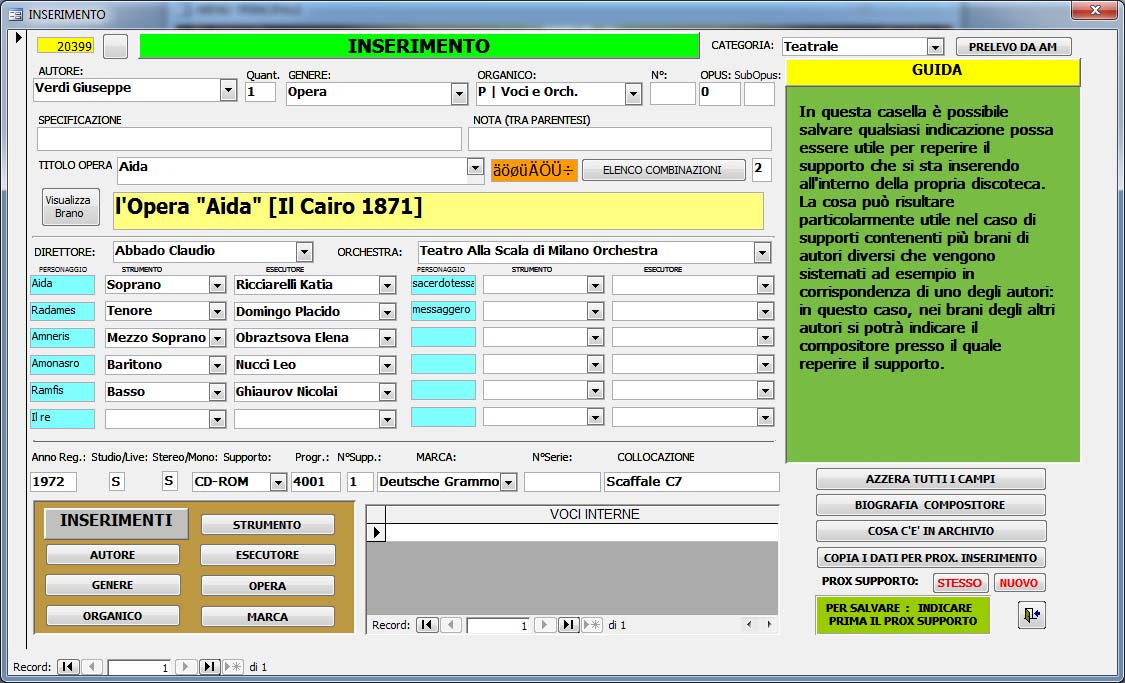
The entry screen (I am attaching an image) makes data entry easy because, for coded fields, you only need to start typing a word and the program opens the relevant archive and proposes the first name corresponding to the letters entered. In the event that the desired name is not in the list, simply press the relevant button in the ENTRIES box and it is possible to add the new entry to the list.

As far as the level of detail is concerned, this depends on the user's intention (but I would also say their patience). To explain: if you have to enter a CD with 20 Schubert Lieder, you can make 20 successive entries (considering them all belonging to the same disc), but there is also a faster and more convenient way, as at the bottom of the form there is a box in which you can list all 20 titles, thus making a single entry. I specify, among other things, that at the time of searching, you can search for a single word (and the search also covers this list), so the disc in question will be identified regardless. In the case of vocal recitals, if each aria is entered individually by linking the singer to the character, in the Search I will be able to request, for example, all musical pieces related to (e.g.) Donna Anna from Don Giovanni, whether they are scattered arias or complete editions.

I am rambling too much, but I would like to mention at least two other qualifying features of the program:

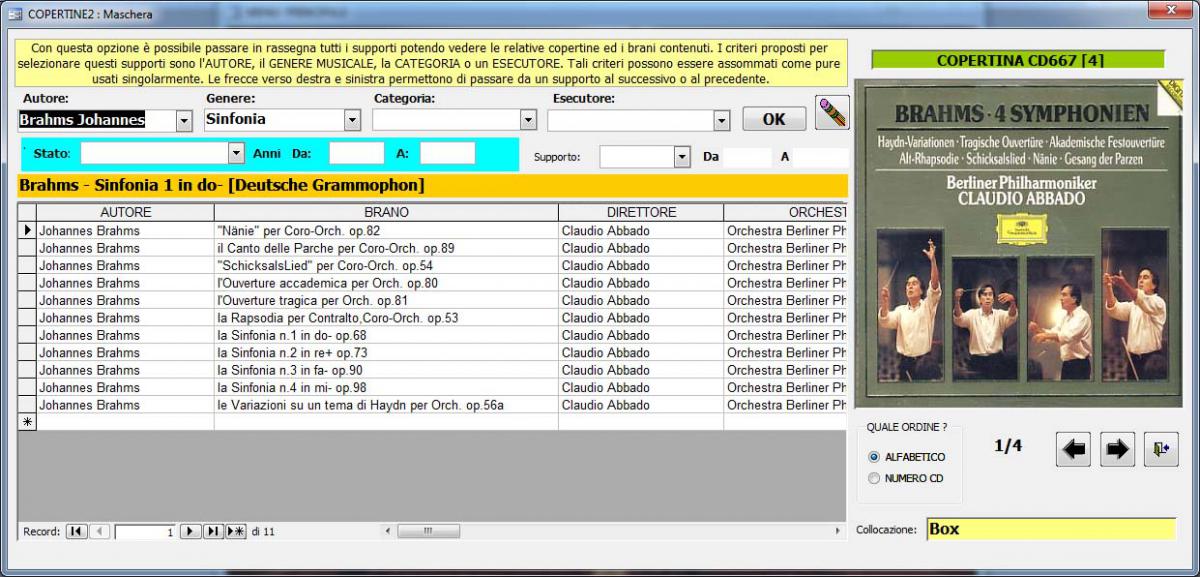
1) The possibility of inserting disc covers (to do this, however, the contribution of a graphic editor is necessary (I use Photoshop)) and then viewing them at the time of searching (second attached image).

2) The possibility of linking the CLASSICAL DISCOGRAPHY to my other program (MUSICAL ATLAS), which provides important advantages, including being able to open the composer's biography (with image) and the ability to retrieve data from it: genre, ensemble, title, but also place and year of composition: in this way, one can, during a search, find out which music is present in their discography that was composed in a certain place and at a certain time (which can be interesting for a music history enthusiast).

I will close by saying that currently in the archive (in addition to a few thousand LPs, which have unfortunately been retired), I have 4000 CD media which correspond to over 5500 actual CDs (meaning that many media consist of box sets with multiple CDs). There is no limit to the quantity to be entered and the search speed is very fast.

AttachmentAttachmentAttachment

Member

Reply 13 by kEEs

Posts
14
City
brescia
Oliviero wrote:

I am responding to Carlo:

First of all, thank you for your interest. A basic concept of my program is that almost all the data entered comes from auxiliary archives managed by the user. These concern:

1) AUTHORS (currently over 2000)

2) MUSICAL GENRES (e.g., Symphony, Mass, Opera, Quartet, etc.) (currently over 200)

3) ENSEMBLES (divided into 6 groups, namely for 1 performer, 2, 3, 4, 5 and More) (currently over 200)

4) WORKS (for each one, it is possible to indicate 12 characters) (currently almost 1500)

5) RECORD LABELS (currently more than 300)

6) INSTRUMENTS (linked to the following list) (e.g., Piano, Violin, Soprano, Conducting, Orchestra, etc.) (currently 49)

6) PERFORMERS (each linked to an INSTRUMENT) (currently over 7600)

However, for every piece entered, there are also free fields including a DESCRIPTION (in which to enter titles, keys, or anything else you wish to add), a LOCATION (to specify where to find the piece), and more.

The entry screen (I am attaching an image) makes data entry easy because, for coded fields, you only need to start typing a word and the program opens the relevant archive and proposes the first name corresponding to the letters entered. In case the desired name is not in the list, simply press the relevant button in the ENTRIES box and it is possible to add the new entry to the list.

As for the level of detail, this depends on the user's intention (and I would also say their patience). To explain: if you have to enter a CD with 20 Schubert Lieder, you can make 20 successive entries (considering them all belonging to the same disc), but there is also a faster and more convenient way, as at the bottom of the form there is a box in which you can list all 20 titles, thus making a single entry. I should specify, among other things, that during a search, you can search for a single word (and the search also covers this list), so the CD in question will be identified regardless. In the case of vocal recitals, if each aria is entered individually by linking the singer to the character, in the Search I will be able to request, for example, all musical pieces related to (e.g.) Donna Anna from Don Giovanni, whether they are scattered arias or complete editions.

I am rambling too much, but I would like to mention at least two other qualifying features of the program:

1) The possibility of inserting disc covers (to do this, however, the contribution of a graphic editor is necessary (I use Photoshop), and to see them later during the search (second attached image).

2) The possibility of linking the CLASSICAL DISCOGRAPHY to my other program (MUSICAL ATLAS), which provides important advantages, including being able to open the composer's biography (with image) and the ability to retrieve data from it: genre, ensemble, title, but also place and year of composition: in this way, during a search, one can find out which music is present in their discography that was composed in a certain place and at a certain time (which can be interesting for a music history enthusiast).

I will close by saying that currently in the archive (in addition to a few thousand LPs, which have unfortunately been retired), I have 4000 CD media which correspond to over 5500 actual CDs (meaning that many media consist of box sets with multiple CDs). There is no limit to the quantity to be entered and the search speed is very fast.

Thank you very much for the reply,

it seems like an excellent piece of work.

I am downloading the files from the Atlas, which I will look at very closely.

I will let you know

thanks and see you soon

Carlo

Member

Reply 14 by kEEs

Posts
14
City
brescia
kEEs wrote:

Thank you very much for the answer

it seems like an excellent job.

I am downloading the files from the Atlante, which I will look at very closely.

I will let you know

thanks and see you soon

Carlo

The Atlante is a truly immense work... compliments!

Thank you for sharing it

Carlo

Member

Reply 15 by Oliviero

Posts
14
City
Ravenna

I have uploaded to the same Google Drive shared area the RAR package containing the files necessary for the installation of the DISCOTECA CLASSICA program, which was also made on the Access 2003 platform and allows for the archiving of one's own classical music collection. The same warnings previously written for the ATLANTE MUSICALE apply to the installation.

I have also uploaded a DOC file in which the characteristics of the program are illustrated, accompanied by several images to better exemplify the concepts presented.

As already stated, the link with the ATLANTE MUSICALE increases the potential of this program.

The link to access it is the one indicated in a previous message.

I am, however, ready to answer any questions, clarifications, or other matters.

Member

Reply 17 by kEEs

Posts
14
City
brescia
Oliviero wrote:

I have uploaded to the same Google Drive shared area the RAR package containing the files necessary for the installation of the DISCOTECA CLASSICA program, also made on the Access 2003 platform which allows for the archiving of one's own classical disco.
For the installation, the same warnings previously written for the ATLANTE MUSICALE apply.

I have also uploaded a DOC file in which the characteristics of the program are illustrated, accompanied by several images to better exemplify the concepts presented.

As already stated, the connection with the ATLANTE MUSICALE increases the potential of this program.

The link to access it is the one indicated in a previous message.

I am nonetheless ready to answer any questions, clarifications, or other matters.

Thank you Oliviero

A presto

C

Member

Reply 18 by Oliviero

Posts
14
City
Ravenna

ATTENTION:

Regarding the DISCOTECA CLASSICA program, unfortunately I realized that I put a version in the Google Drive area that cannot be linked with the Atlante Musicale. I have therefore replaced the installation package with the correct one (DC_Copertine_2015-12-24.RAR).

If anyone has already downloaded and installed the previous package, they can download only the program file (DC_COPERTINE.MDB) to replace the previous one. The link with the Atlante is optimal if the Atlante is located directly under the C: root, i.e., in the directory C:\AM.

I apologize for the error made.

Member

Reply 19 by Oliviero

Posts
14
City
Ravenna

If anyone has downloaded one or both programs, I would appreciate some feedback: if everything went well, if there were any problems, if there are clarifications to be given or advice to be received. Thank you

Member

Reply 20 by kEEs

Posts
14
City
brescia
Oliviero wrote:

If anyone has downloaded one or both programs, I would appreciate some feedback: if everything went well, if there were any problems, if there are clarifications to be given or advice to be received. Thank you

Hi Oliviero

I returned yesterday from my Christmas holidays.

I installed the program (Discoteca) and am taking the first steps, but I fear I have an ACCESS version that is not entirely compatible (Office 2016)... right from the start it's giving me some warnings and signs.

I will look into it further and then let you know

Bye, see you soon and thanks

C

Log in to participate