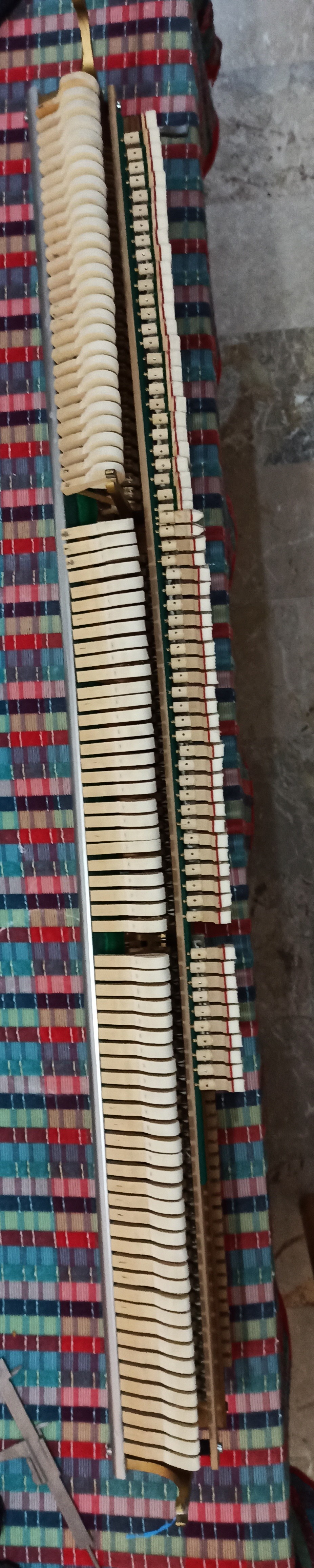
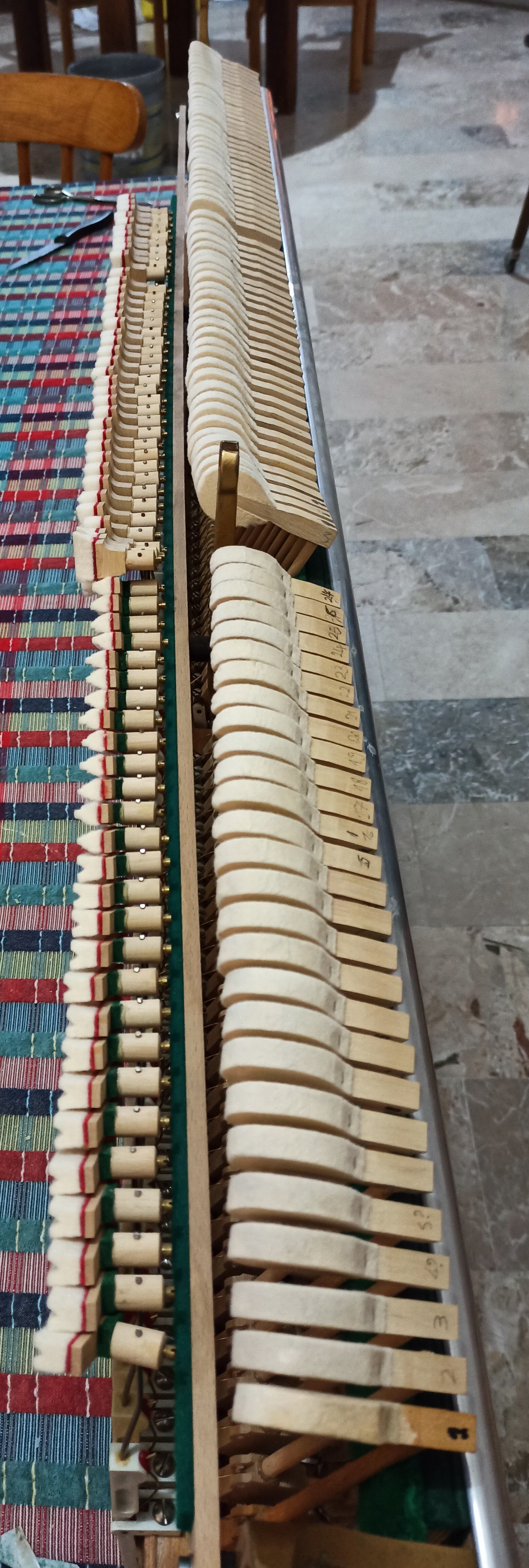
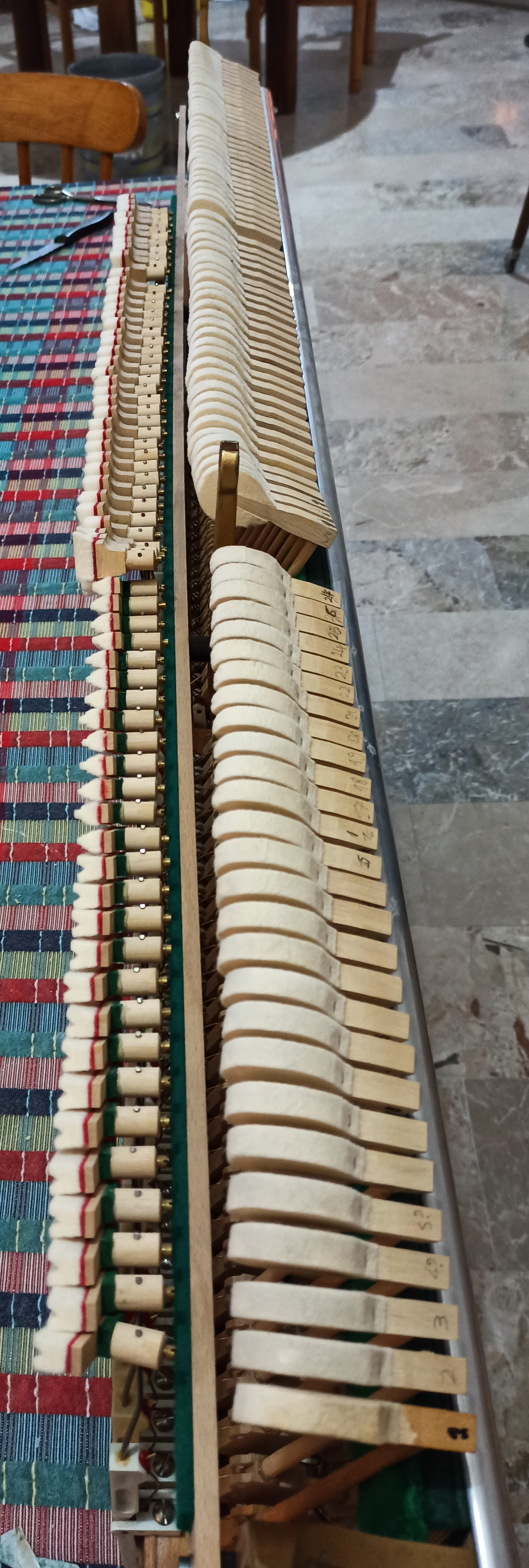
Hello everyone, my brother (a pianist) and I have a 90s Leipzig DDR upright piano, but since we are not experts, we are asking for guidance regarding the calibration of the damper let-off/travel. I should mention that since the piano is no longer in use, we decided to unscrew the hammers and dampers, sand the hammers with sandpaper, replace the damper spring clips and associated cords, lubricate the capstans and pins, and replace the damper felts. 1) Unfortunately, not knowing how to perform the damper alignment, the result is what you see in the photo (the effect is as shown in the video..). Could this lead to the fact that for a couple of central octaves the dampers intervene too much? In particular, when holding the key down, there is no sustain. Furthermore, the sustain pedal does not have its effect on those keys..
2) On a couple of keys, the problem is the opposite (the dampers do not act at all).
What do you advise us to work on? Thanks for any advice
I can't see the photo, anyway, the alignment of the dampers is quite a difficult task. For new ones, it is recommended to glue the new damper felt (especially for the bass) directly while the instrument is present so that any slight tilt defect can be compensated by adherence to the strings. In old ones, dismantling them forces you to find the perfect height for each one, one by one, otherwise there might be slight deviations that could cause other sounds to resonate. Then you have to intervene on the damper levers to advance or delay the release. Finally, you act on some metal parts that would cause too late a release when acting on the pedal. Difficult work.
Lubricating the pins? It is not a recommended procedure. Nor shaving the hammers, I say this in numerous posts.
thanks for the tips, unfortunately we arrived at this forum too late to follow your precious advice..
I'll try to reattach the photo, I don't understand why it isn't visible (I'm attaching both .jpg and .png), I imagine the video is fine.
I should specify that in the process of replacing the felts we did not unscrew the damper head, so I hope there hasn't been a considerable misalignment :(
At this point we were wondering if there is a standard procedure for adjusting the key levers regarding the stroke of the hammers/dampers (perhaps by referring to the keys that have a correct adjustment), it's just that we don't know what the steps to be performed might be and the parameters that can be measured in a repeatable way.
PS I also tried to make a slow-motion video: in the case of the keys where the adjustment seems correct (from the sound result), the damper stroke is barely noticeable; conversely, in the keys where the damping is too present, it seems that the damper does not lift except for such short periods as to be unappreciable even in a video like this.
watching videos does not matter. Little can be indicated from a distance. The damper must be raised at the halfway point of the hammer stroke. After taking some samples, the same will be repeated on the others, with the action detached, by acting on the spoons (damper levers).