Technical problems and their resolution

Damper problem

24 replies 5,033 views

Started by

danielerispoli

Member

Member

Opening post by danielerispoli

Posts
12
City
Amalfi

Hello everyone, this is my first post on this wonderful forum and so please excuse me if I use some "non-technical" terms.

I have an Ed Krauss upright piano purchased about 25 years ago.

Thanks to your guides and comments, I managed to resolve a very annoying "clicking" problem on some keys.

Where the problem occurred, I resolved it by tightening the screws that fix the hammer to the rail. In fact, before performing this intervention, the hammers had horizontal play which was almost zeroed out after giving them a good tighten.

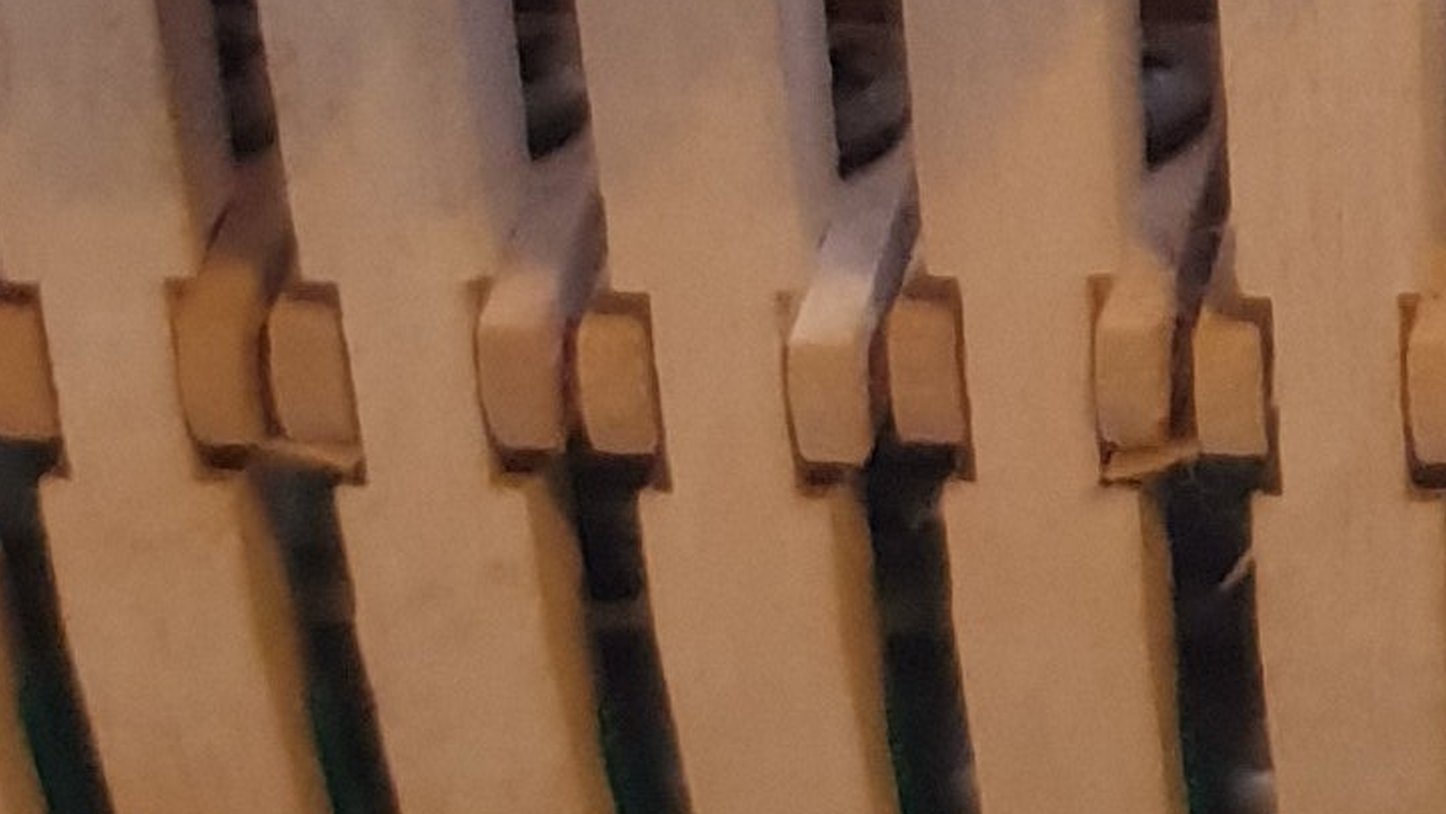
Some keys, however, despite the tightening, continued to have the problem. In this case, I noticed that the horizontal play was occurring in the entire block where the damper lever is located.

I removed all the action from the piano to access the back side and tightened the screws that attach the damper lever system to the rail at the bottom.

By doing this, I managed to eliminate all the "clicking" noises from the keys but unfortunately, I don't know if due to movement during extraction, a new problem has appeared on 3 notes (G3, G#3, A3): I believe the dampers have become misaligned.

In practice, when I play a staccato on these notes, the sound is not stopped immediately as happens with the other keys, but a very slight reverb with some resonances can be heard.

I hope I haven't caused an "unfixable mess"!

Could someone give me some tips or perhaps specific instructions on how to perform the adjustment of these dampers that are exhibiting the problem?

I noticed that the wooden rod that rests on the "spoon" (I don't know if that's what it's called) which pushes the damper back and forth, has a small screw used to move the wooden rod further from or closer to the spoon, but I believe this is only used to regulate when the damper releases from the strings during the hammer stroke.

How do I instead regulate the alignment or ensure that when the key is released, the damper has more force on the strings in order to stop them?

Thank you all!

Moderator

Reply 2 by pianoexpert

Posts
3,876
City
rocca di papa

You must act directly on the dampers, but a specific pair of pliers would be needed. You can also do it by hand. You can also act on the small screw on the head of the damper if there is one. That helps the damper to center itself. Now it is a matter of seeing whether the damper is catching all the strings (right-left lateral adjustment) or if it is not stopping the string because it is not resting well and simultaneously along its entire length. Consider both cases, but do not move the screws on the damper rods. It wouldn't solve anything. It could also be that the spoon causes the damper to engage too early or even prevents it from stopping the string. In this case, move it back a little.

Member

Reply 3 by danielerispoli

Posts
12
City
Amalfi
pianoexpert wrote:

14 hours ago, pianoexpert said:

You must act directly on the metal parts (ferri), but you would need a specific pair of pliers. You can also do it by hand. You can also act on the small screw on the head of the damper if there is one. That helps the damper to center itself. Now, the issue is to see whether the damper is not catching all the strings (right-left lateral adjustment) or if it is not stopping the string by resting well and simultaneously along its entire length. Consider both cases, but do not move the screws on the damper rods. It wouldn't solve anything. It could also be that the spoon causes the damper to engage too early or even prevents it from stopping the string. In this case, move it back a little.

Thank you very much for the advice.

However, I have some doubts: I can act on 3 things: the metal part that starts from the wooden base to which the damper is screwed, the screw that locks the damper to the metal part, and furthermore there is a screw in the rear part a few cm more above the spoon. (it acts on the felt lining but not directly on the head of the spoon)

However, I don't know what each of these things affects. Furthermore, the damper begins to retract when the hammer is halfway through its stroke, so I believe it is fine from this point of view.

I am afraid that in disassembling and reassembling the action, I have decentered the damper. In this case, how do you advise me to act? For example, if I try to deform the metal part, is it better to do it with the action mounted while the damper presses on the 3 strings?

Additionally, could it be that the damper spring has lost its strength in pushing it against the strings?

Forgive me for asking all these questions, but I have very little knowledge and therefore prefer to acquire as much information as possible from you who have so much experience.

Thanks again!

Moderator

Reply 4 by pianoexpert

Posts
3,876
City
rocca di papa

Just try to act laterally by twisting the metal rod very slightly and gently. Leave the rear screw above the spoon alone. If necessary, loosen the damper head screw slightly and you will see that it moves in two directions: around the metal rod (to calibrate the simultaneous grip of the strings) but also vertically (which makes it move laterally).

Member

Reply 5 by danielerispoli

Posts
12
City
Amalfi

Thank you so much Paolo!

Tomorrow I will do some practice following your advice, hoping to succeed in the endeavor.

Always for "educational" purposes: does the rear screw above the spoon serve to regulate after how much time the damper begins to retract, as when the spoon is bent, or does it have another use?

Member

Reply 7 by Gia

Posts
48
City
Pescara

I don't think that by extracting the action you managed to bend the damper wires,

unless you hit or forced them against something.

so I wouldn't try to bend the wires,

but I would try to look at the three dampers and compare them with the others,
and they will almost certainly be turned either to the right or to the left... so they need to be realigned

you could also post a photo.

Member

Reply 8 by danielerispoli

Posts
12
City
Amalfi

Sorry for only replying now, but I have been without a connection for a few days due to ADSL line problems (just to gloat about the quarantine?)

Anyway, I ordered some tuning tools (I would like to tune some unisons) and they arrived this morning.

In the afternoon, hoping to have time, I will extract the action from the piano again so I can take some photos of the hammers and dampers.

In reality, I am sure that I did not hit either the dampers or the hammers, but I performed a repair on the cord where the spring is inserted (following pianoexpert's instructions in another post) and to do this I had to disassemble 2 hammers. At this point, I am sure that when I reassembled them, I definitely moved something.

Thanks as always for all your advice!

Moderator

Reply 9 by pianoexpert

Posts
3,876
City
rocca di papa

Repairing the forcola cord and dismantling the hammers does not affect the dampers!

The photos are of little use because the damper does not dampen the sound due to a movement imperceptible to the eye. You must act on the sliding screw. I mentioned the rods because sometimes the head of the dampers is fixed. In this case, you can only act laterally on the rods (it is a bit more difficult)

Member

Reply 10 by danielerispoli

Posts
12
City
Amalfi

Hi Paolo,

I probably performed an incorrect procedure; to repair the cord, I disassembled both the hammer and the damper. I disassembled the damper because otherwise I couldn't extract the hammer. I probably did it unnecessarily and made a mess!

Anyway, in my plan, there are the adjustment screws that allow loosening the "head" and moving it up or down on the iron rod. I tried unscrewing it to make it go down or up a little bit, but the problem persists. Do you have any advice on how to figure out what kind of adjustment needs to be made?

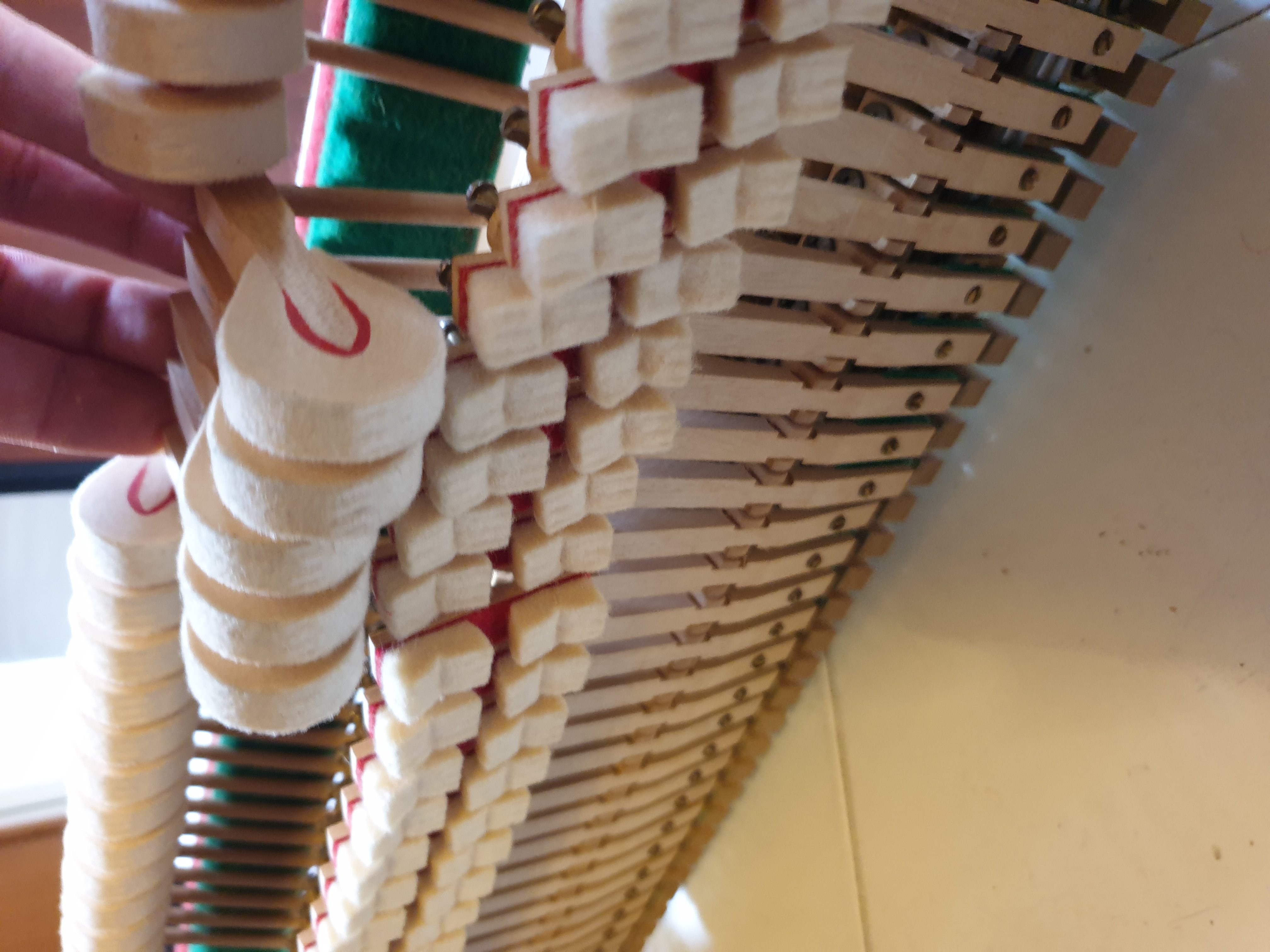
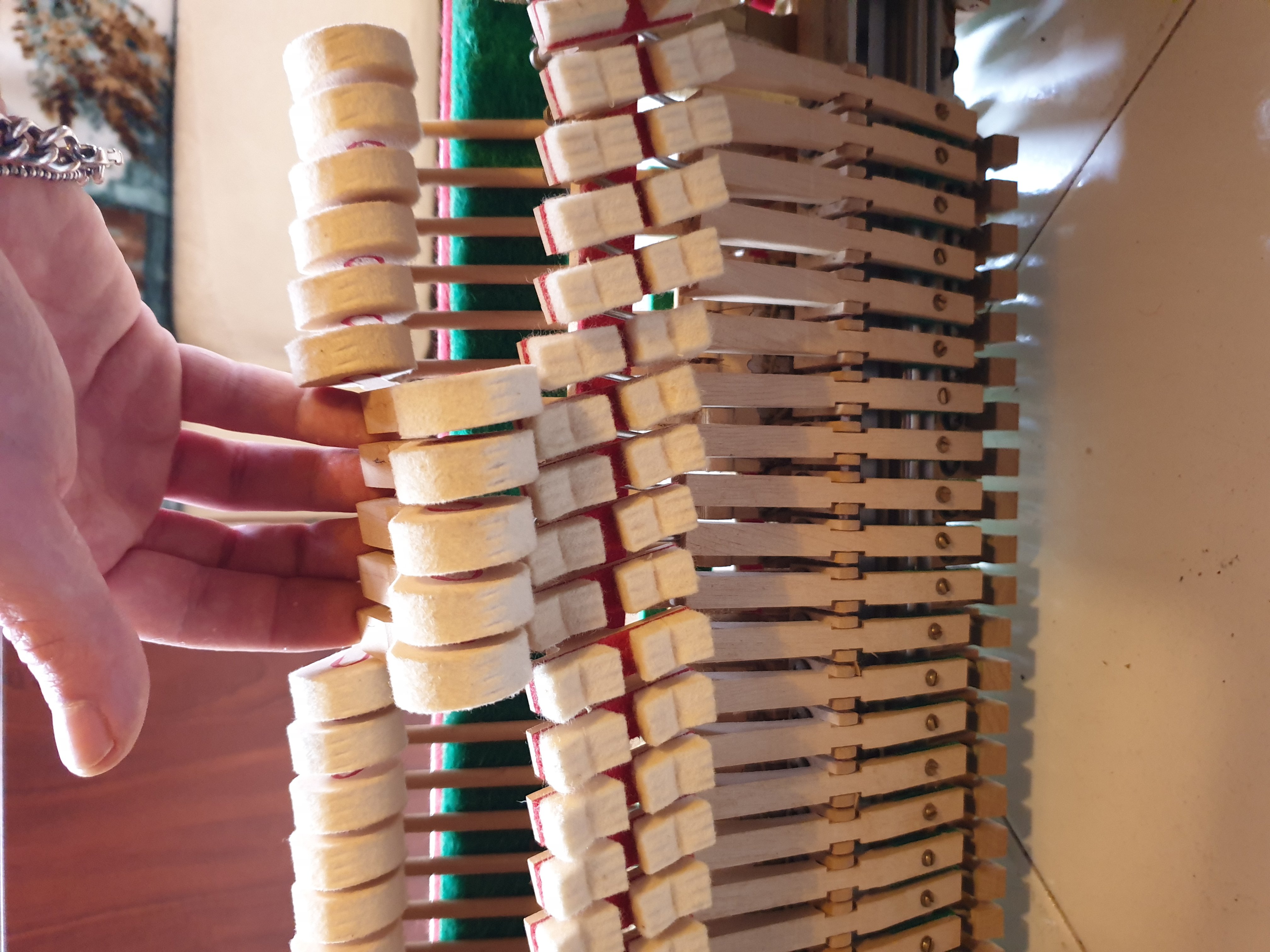
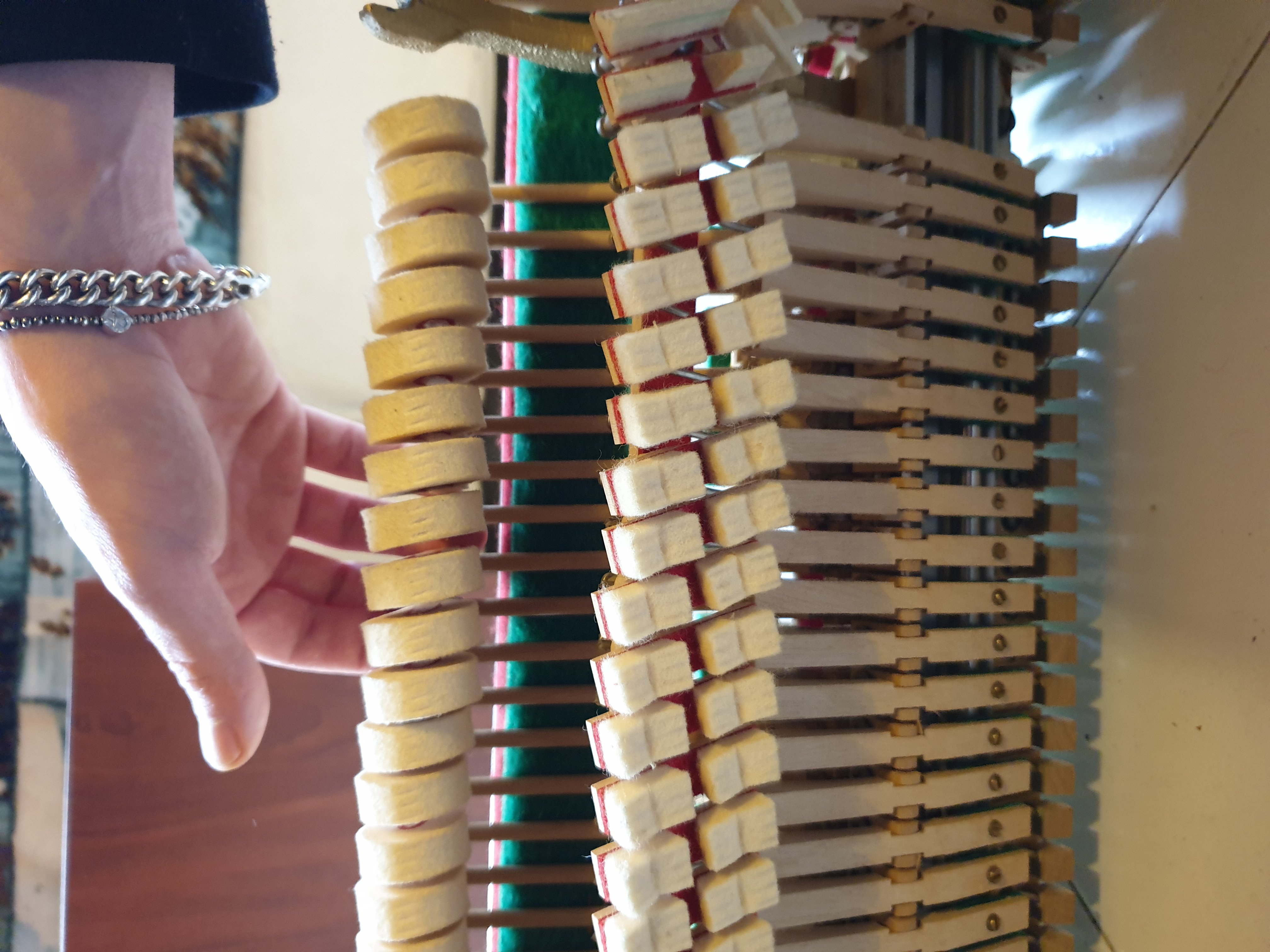
I am attaching the photos. Basically, the problem occurs on the mechanisms/notes that I am holding in the photo.

I await your reply as I still have the action disassembled.

Thanks!

smorz1.jpgsmorz2.jpgsmorz3.jpgsmorz4.jpg

Member

Reply 11 by Gia

Posts
48
City
Pescara

check that you haven't swapped the two dampers, then loosen the screw (that you unscrewed to remove them) and try to realign them.

Moderator

Reply 12 by pianoexpert

Posts
3,876
City
rocca di papa

Right. Also check that the three strings are well centered on the strings. I see one tilted differently. Then act, loosening the screw, also on the transverse orientation

Member

Reply 13 by danielerispoli

Posts
12
City
Amalfi

I have spent hours trying to solve it but to no avail.

Looking from above, with the action mounted, it seems to me that the felt correctly touches all 3 strings. I pulled back the one immediately to the left and the one immediately to the right to see better. I loosened the screw on the "head" and tried moving up and down along the damper rod. Finally, I tried loosening the screw that fixes the mechanism flange to the rail; even in this case, by eye, despite the strings being centered in the "dimples" of the felt, the same problem continues. In fact, it was even worse initially.

I am almost convinced that the problem is not the horizontal centering on the strings but that it is not perfectly perpendicular. That is, I have the impression that the bottom part touches before the top part and therefore uniform pressure is not applied. Obviously, I tried to slightly force the inclination with my hand while loosening the screw on the head, but I cannot align it in any way.

I know that this is work that a technician/tuner should do, and now I understand even more why! Unfortunately, it would be impossible right now to have a technician come to the house given the situation... Is it possible that centering the felt on the strings is this difficult??

Member

Reply 14 by Gia

Posts
48
City
Pescara

I think you have moved and therefore misplaced a couple of maps for centering the dampers, at least that's how it looks from the photo you posted, the third one, which I enlarged ...and I am attaching

smorz3.jpg.4abf3ebc8270fc4f063b8770990cf041.jpg

Member

Reply 15 by danielerispoli

Posts
12
City
Amalfi

wow what an eye! there's just one problem: I have no idea how these maps work and therefore how to reposition them correctly?

Moderator

Reply 16 by pianoexpert

Posts
3,876
City
rocca di papa

The jack placed to the left deviates the piece to the right and vice versa. But I don't think this is influential given the very short stroke of the damper. I think it's more about the orientation around the capstan (which is adjusted by slightly unscrewing the screw and orienting the damper or simply letting it rest against the strings. Then tighten). Try if this is it.

It should be simple to identify because it involves flat felt and not the wedge-shaped or trichord felt, which are much more difficult to adjust

Member

Reply 17 by danielerispoli

Posts
12
City
Amalfi

thanks Paolo! So it is definitely positioned incorrectly in the photo since it's neither to the left nor to the right?

Anyway, if I understood your advice correctly: I slightly unscrew the screw on the "head" of the damper to allow it to have a little bit of "play". With my hand, I keep pressing the damper against the strings and simultaneously tighten the screw again. Right? Maybe this time it will work?

Moderator

Reply 18 by pianoexpert

Posts
3,876
City
rocca di papa

Test. Check that there are no other dampers, perhaps in the bass, which, by damping poorly, could generate a harmonic corresponding to the notes in question. Last hypothesis: the spoons (cucchiaini). It is possible that the spoon has moved and does not allow the dampers to touch the string. If so, you should see the damper engage as soon as you touch the key. In that case, move the spoon back a little, which will cause the damper to engage at the halfway point of the hammer stroke.

Very last one: check the resonance pedal (sustain) to see if it engages too early or if it has no play at all. Act on the adjustment screw located just above the right pedal (resonance pedal or improperly called "forte pedal").

Good luck

Member

Reply 19 by danielerispoli

Posts
12
City
Amalfi

Hi Paolo,

I followed your advice and let's just say the situation has improved.

I adjusted the dampers because the damping started to move when the hammer was beyond 3/4 of its stroke.

The situation hasn't improved despite the damper now starting to lift exactly halfway through the stroke.

Next, I loosened the screw on the damper head, pressed the felt against the strings, and while holding it pressed, I screwed it back in.

After doing this, the situation improved but was not completely resolved. Now the sound is stopped (there is still a very slight sustain but it's acceptable), but on one key, an annoying harmonic occurs that sounds almost like a whistle. The interesting thing is that I tried to stop all the other strings with a cloth (holding it pressed with my hand) and despite this, the harmonic can still be heard; therefore, it depends specifically on the strings of the note where the problem occurs.

The note in question is A3 and the situation is as follows:

- I press the note and release immediately, basically a staccato. As soon as I release the key, a very strong harmonic is heard that lasts about 2 seconds.

- I hold the note down: same thing. The harmonic is heard along with the note.

- I play the note with the forte pedal pressed: same thing as in the other two cases.

Now I am quite sure it depends on the fact (at least seeing it by eye) that the lower part of the damper, even though it is horizontally aligned on the strings, does not exert enough pressure on the strings (unlike the upper part where you can see that the strings practically sink into the felt). I believe it generates the same effect that is intentionally done when playing the guitar to make only the harmonics heard by brushing the strings and keeping them slightly dampened. I feel like trying to bend the metal in order to try to make the damper as perpendicular to the strings as possible, but at this point, I am afraid of losing the improvements I have managed to achieve?

However, at the same time, I cannot understand why the harmonic is generated even when the note is pressed or with the forte pedal depressed, given that in these two cases the damper does not touch the strings.

In any case, compared to before, the situation has improved and so for the moment I can "make do" until I have the opportunity to call a tuner to fix everything.

However, do you have any idea how to understand what the harmonic problem depends on?

Finally, I'll take this opportunity to ask you a question about tuning: the issue of beats between third intervals is "fairly clear" to me. As for fifth intervals, should there be beats or should they be absent?

Thank you very much for all the advice you are giving me!

Moderator

Reply 20 by pianoexpert

Posts
3,876
City
rocca di papa

the fifths are slightly flat, meaning a little narrower. However, on some pianos and in certain areas of the keyboard, they can be almost correct

Regarding the dampers, at this point, if it is heard along with the note, it depends on the hammer's striking point and the prevailing damping point of the damper.

It could also be a problem with the hammer voicing. It could also depend on the string (the straightness of the strings should be checked). It could depend on a displacement of the string on the bridge (tap the string with a brass wedge at the bridge location)

The technician will check

Log in to participate