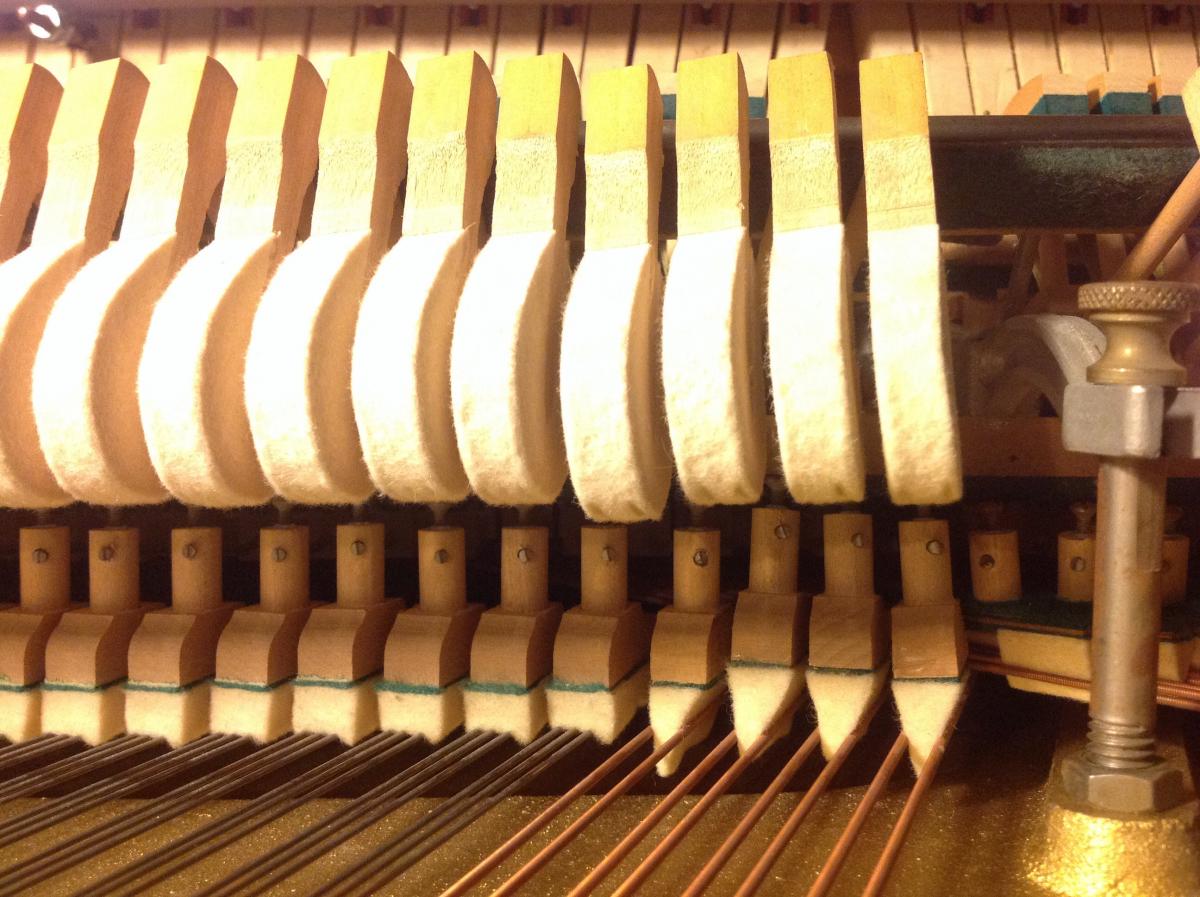
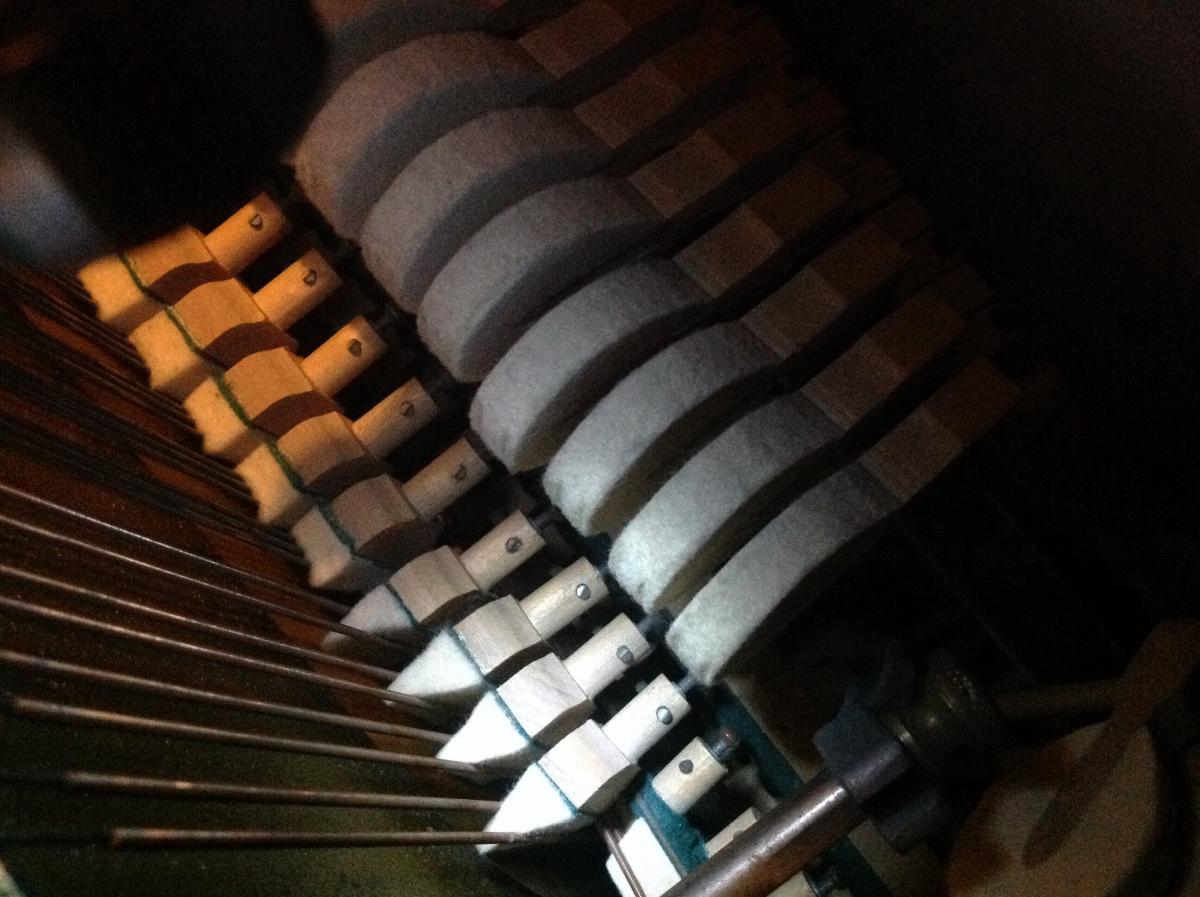
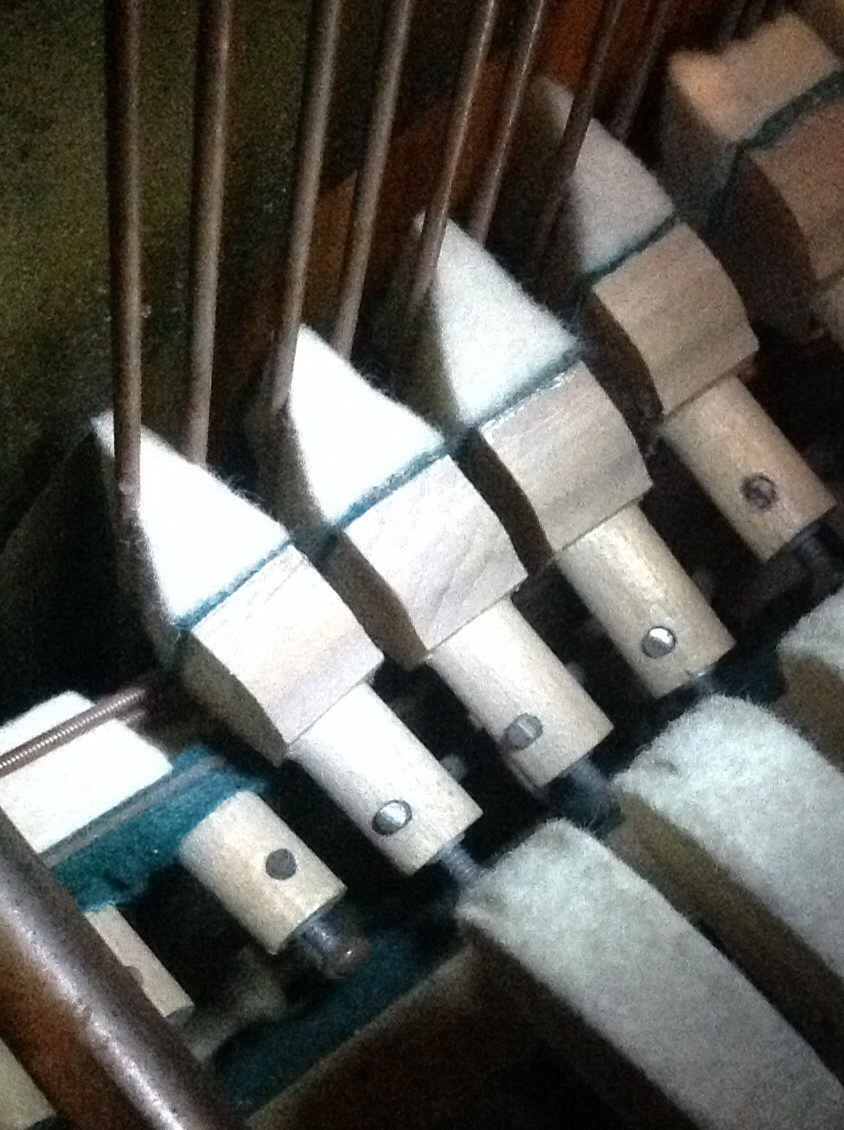
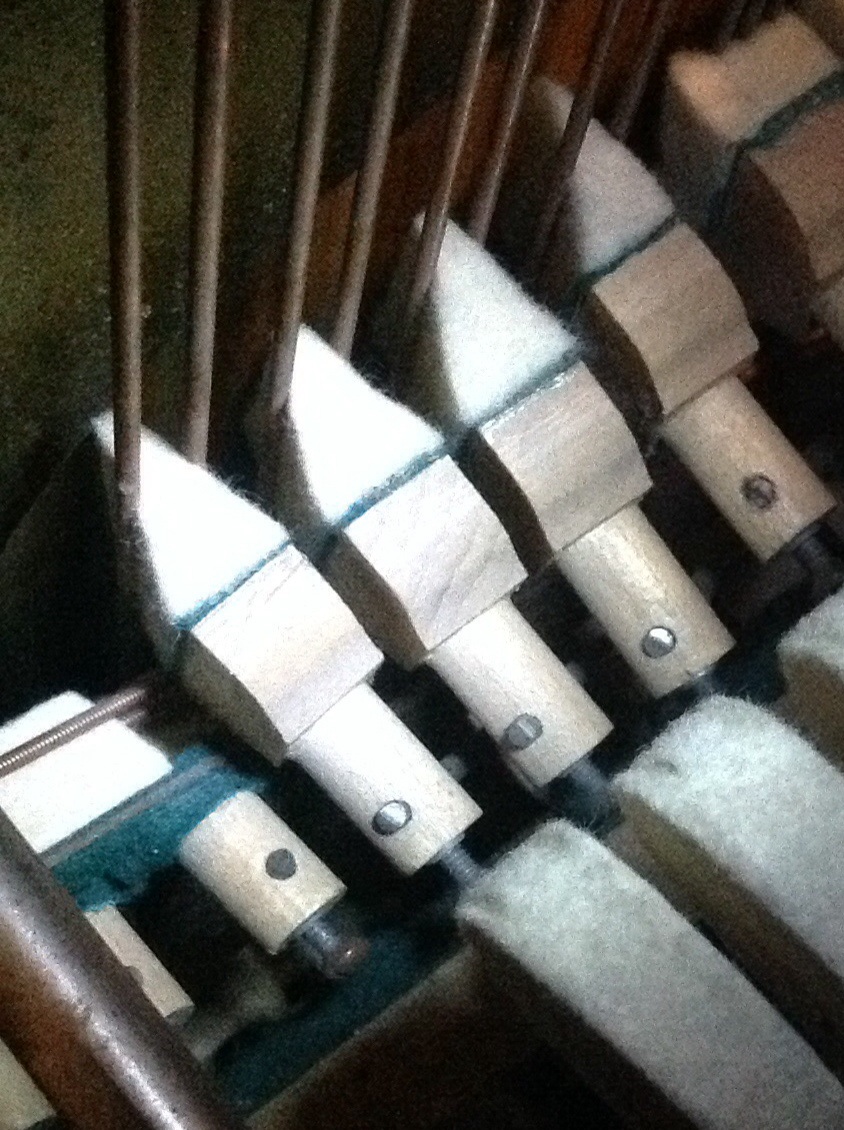
Hello everyone, I would like to tell you about my new purchase, which is: a Baldwin Monarch piano in mahogany (Upright) dated 1980, I don't know the exact year precisely. I wanted to try to explain some problems I noticed on this piano. So, besides when playing the C Major scale, the piano plays B Major exactly (but it just needs tuning or at least I hope). The most interesting problem is this: on three notes Do Re Mi (C2 D2 E2), I noticed that the dampers for these three are slightly further forward than the other 85, and this compromises the sound, to the extent that even when I hold the key pressed, it immediately cuts off the sound and for an instant some note (harmonic) can be heard due to the immediate blocking of the string (OTHERWISE IT WORKS MARVELOUSLY). What can I do? Is it a serious problem? Tonight I am waiting for the technician who is coming to inspect it. The piano has been stationary for more than 10 years and I purchased it because compared to all those I saw before it, it turned out to be the best in terms of mechanics and preservation. I purchased it for the moderate sum of €250. I hope I made a bargain. I will take some photos to show you. Thank you in advance
I am just returning from Frankfurt and I believe my response is late... and nocturnal. The piano, as I understand it, is half a tone flat. One must check the condition of the strings and the bridges before tuning it back to 440 Hz. Given the 85 notes, I believe it is from the early '90s... I don't think the dampers are on all 85!!??? ...The buzzing sound you hear could be due to the misalignment of the damper relative to the string... and then these damper felts, I think it's time to change them... they might have hardened and make noise when they approach... perhaps slowly... the string. Anyway, send some photos and an MP3, if you want
I thank you for your response and apologize for replying just now. I have attached a photo of the problem; thanks to your tutorial (truly of great help and utility!) where you explain how to regulate an upright piano, I managed to repair 3 hammers that were bouncing on the strings. The dampers (I apologize for saying 85 when there are actually fewer) end at the middle of the sixth octave and I think this is normal. As far as the date is concerned, I don't really think it is that old; the previous owner bought it new in the '80s. The biggest problem lies in the (C//D//E) of the third octave which, from what I can see (besides noticing they are off-axis), do not return as they should, thus causing the strings to block almost instantly after the hammers strike them. So now I hope that the problem is repairable, also because I have to practice on this piano and I cannot change it. The strings have small signs of rust but not all of them; the tuner told me that it needs to be tuned gradually. Thank you again for your response, I hope the photo is clear enough.
It seems I have understood correctly that the dampers do not rise and/or stop the strings too early (this is how it seems to me). It could depend on the saddle pins that need to be adjusted, or from the escapement lever that does not "escape" because the button is too high. You must tell your Tuner that there is no point in tuning "slowly" (piano piano)... when the string is going to break... it breaks and that's it. Instead, it is never convenient to tune "softly" (piano). By tuning strongly, the string truly stretches along its entire length and the tuning "lasts"! Tune strongly and listen softly. Verify the stability by resonating again very loudly.