

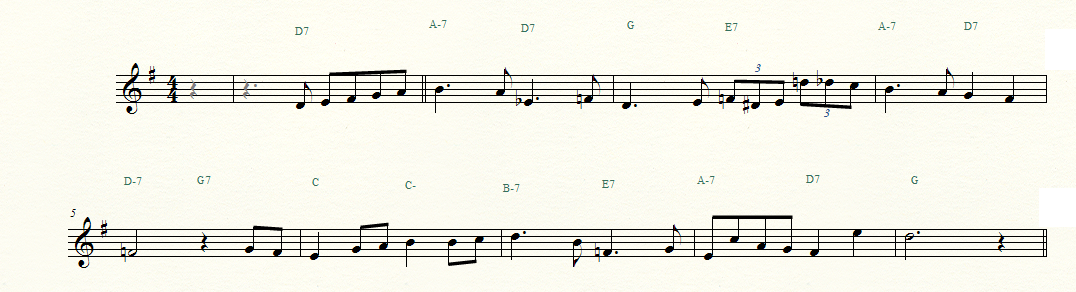
Given how the previous thread went, I propose another exercise on the same theme.
Let's do the analysis first and then try to harmonize
PS
Triads are understood with an added sixth.
Jazz

Started by
Moderator
Moderator
Given how the previous thread went, I propose another exercise on the same theme.
Let's do the analysis first and then try to harmonize
PS
Triads are understood with an added sixth.
Member
Great idea, what do you think?


Member
I would perform a genre analysis, basing it solely on the relationship between notes and chords; afterwards, I would decide whether to harmonize according to this analysis or treat other notes as non-chord tones.
P.S. I defined the G over D7 as non-chord tone unless one wants to think of it as a D7sus4; the Eb over E7 is non-chord tone, but enharmonically it could be a tension (13).
Moderator
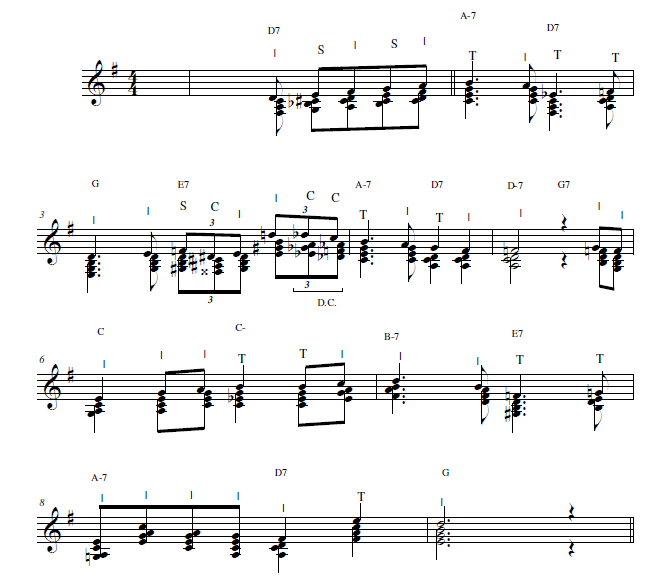
I'm taking a look at the analyses; Doc, typically as bits I indicate scale notes with "S" (harmonized specifically with the diminished) and chordal notes with "|". I reserve C instead for chromatics. Aside from it being quite clear that C for you is chordal, I would like you to indicate where, for example, you would harmonize with a chromaticism (I imagine the Db in measure 3, or with the scale like in the initial measures.
Without forgetting that the exercise was created to use the Additional Approach Methods, so I expect that, as in the previous case, moments where one can challenge themselves can be found.
... but even here, I would do without it ... for this reason I would like to discuss the subject
Moderator
I am not very satisfied, I probably should have used some Drop2, for example at measure 3 (where the melody rises a lot) or on the penultimate chord. It wouldn't have been bad to go to wide voicings even at the beginning of measure 7 in order to prepare the leap onto the E7 tension.
What do you think? I had set myself the goal of staying with close voicings; I kept the repeated notes in measures 2, 4, 5, 7 as they have a sustainable duration in relation to the swing.
Member
Frank wrote:I am not very satisfied; I probably should have used a bit of Drop2, for example at measure 3 (where the melody rises significantly) or on the penultimate chord. It wouldn't have been bad to go to wide voicings even at the beginning of measure 7 in order to prepare the leap onto the E7 tension.
What do you think? I had set myself the goal of staying with close voicings; I kept the repeated notes in measures 2, 4, 5, and 7 since they have a sustainable duration in relation to the swing.
It is very low-register, much like how I would have done it, with a few slight differences (I will have some considerations to make regarding this exercise later): the first measure always gives me some trouble because: 1) although the melodic analysis suggests treating D, F#, and A as chord tones, these are located at "weak" points from a rhythmic standpoint, but this might not be a problem; 2) as much as it might work, I am a bit reluctant to use the diminished approach on dominant chords, since the diminished chord does not belong to the relative scale; at most, it could be considered a dominant approach; in many of these cases, however, it is a matter of personal taste (is the lack of a natural sign on the C of the third chord an oversight?). The F in measure 3 could also have been harmonized with F7, creating parallelism on all the notes of the triplet.
On the other hand, I have serious doubts about the harmonization of what I would have considered (enharmonically speaking) the augmented ninths, namely the F natural in measure 2 and the G natural in measure 7: harmonized this way they result in m7 chords, whereas I would have thought of them as 7(#9) and would have kept the major third in the lowest voice (it seems to me that Tronky did this as well).
Finally, there is a repeated note on the eighth notes:
the G in measure 8 I would have harmonized with a chromatic approach, moving all the voices (that would suit it perfectly).
The doubt I had regarding these exercises is that they do not seem aimed at "forcing" you to use alternative methods; quite the opposite.
Either whoever made them is a real bastard...
Member
Let's say that, as a general rule, I proceed like this (if I don't need to experiment with particular sounds): on non-chordal notes, diminished approach or diatonic approach, eventually chromatic approach; if there is no way, dominant approach; out of desperation, linear approach. After that, anything goes.
(Joking aside, there are lines that it is impossible to harmonize with this method while respecting all the rules, so I proceed with various parallelisms, independent lead, or simply modify the harmony).
Member
Correction: in the last discussion, the terms linear approach and independent lead should be reversed. Seniority is a rogue.