

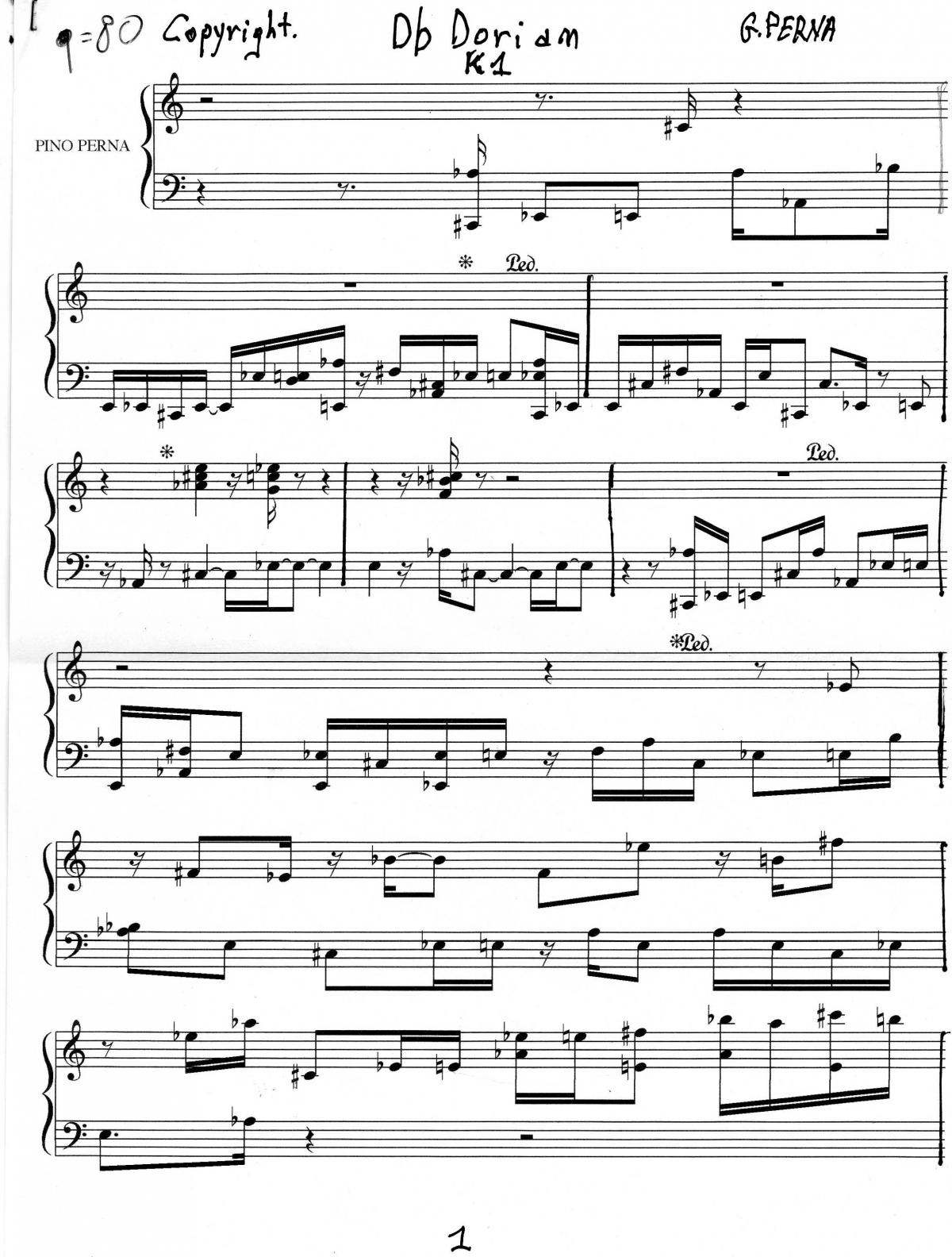
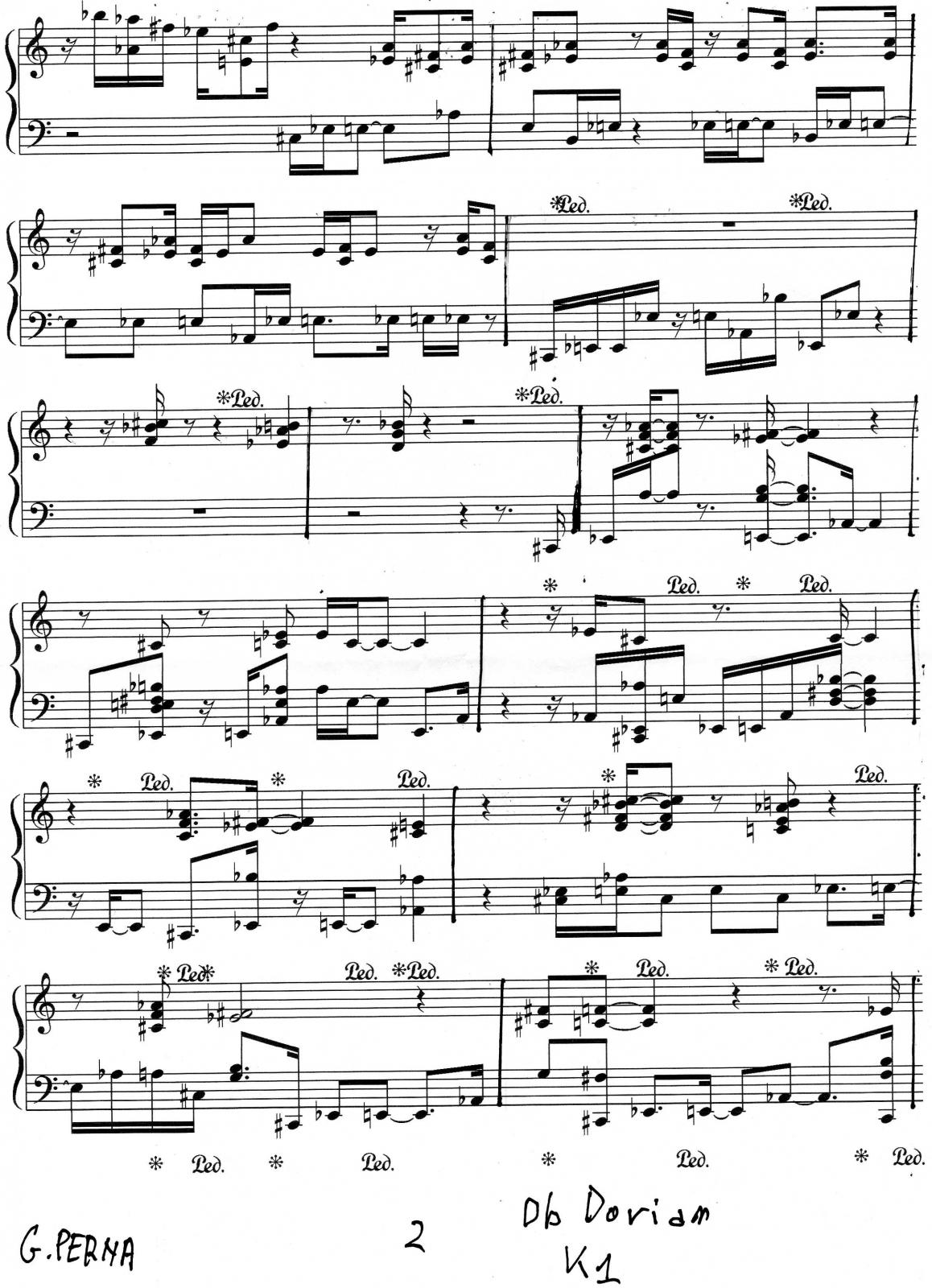
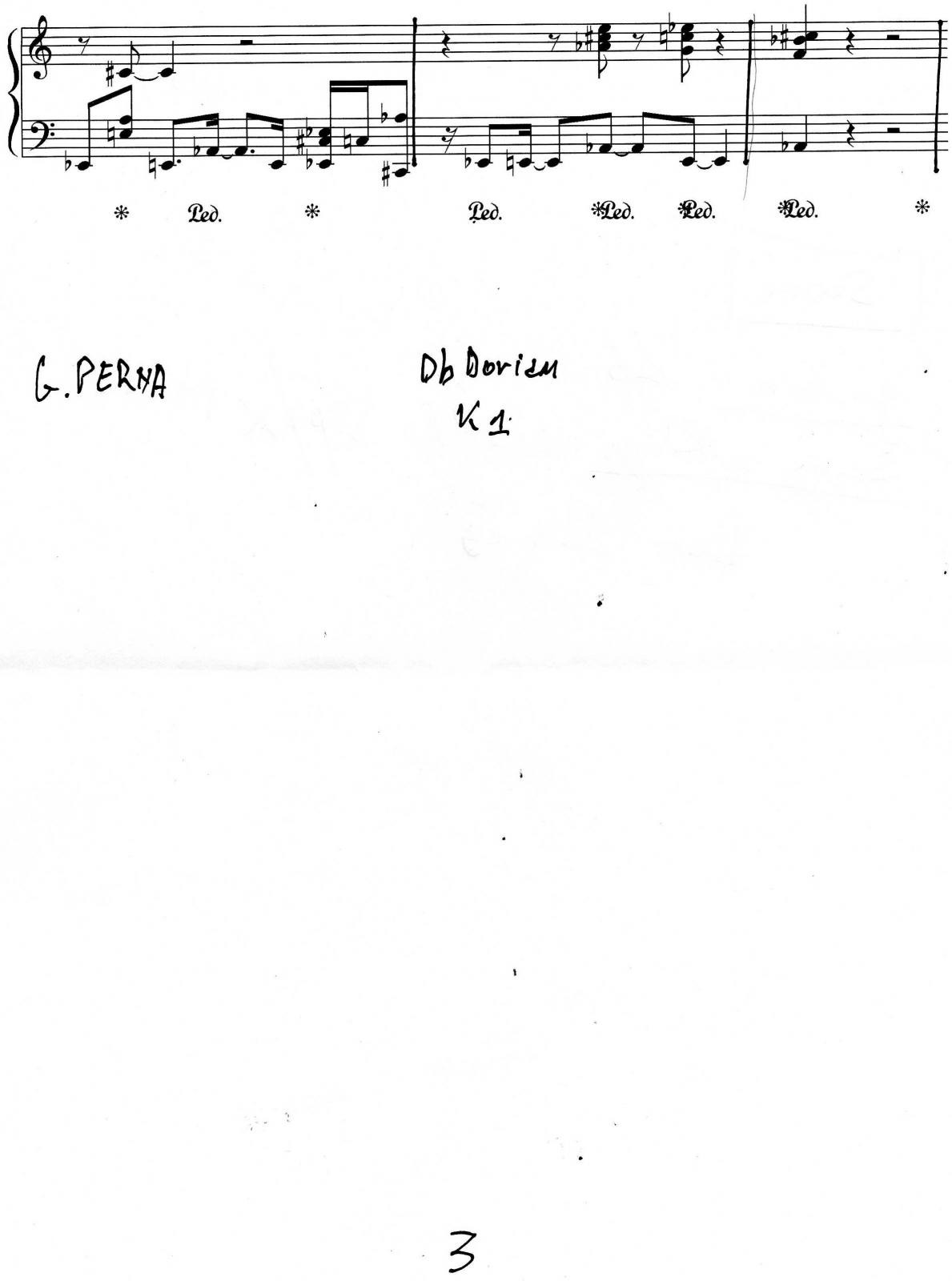
Here is a score in Dorian mode
Started by
Moderator
Moderator
Here is a score in Dorian mode
Member
How do you download it?
Member
I have done it...
Member
I tried playing it ... it seems challenging to me mainly due to the search for sound, which is the basis for a good performance for a piece like this.
Moderator
I tried playing it ... it seems challenging to me mainly due to the search for sound, which is the basis for a good performance for a piece like this.
In effect, I believe it is not simple to play mainly because of the type of note division and the type of overlapping between the right-hand line and the left-hand line. The advice I give you from a stylistic point of view is to play calmly using plenty of rubato, legato, accelerations, and decelerations. Then it is important to understand its harmonic and melodic sense, and this is achieved only by studying and repeating many times.
Let me know how it goes.
greetings
Member
I agree with the author of the piece, and music built on these aspects .. otherwise the beauty is lost
Member
Very sophisticated, compliments.
Moderator
This is the only score in my possession obtained by connecting a digital piano to a PC, an instrument that absolutely does not stimulate my imagination; for the rest, I only have recordings in audio CD format; the operation was done in a studio by a technician because I am a bit clumsy with computers, then I didn't think about the possibility of making sheet music anymore, perhaps because I don't see the utility in relation to their possible users.
I am curious to know your opinions. Who knows if from you I will get the stimulus to make others......
Thank you for the favorable comments.
Member
In my opinion, reading a score like this is perfectly useless, because the piece was not created to be written down and the author himself, if he wanted to read it, would not be able to; it's a bit like reading Jarrett's Köln concert (with the necessary comparisons), it's a senseless operation because even if Jarrett himself played it 10 times, he would play it 10 times differently. It makes much more sense to start from the audio to try to grasp its salient aspects without otherwise trying to reproduce it verbatim.
Furthermore, the computer certainly does not take into account rubato and other rhythmic nuances; in fact, to overcome this problem in this score, the beamed notes were added by hand, for the series: I play, I set a metronome, let's see what the computer writes for me and whatever comes out I call a "score".... it is not a serious approach to writing, so it does not require a rigorous approach to reading....
Member
I agree with Geppino, but I would add that at the moment it is written down, the enharmonic exactness of the sounds should also be taken care of, precisely to appreciate their harmonic and melodic sense.
Moderator
I fully agree with zedef and geppino on all the issues they have raised, but still without extremism. this is the reason why this sheet music is the only one in existence.
I thought and I believe that it is indeed useless to create others.
However, I believe that on a conceptual and didactic level for those interested in modal harmony, studying this sheet music could be interesting.

Member
geppino12575 wrote:it's a
meaningless operation because if Jarrett himself were to resonate it 10 times, he would resonate it 10 times differently. It makes much more sense to start from the audio to try to capture its salient aspects without trying, for any other reason, to reproduce it verbatim.
...I ask. Without prejudice to the discussion of writing vs. harmony ...but isn't it the same discussion as Bach's music?
Member
modale wrote:I still believe that on a conceptual and didactic level for those interested in modal harmony, the study of this score could be interesting.
Certainly, but perhaps writing it with the "right" notes would help more. By right, I mean with the correct name in reference to the reference mode.
At this point, if I wanted to listen to it... since I am not a pianist?
Moderator
Undoubtedly there is the enharmonic error generated by the computer, but those who are interested can correct it themselves.
Unfortunately Margherita, it is not possible to listen to it since, like all my creations, it is an extemporaneous composition.
Member
It seems to me that you don't agree much with Modale regarding teaching.
modale wrote:Undoubtedly there is the enharmonic error generated by the computer, but whoever is interested can correct it themselves.
If you say that "on a conceptual and didactic level, for those interested in modal harmony, the study of this score could be interesting" it means you are referring to a learner ... if the student already masters the subject they are not a student and the teaching interest ceases; if one does not master it they are a student but wouldn't know how to correct the score.
Not that you must do it by force, of course not ... mine are just considerations from a low-ranking student
Moderator
COMPOSITION IN Db DORIAN -K1-
The Dorian mode is characterized by an uncertain progression since it is not a tonal center. The capacity to be tonal centers belongs to the modes: PHRYGIAN, AEOLIAN, MIXOLYDIAN AND IONIAN. The modes: Lydian, Dorian and Locrian do not have the capacity to be tonal centers, so when playing in such modes there is an underlying tonal uncertainty due to the constitution of the mode itself. The Dorian mode expresses feelings of sadness, oblivion, not to be confused with feelings of romanticism or passion, which are more properly expressed by the Aeolian mode. Unlike the Aeolian mode, the Dorian mode "withstands" chromatization better because, as already stated, it lacks tonal power. It is like saying that an individual with a weak personality is more easily influenced than one with a strong personality.
Advice on how this score should be read and performed; unfortunately, I lack the time to correct the enharmonic error, I would have to rewrite everything. However, I advise you to consider the composition in C# Dorian, so Eb becomes D#, Ab becomes G#, and Bb becomes A#.
1) Note alterations are valid only for the current measure.
2) The alteration is valid only for the same note. That is, if you find an Eb on the fifth space, that alteration does not apply to other Ebs located elsewhere on the staff and consequently on the keyboard.
3) Alterations in the treble clef and those in the bass clef are completely independent.
4) The reference metronome speed is approximately 80
Member
Could you explain why Dorian and Lydian do not have a tonal center..? You write it as if it were a dogma, but there are many pieces that use these modes in which the tonal center is clearly recognizable: the piece "So What," an emblem of cool jazz, is in D Dorian, but it is clearly in D, except for the 8 bars of B where it goes into Eb Dorian, but even there the tonal center is certainly present; the same can be said for all those tarantellas that refer to the Lydian mode. You yourself first say that the Dorian mode has no tonal center and then you say that your piece is in C#.... I don't understand, I have a different vision of modes....
I don't even agree with the fact that Dorian is a mode that expresses sadness and oblivion; "So What" by Miles Davis is a relaxed piece, it is cool jazz, "cold" jazz... Dorian is a minor mode, perhaps that is why it can generate feelings of reflection or sadness, but not because of the major sixth, especially since it is well known that major intervals are more "open," "sunny," "radiant" than their respective minors, so why should a major sixth be sad?
Moderator
FIRST, LET'S TRY TO UNDERSTAND EXACTLY WHAT TONAL HARMONY IS AND WHAT MODAL HARMONY IS.
The "mode" should not be seen as a collection of notes. The "modal scale" is a collection of notes; the latter is used in tonal harmony to identify the spelling of a given scale and facilitate the musician's task.
The "mode" is the expression of a state of mind.
At the base of tonal harmony, there is an Ionian organization, meaning that modes are built upon the Ionian scale.
At the base of modal harmony, there is a Lydian organization, meaning that modes are built upon the Lydian scale because only it holds the "pure major sound," as it possesses only one tonic and not two tonics like the Ionian scale.
In the Ionian organization, the V degree is a Mixolydian scale which functionally has a significant cadential tendency towards the tonic triad.
In the Lydian organization, the Mixolydian scale is on the second degree, and therefore the cadential tendency towards the tonic triad is absent.
Playing modally means freeing modal scales from the functional role they possess in tonal harmony, and to do this, one must conceive them in another tonal system—that is, making them arise FROM THE DEGREES OF A LYDIAN SCALE and not from an Ionian scale.
Member
Forgive me, but of everything you say in your pieces there is no trace; you play the modes in their tonal conception. This piece is in C# minor with a few A#s thrown in... and I still don't understand where the two tonics are in the ionian scale compared to the single tonic of the lydian scale; could you clarify this concept?
I also don't understand when you say that "the mode is the expression of a state of mind," since tonal music also expresses states of mind, not just modal music, assuming that this difference is even real nowadays....
You say that "in lydian organization, the mixolydian mode is on the second degree and therefore the cadential tendency towards the tonic triad is absent"; I could argue that this cadential tendency occurs towards the dominant triad.
If we must use the lydian mode as a reference instead of the ionian mode, let's see which modes will arise on which degrees: I lydian, II mixolydian, III aeolian, IV locrian, V ionian, VI dorian, VII phrygian. Having established this, what changes in terms of approach? If I transpose all the reasoning I was doing on the I degree to the V degree, I get the same sonic effects but in another key, the dominant...
Could you explain this modal approach better from your point of view...?
Member
Actually, this thing seemed a bit shady to me from the beginning, which is why they were asking for reference original compositions anyway.