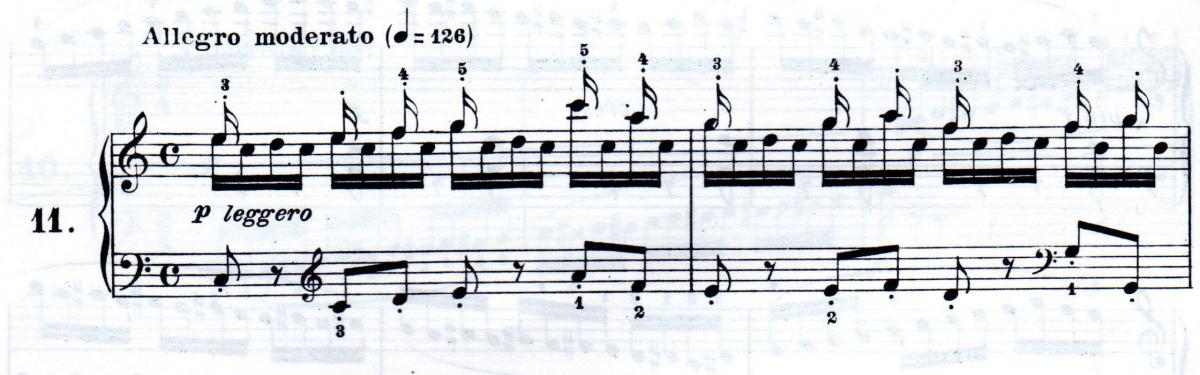
Hello. I am also one of the retirees who have taken up studying piano as a self-taught musician.
I am asking the experts of this forum how to play the first note of each group of four sixteenth notes, given that they have the normal vertical stem, but also a stem at the top with a dot above it.
It is not very easy to explain, but I will try: the piano is the instrument of choice for reductions, that is, for transcriptions from larger instrumental ensembles. In practice, you are asked to recreate not only the effect of the down-strokes, but also that of another instrument that mimics, with a staccato (for example, a violin's pizzicato), the higher notes of the right hand. And to do so by highlighting this very effect, both from the perspective of dynamics and overall volume. Naturally, you cannot recreate on the piano the staccato along with the same held note... Consequently, in practice, you will have to recreate the staccato effect by imagining (and making others imagine) that the notes with stems pointing up are played by another instrument; and by highlighting, with the appropriate volume, that it is a melodic line.
We are talking about an abbreviation called staccato; in this particular case, we are talking about simple staccato.
Simple staccato, which is graphically represented as a dot on the note, rhythmically reduces the value of the note on which it is placed by half of its value.
In your case, you have eighth notes with a dot, which abbreviate the writing of the sixteenth note (1/2 the value of the eighth note) and the sixteenth note rest.
Using the same criterion, one also approaches sixteenth notes or any other figure topped by the dot.
By performing what is written on an instrument, you will notice that the sound of the notes will give you a sense of staccato that will explain the meaning of the name.
I advise you to follow TheSimon's tutorials that discuss music theory. These topics will surely be treated in a more complete manner.
Ok the staccato, the stems pointing upwards indicate the vocal line.
C
Carlos
Member
Reply 6 by Carlos
Posts
759
PasqualeTivoli wrote:
Hello. I am also one of the retirees who have taken up studying piano as a self-taught musician.
I am asking the experts of this forum how to play the first note of each group of four sixteenth notes, given that they have the normal vertical stem, but also a stem pointing upwards with a dot on top.
It is very simple. The right hand plays two distinct voices: one is the "perpetual motion" (if you'll excuse the term), the other is that of the notes with the stem pointing up. Did you notice that those notes go exactly along with the left hand? Try playing them alone, and you will see that everything will be clearer to you. It is called "polyphony"...