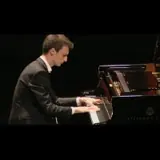
I joined the forum very recently, and after reading some of your countless comments regarding a wide variety of musical topics, I felt a great desire to try and get involved myself and contribute my voice to your choral symphony of ideas.
Therefore, I propose for your listening a piano piece that I wrote recently titled "Sogno" (Dream), to get an opinion and judgment, and naturally critiques if you wish!!
The piece is part of a small collection of piano pieces titled "Colori della notte" (Colors of the Night) which contains nine compositions for piano written over the last few years and was recorded with a Viscount electric piano, played by myself, so I apologize in advance for the sound quality, about which I still have some things to learn.
I leave it for you to listen to, hoping that it may be to your liking!!
Gradually, I will be happy to insert other pieces from this collection, and since it has been requested, I am happy to attach the score, if anyone wants to have fun playing it!!
(To tell the truth, I am a violinist, not a pianist... but I always try to play what I write!! )
Z
Zazza
Member
Reply 6 by Zazza
Posts
250
Since we are talking about a piano and not a violin, why the choice of the key of B-flat minor? Surely in A minor it would have had the same effect (pleasant) but would probably have facilitated reading. Or are there extra-musical reasons? (given the dedication)
There isn't a precise reason regarding the choice of key; the initial theme simply took shape naturally in this key, and then developed within it; but I can certainly say that keys such as D-flat or G-flat (and their relatives) have often been congenial to me, perhaps for their particular color, which is a bit darker and more nostalgic. But it is certainly a personal judgment. Let's just say that I feel more comfortable with many flats rather than many sharps!!
Z
Zazza
Member
Reply 8 by Zazza
Posts
250
Musicista wrote:
Let's just say I feel more comfortable with many flats rather than many sharps!!
Of course, you are a violinist.
Musicista wrote:
but I can certainly say that keys like D-flat or G-flat (and their relatives) have often been congenial to me, perhaps because of their particular slightly darker and more nostalgic color. But it is certainly a personal judgment.
It depends on the instrument and it is a very objective matter. Equal temperament creates no color; every key is equal to the next... only the pitch changes. A semitone transposition is practically imperceptible and does not overturn the structure of a piano piece. Obviously, this argument does not hold for, for example, strings and the voice.
A very interesting discussion could indeed open up here!!
I perfectly agree that the tempered system makes, at least "mathematically", all keys analogous, allowing one to transpose and play a given piece in any of them without altering its tonal relationships in any way.
It is equally true, however, that our ear does not have the same perception for all frequencies and that individual sounds are actually composed of a large number of harmonics. Certain frequencies sound different precisely because of their harmonic "spectrum", and consequently certain keys have a sonority that can evoke different sensations.
We are still talking about frequencies (hertz) whose relative harmonics are different, and this is what our ear perceives, and consequently our brain.
In my opinion, it is not true that by transposing it a piece sounds the same; on the contrary, it can change profoundly.
To tell the truth, a very interesting discussion could open up here!!
I perfectly agree that the tempered system makes all keys analogous, at least "mathematically," allowing one to transpose and play a given piece in any of them without altering its tonal relationships in any way.
It is equally true, however, that our ear does not have the same perception for all frequencies and that individual sounds are actually composed of a large number of harmonics. Certain frequencies sound different precisely because of their harmonic "spectrum," and consequently, certain keys have a sonority that can evoke different sensations.
We are still talking about frequencies (hertz) whose relative harmonics are different, and this is what our ear perceives, and consequently our brain.
In my opinion, it is not true that by transposing it a piece sounds the same; it can, in fact, change profoundly.
The good old "Fourier series" "teaches" us this... that frequencies change despite "maintaining" the temperament
G
GianBurrasca
Member
Reply 11 by GianBurrasca
Posts
36
Regarding the discussion on key, I had opened this topic in the past, perhaps it might be of interest
I would also reason about the tuning fork; practically speaking, in terms of pitch, we have essentially transposed pieces a semitone higher... so I think that as Zazzà says, in equal temperament... a semitone practically changes nothing. Of course, if we are talking about transpositions beyond a whole tone, some things can indeed change; but a general discussion is never functional, although Zazzà was actually speaking only of the piano, a simplification that facilitates the discussion.
It also comes to mind that, for example, many of Schubert's Lieder, due to requirements related to the singers' ranges, were and are transposed... without gaining or losing anything from the transposition process itself.