Tuning

Entropy Piano Tuner vs Tunelab

23 replies 9,615 views

Started by

magnalf

Member

Member

Opening post by magnalf

Posts
56
City
Correggio

Hi The Simon,

I wanted your opinion, and obviously also the opinion of anyone who wants to weigh in, on the software "Entropy piano tuner" which is an experimental open-source project for tuning the piano.

I read your paper and saw your video, and I agree with the fact that perfect tuning does not exist.

I don't know well how Tunelab works (I will read the manual) but regarding this Entropy piano tuner, what seems interesting to me is the fact that first every single note of the piano is recorded, then the software processes the tuning based on its own algorithm that tends to minimize the entropy of the partials spectrum (the validity of which remains to be proven), but above all it is interesting that before starting to work on the tuning pins, one can listen to the result of the processing by connecting a MIDI keyboard.

It seems good to me that it calculates the inharmonicity of each string, and that it tries to take into account the ratio between partials somewhat like ear tuning.

However, in my opinion, the problem of stretch in the lows and highs remains unresolved, as it is subjective.

I haven't yet clearly understood by what criteria this stretch is quantified in software.

But I believe that this problem is also present in other professional software like Tunelab, Verituner, etc. (If I am not mistaken).

...bring on the comments....

Member

Reply 2 by giovannip

Posts
553

Hi magnalf, I wasn't aware of this program; it seems like a clone of this other program that I know very well https://www.youtube.com/watch?v=95ZMzfk7hOA

with the difference that you can listen to the result of the "stretching" on a MIDI keyboard, and it's something not to be underestimated because it is FREE!! That being said, I can tell you that usually these programs do a good job in the middle part of the keyboard, okay on the lows, and insufficient on the highs. I find them very useful for learning how to tune without damaging the piano; with a bit of attention and some adjustments, one can achieve decent tunings.

P.S. I will try it as soon as possible, then I'll let you know.

Member

Reply 3 by magnalf

Posts
56
City
Correggio

Hi Giovanni,

I had already seen this tutorial during my web search, but I am very pleased that you know it well, so I would like to ask you if this software, during recording, stores only the fundamental or also the partials?

Do you know on what principle the algorithm used to reach the final stretch is based?

Regards Alfredo

Member

Reply 4 by magnalf

Posts
56
City
Correggio

Hi Giovanni,

i read Dirk's Piano Tuner manual and I have the answer to my first question, which is that it also considers partials (quasi-harmonics).

Ok, but it is not clear what algorithm it uses to obtain what they define as "optimal expansion" by "comparing millions of combinations of harmonics."

It is obvious that this definition says everything and nothing, perhaps so as not to reveal their actual operating engine.

Do you know more about it?

Administrator

Reply 5 by Thesimon

Posts
4,504
City
Ariccia, RM

Hi Magnalf, I'm glad you read my paper and I hope you liked it.

The discussion related to entropy can be interesting, but it is another way of arriving at a solution to part of the problem. The equilibrium point is nonetheless based on a count of beats between harmonics, so doing it at runtime as tuners like Tunelab or Veritune do, or doing it by sampling sounds and then calculating them together, doesn't seem to me to change much about the matter. Certainly, sampling a certain number of sounds instead of just a few as Tunelab does can increase measurement sensitivity and certainly promises better results in terms of tuning accuracy. Now we have to see if this greater accuracy is truly justified in practice. I'll give an example... In any case, when tuning, one must consider the tuner's hand. To be fair, a tuner always tunes a note well within a margin of error relative to the frequency at which that string should theoretically vibrate. We are human and therefore there is a certain margin of error; I would say in the order of 2/4 cents. Now, if the measurement sensitivity increases to the order of tenths of a cent, you understand perfectly well that such accuracy is completely useless. It would be like asking you to measure the length of a desk to put in a room with a laser meter... It would be perfectly fine to measure it with a tailor's tape! It is useless to know that the desk is 10 meters long, 1 centimeter, 2 millimeters, and 234 thousandths of a millimeter! Moreover, in this context, but also in the context related to tuning, it could even be misleading! Climatic conditions change the physical variables at play, just as they would with the desk. If the temperature increased by one degree Celsius, probably the thousandths of a millimeter would no longer be 234 but 879, for example.

The point is that, by necessity, tuning with these software tools is still a hybrid tuning since they work very well only in the center. In the lows and highs, as I have repeatedly motivated and demonstrated even in my paper, it is necessarily the ear that commands. What I was suggesting in the paper could be, for example, conducting an acoustic test on the perception of the succession of ascending and descending octaves to the ear of the person about to tune. In this way, we could have software that behaves a bit like the tuner's ear by imitating it in these zones. The fact remains that for the tuning—let's call it "technological"—of this instrument, an absolutely definitive solution will probably never exist. Perhaps one day there will be pianos that are tuned by ear only the first time. They will memorize the frequencies set by the tuner and, as a note drops, they will retune themselves by comparing the recorded frequency with the current one. Even in this case, however, things will not work indefinitely. Every time a piano is tuned, the string becomes thinner and less disharmonious; rust can appear on the strings, and this also implies physical changes in their vibratory motion. In short, the good old tuner's ear seems irreplaceable so far. In any case, this latter "self-tuning" method could certainly be a good solution for those who use the piano at home for studying (not having to seek perfection). For concerts and concert pianos, however, it will always be necessary to call a tuner. Let's not forget that even if we somehow managed to solve the tuning problem, all the discussion regarding the preparation of the piano, its regulation, and the voicing of the hammers would remain. True craftsmanship can hardly be replaced by machines! But this is just my opinion.


Member

Reply 6 by giovannip

Posts
553

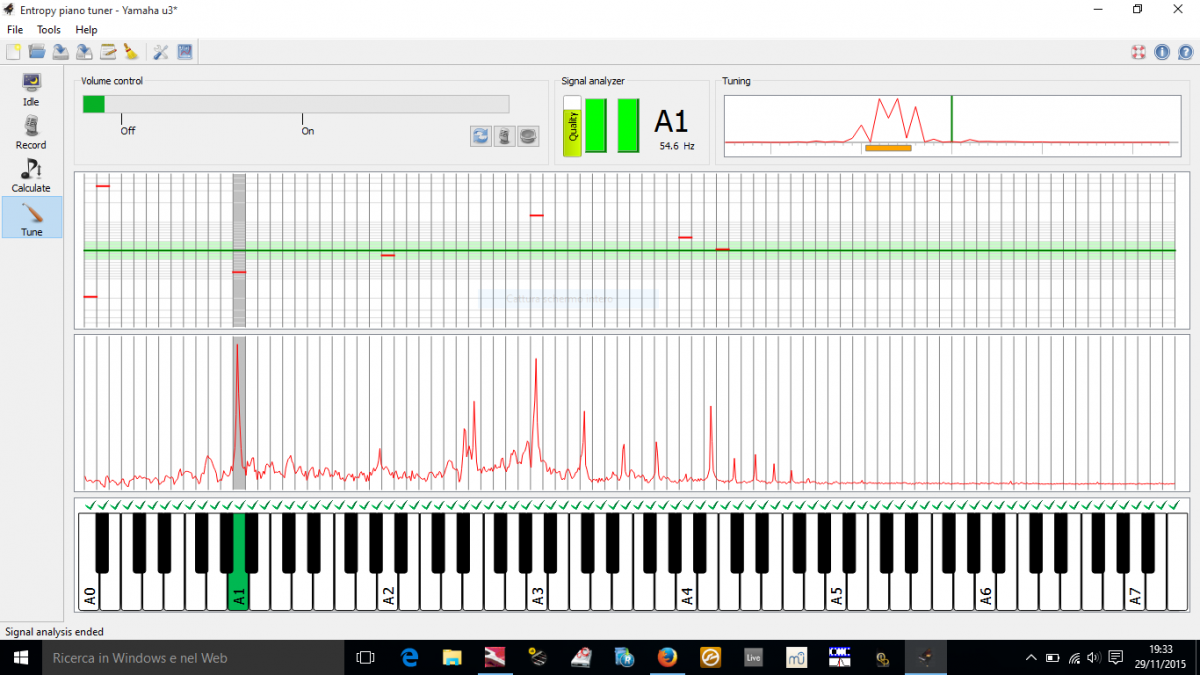
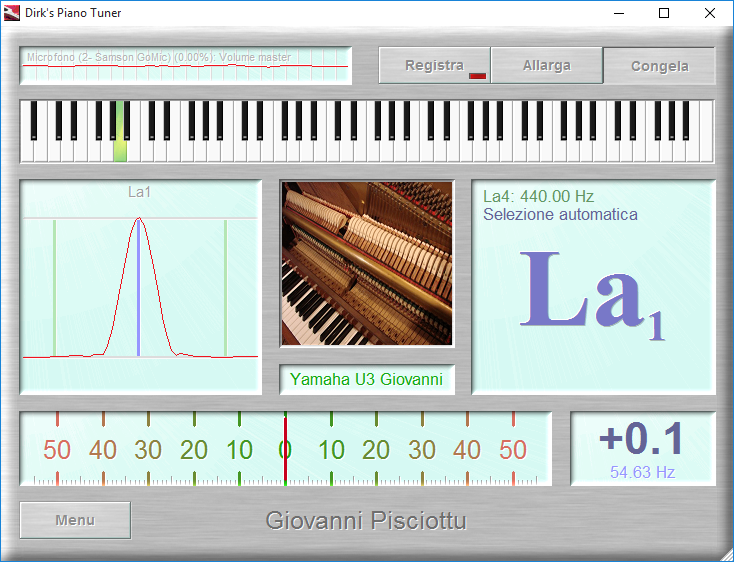
Last night I tried the "Entropiy Piano Tuner" program along with my "Dirks Projects" and I must say that I didn't like it at all (see photo). I found it to be imprecise and difficult to read compared to "Dirks Project". The microphone with the stand is also impractical; just imagine if you had to tune an upright piano, which is almost always located in tight spaces, with the stand and cable getting in the way—you would probably leave the job half-finished due to exhaustion.

If I were you, I would try "Tunelab"; there's no need to buy it, you can download it for free in the Trial version; if I remember correctly, it allows you to tune about ten notes and then it pauses for 10 minutes before you can start using it again. In my opinion, the tunings from "tunelab" are not as precise as "Dirks Projects".

AttachmentAttachment

Member

Reply 7 by magnalf

Posts
56
City
Correggio
TheSimon wrote:

Hi Magnalf, I am glad you read my paper and I hope you liked it.

The discussion related to entropy can be interesting but it is just another way of arriving at a solution to part of the problem. The equilibrium point is nonetheless based on a count of beats between harmonics, so doing it at runtime as tuners like Tunelab or Veritune do, or doing it by sampling sounds and then calculating them together, does not seem to me to change much about the matter. Certainly, sampling a certain number of sounds instead of just a few as Tunelab does can increase measurement sensitivity and certainly promises better results in terms of tuning accuracy. Now we have to see if this greater accuracy is truly justified in practice. Let me give an example... In any case, when tuning, one must consider the tuner's hand. To be fair, the tuner always tunes the note well within a margin of error relative to the frequency at which that string should theoretically vibrate. We are human and therefore there is a certain margin of error; I would say in the order of 2/4 cents. Now, if the measurement sensitivity increases by tenths of a cent, you understand perfectly well that such accuracy is completely useless. It would be like asking you to measure the length of a desk to put in a room with a laser meter... It would be perfectly fine to measure it with a tailor's tape! It is useless to know that the desk is 10 meters long, 1 centimeter, 2 millimeters, and 234 thousandths of a millimeter! Moreover, in this context, but also in the context related to tuning, it could even be misleading! Climatic conditions change the physical variables at play just as they would with the desk. If the temperature were to increase by one degree Celsius, probably the thousandths of a millimeter would no longer be 234 but 879, for example.

The point is that, by necessity, tuning with these software tools is nonetheless a hybrid tuning since they work very well only in the center. In the lows and the highs, as I have repeatedly reasoned and demonstrated even in my paper, it is necessarily the ear that commands. What I was suggesting in the paper could be, for example, conducting an acoustic test on the perception of the succession of ascending and descending octaves to the ear of the person about to tune. In this way, we could have software that behaves a bit like the tuner's ear by imitating it in these areas. The fact remains that for tuning—let's call it "technological" tuning with this tool—there will probably never be an absolutely definitive solution. Perhaps one day there will be pianos that are tuned by ear only the first time. They will memorize the frequencies set by the tuner and, as a note drops, they will retune themselves by comparing the recorded frequency with the current one. Even in this case, however, things will not work indefinitely. Every time a piano is tuned, the string becomes thinner and less disharmonic; rust can appear on the strings, and this also implies physical changes in their vibratory motion. In short, the good old tuner's ear seems irreplaceable so far. In any case, this latter "self-tuning" method could certainly be a good solution for those who use the piano at home to study (not having to seek perfection). In concerts and with concert pianos, however, it will always be necessary to call a tuner. Let us not forget then that even if we managed somehow to solve the tuning problem, all the discussion regarding the preparation of the piano, its regulation, and the voicing of the hammers would remain. True craftsmanship can hardly be replaced by machines! But this is just my opinion.

Yes, I found the paper very interesting, but you must forgive my doubts as an inexperienced person who has recently approached this world of tuning.

If I understood correctly, in ear tuning, first one performs the division of the 12 semitones of the middle octave using the beat-counting method and one also arrives at having zero beats between A2 220 Hz and A4 440 Hz, and so far one could arrive there quite realistically with software (in case someone like me cannot hear and count the beats of a 4th and a 5th).

Then, at this point, one tunes to zero beats the octaves increasing towards the high octaves and decreasing towards the low octaves.

But now my doubt arises which I cannot understand: how can an octave with zero beats (meaning, I believe it is intended as zero beats between the fundamentals, for example, of C5 and C6) coexist if I have to widen at the extremes of the keyboard to compensate for the physiological perception of hearing?"

human that, moreover, is also subjective? Then in this expansion, inharmonicity also comes into play. This point is a bit confusing to me.

Member

Reply 8 by magnalf

Posts
56
City
Correggio
Giovanni wrote:

Yesterday evening I tried the “Entropiy Piano Tuner” program along with my “Dirks Projects” and I must say that I didn't like it at all (see photo). I found it to be imprecise and difficult to read compared to the “Dirks Project”. The microphone with the stand is also impractical; just imagine if you had to tune an upright piano, which is almost always located in tight spaces, with the stand and cable being underfoot—you would probably leave the job halfway through due to exhaustion.

If I were you, I would try “Tunelab”; there's no need to buy it, you can download it for free in the Trial version. If I remember correctly, it allows you to tune about ten notes and then pauses for 10 minutes before you can start using it again. In my opinion, the tunings from “tunelab” are not as precise as “Dirks Projects”.

Hi Giovanni,

Regarding the microphone, I think you are referring to what is seen in the demo video, but it is absolutely not necessary to do it that way; in fact, it is certainly better to record from below, perhaps avoiding placing the microphone against the piano to improve the signal-to-noise ratio of the audio signal transferred to the software. Also, I don't understand how you determine it is “limprecise”.

Administrator

Reply 9 by Thesimon

Posts
4,504
City
Ariccia, RM
magnalf wrote:

Yes, I found the paper very interesting, but you must forgive my doubts as an inexperienced person who has only recently approached this world of tuning.

If I understood correctly regarding ear tuning, first one performs the division of the 12 semitones of the middle octave using the beat counting method, and furthermore one arrives at having zero beats between A2 220 Hz and A4 440 Hz; so far, this could be achieved quite realistically with software (in case someone like me cannot hear and count the beats of a 4th or a 5th).

Then, at this point, one tunes the octaves to zero beats, increasing towards the high octaves and decreasing towards the low octaves.

But now my doubt arises, which I cannot understand: how can an octave with zero beats (meaning, I believe, zero beats between the fundamentals, for example, of C5 and C6) coexist if I have to widen it at the extremes of the keyboard to compensate for the physiological perception of human hearing, which is also subjective? Furthermore, inharmonicity also comes into play during this widening. This point is a bit confusing to me.

You are doing exactly the right thing by asking anything you have doubts about.

Well, the division of the octave is "fairly simple" because it involves counting beats. In this regard, software is a master and indeed works very, very well in partitioning the middle octave. Bringing the middle octaves to 0 beats does not refer to the fundamentals. You wouldn't be able to hear them. The human ear has a limit in counting beats. I don't remember exactly how much it was, but I seem to remember it didn't reach 20. If you were to bring 220 Hz and 440 Hz to 0 beats, you would have a beat of 220 Hz, which you obviously wouldn't be able to listen to. The beat that you actually hear is between the second harmonic of the lower sound of the octave and the fundamental of the next one. In essence, the second harmonic of A3 (220 Hz) is exactly about 440 Hz (I say

Member

Reply 10 by giovannip

Posts
553

I certainly expressed myself poorly, I meant to say that while tuning with "Entropy Piano Tuner" you only have one reference spectrum at the top; as you can see in "Dirks Project" you have three, and this makes tuning much easier, making it more accurate. In the photos I posted, taken at the same time (I had both software programs running), the difference is clearly visible: in the first one we are far from centering the string, while in the second the string is perfectly centered, and we are talking about the note A1; I'll let you imagine what happens when you get to the higher notes.

Member

Reply 11 by magnalf

Posts
56
City
Correggio

Giovanni, in my opinion there is an error. I see from the photo of Entropy tuner that you have recorded all the notes, but I believe you haven't performed the "Calculate" [command], otherwise I should see the red lines for all the keys on the tuning graph located above the audio spectrum graph.

This means that the difference you notice on A1 is due to this:

on your Dirk's [software] you have already done the note recording, then you have already performed "EXPAND" and therefore the software has already calculated (according to its algorithm) at which frequency you should tune the A1; in fact, if we look at the frequency on which you centered it, it is 54.63Hz (a little below the theoretical 55Hz), this demonstrates that you see it centered at 0.1 cents because obviously your piano would have been tuned with this Dirk's.

Instead, in Entropy you see the red line off-center because it is off-center relative to 55Hz; if you had performed "Calculate", the software would have calculated the tuning frequency according to its algorithm (keep in mind that in the "Tuning" window, the one you put in the photo, the horizontal line corresponds to the tuning point which will only be correct after performing "Calculate"; instead, without having done so, the horizontal gray line coincides with the values of equal temperament without considering inharmonicity). If you had performed "Calculate", at this point there should be all the red lines. Only at that point could its precision be compared.

Tell me if what I have said seems correct to you.

Member

Reply 12 by magnalf

Posts
56
City
Correggio

Hi The Simon,

Even before reading your response, I realized the nonsense I had written regarding the beating between the fundamentals.

So, if I understood correctly, in the bass notes widening is required to compensate for inharmonicity, while in the treble, in addition to the compensation due to inharmonicity, an additional correction is needed to compensate for the physiological perception of high notes, which is also subjective; therefore, the software will never be able to do the right thing, even assuming it manages to perfectly take inharmonicity into account. Am I right?

But what does this mean? That if I tune an A6 with zero beats relative to A5, maybe you or someone else might hear beats because my perception of that frequency is different from your perception?

Administrator

Reply 13 by Thesimon

Posts
4,504
City
Ariccia, RM

No, both in the bass and in the treble, you have different perceptions for psychoacoustic reasons. The problem is that when going down and up, it is very difficult to listen to octaves. If you go down, the vibrations become too slow and it is difficult to hit the center perfectly. If you go up, they become too fast and it is equally difficult to hit the center. This is said in a very unscientific way! Beats are beats. There are those who hear them and those who simply do not hear them, but those who hear them hear them in a way that is perfectly identical to any other person. If there are 3 beats per second, they are so for everyone.

Member

Reply 14 by giovannip

Posts
553

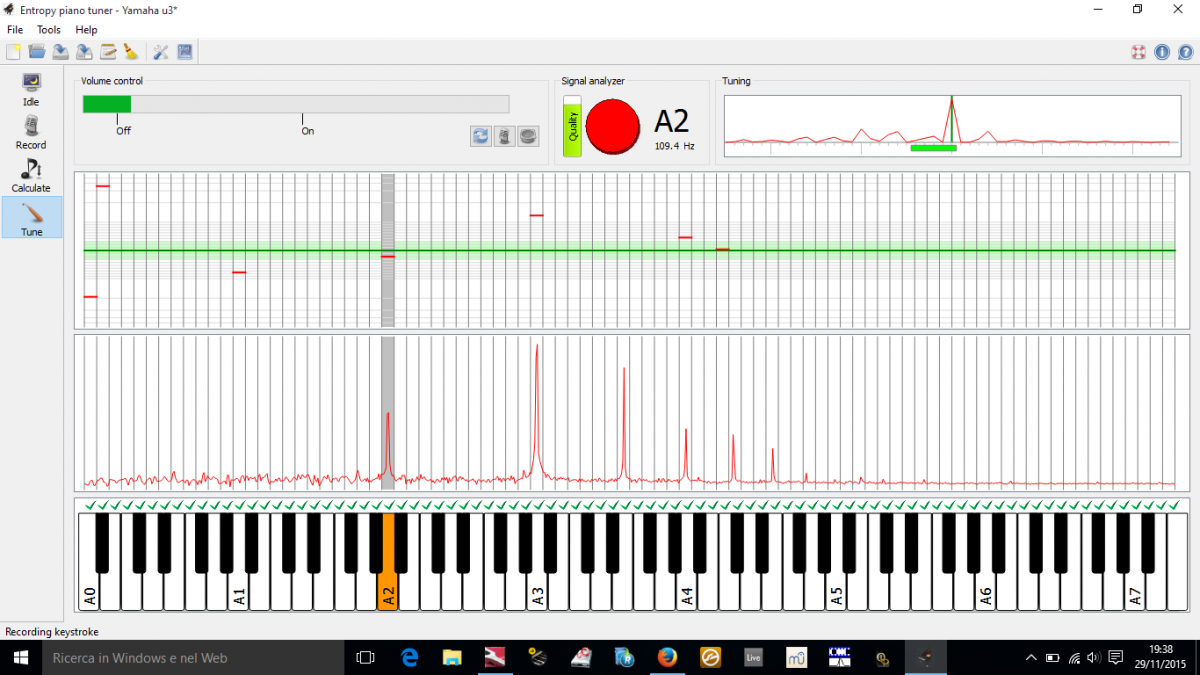
magnalf i am certain that I did the "calculate" on the Entropy tuner, so much so that in this other photo it is perfectly clear that I centered the tuning. Anyway, try it and let us know; if it works on all compartments, great, otherwise oh well, it won't have cost you anything and you won't have any regrets.

Attachment

Member

Reply 15 by magnalf

Posts
56
City
Correggio

Giovanni, I think there is something wrong with your photo.

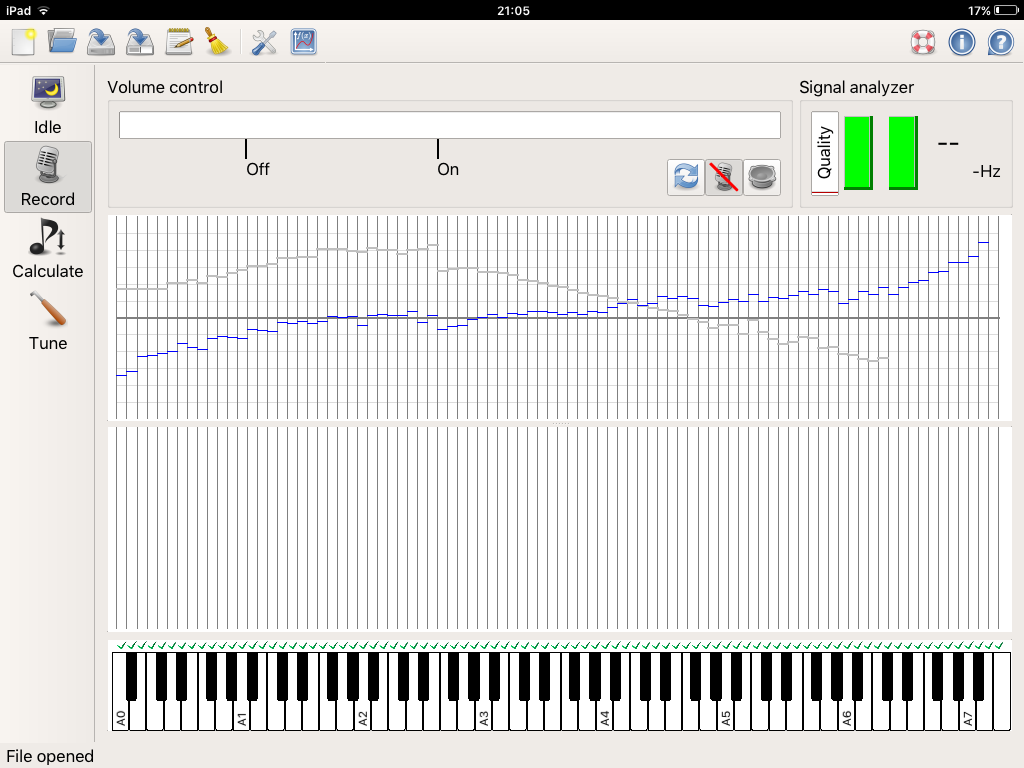
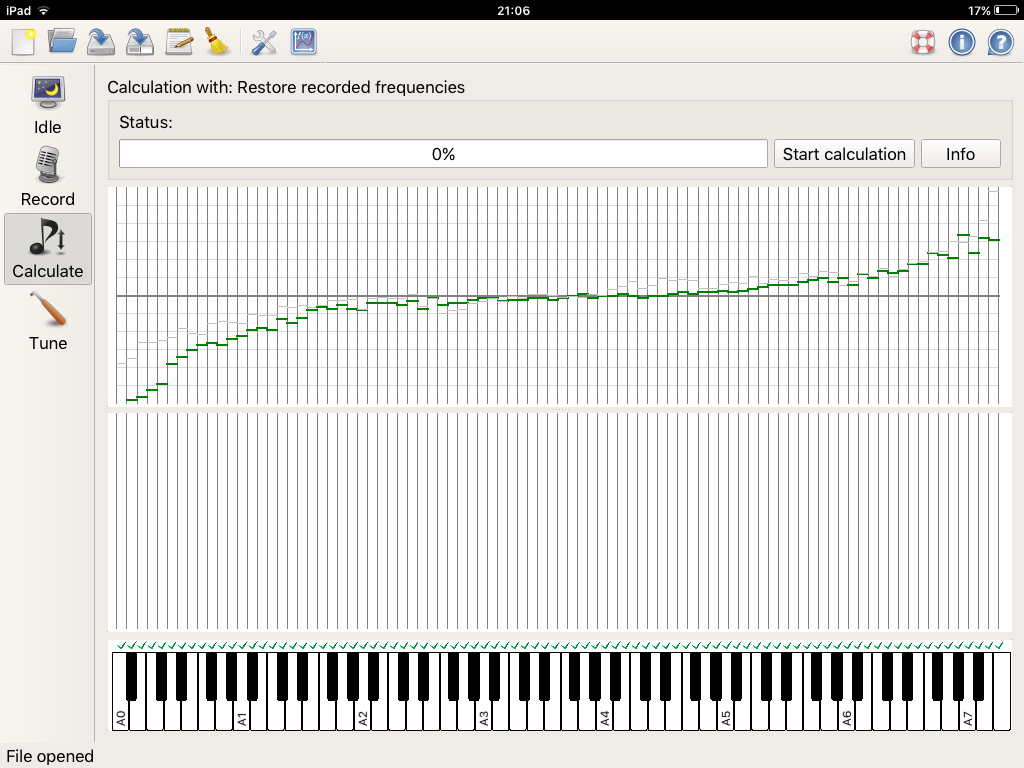
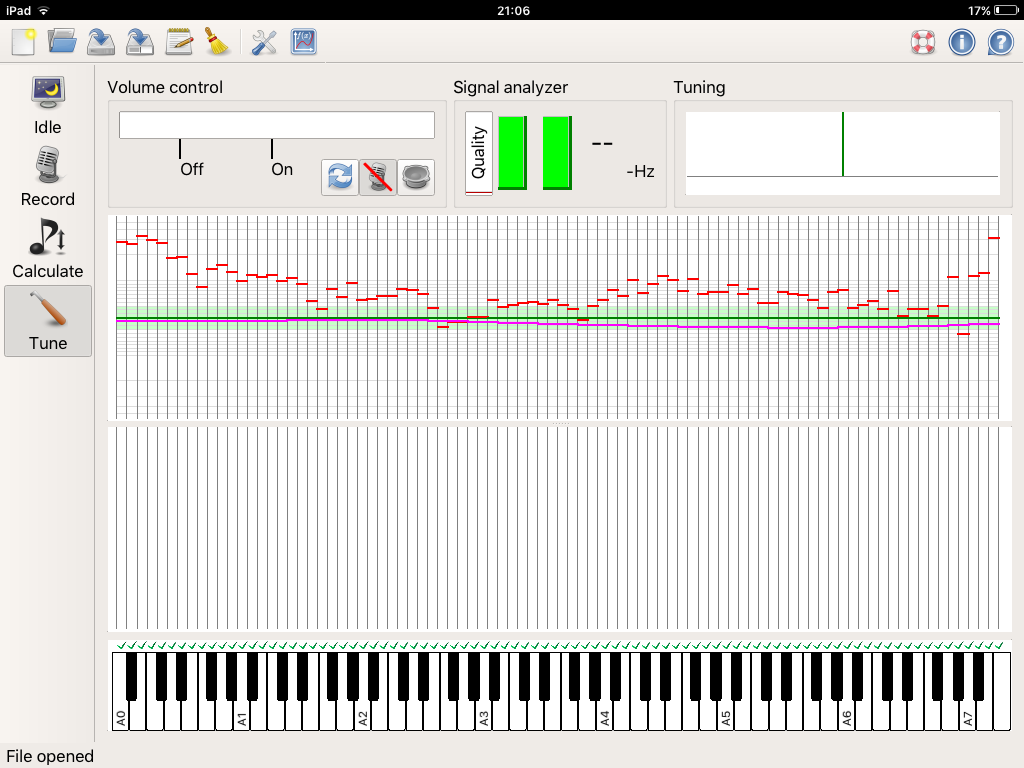
Look at my 3 photos which are respectively: Record, Calculate, and Tuning.

In the Record tab, the grey curve represents the inharmonicity (the graph has inverted values, meaning it grows from top to bottom, intentionally so as not to interfere with the blue graph); the blue is the current state of my pf.

In the Calculate tab, the blue is the current state of the pf, and the grey and green ones would be the result proposed by the software calculation.

Finally, the Tuning tab (the same as your photo) in which the red shows how far my strings are from the calculation proposed by the software. So now I should act on the pins to bring the various red lines toward the central green line.

If you had done the Calculate, you should find all the strings in red, not just some. This makes me think that you did not follow the procedure correctly.

AttachmentAttachmentAttachment

Member

Reply 18 by magnalf

Posts
56
City
Correggio

At the moment I have used the software installed on an iPad. And therefore I used the internal microphone. I only made some evaluative recordings of the software's potential.

However, I want to run tests with two microphones that I use in the laboratory for my work. One dynamic and one electret from a German brand.

I wish to verify if with these I obtain better precision at low frequencies, where it seems to me there is no accurate repeatability in the measurements when using the internal microphone.

Or perhaps it is a problem with the software.

As soon as I have the necessary time, I will conduct the tests and keep you informed.

Member

Reply 19 by salvopiano

Posts
28
City
ct

I think it is really a software problem; I tried it with endrabbi and the result does not change in the bass part (last 2 octaves). The software doesn't seem bad for being free, but I believe it needs to be improved; it doesn't seem very stable to me.

Member

Reply 20 by giovannip

Posts
553

The microphone I use is the "Samson go Mic" with a USB connection; the microphone is very small but excellent for tuning the piano, but as Simone said in a previous post, a contact microphone like those that stick to an acoustic guitar etc... is sufficient...

Log in to participate