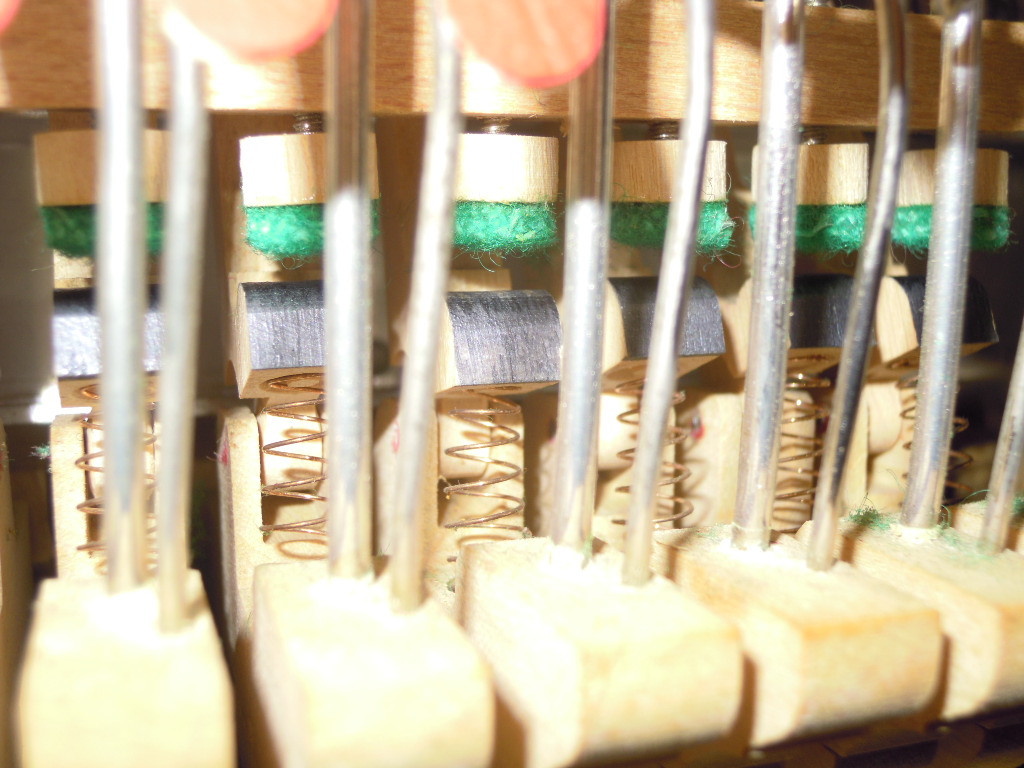
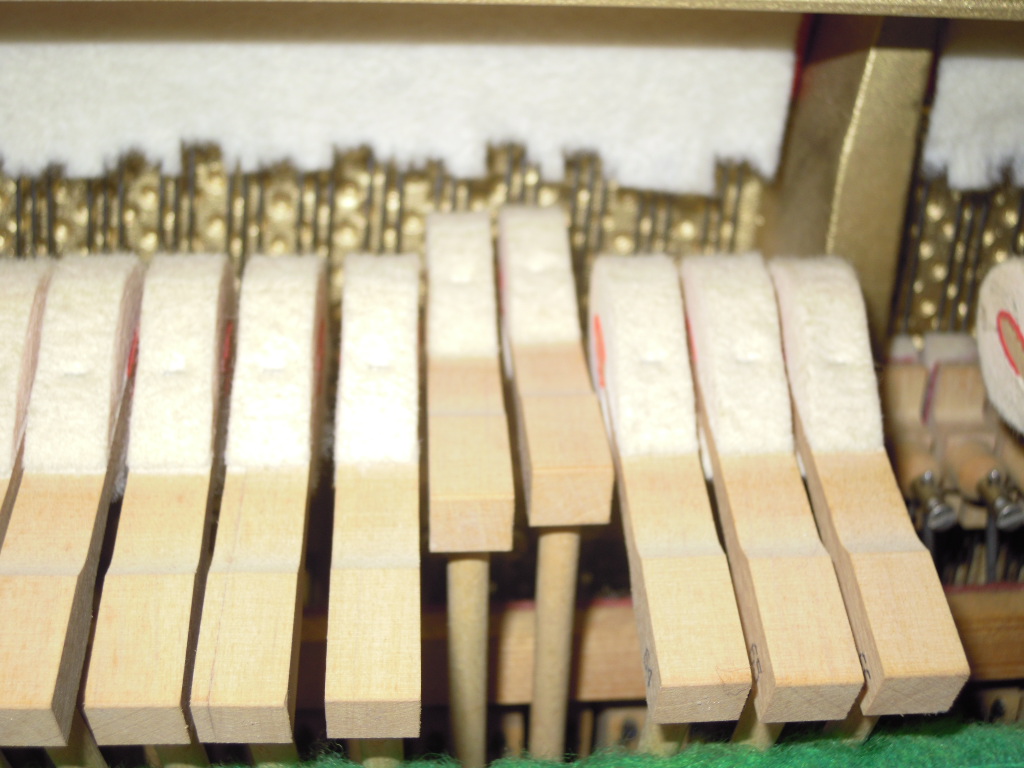
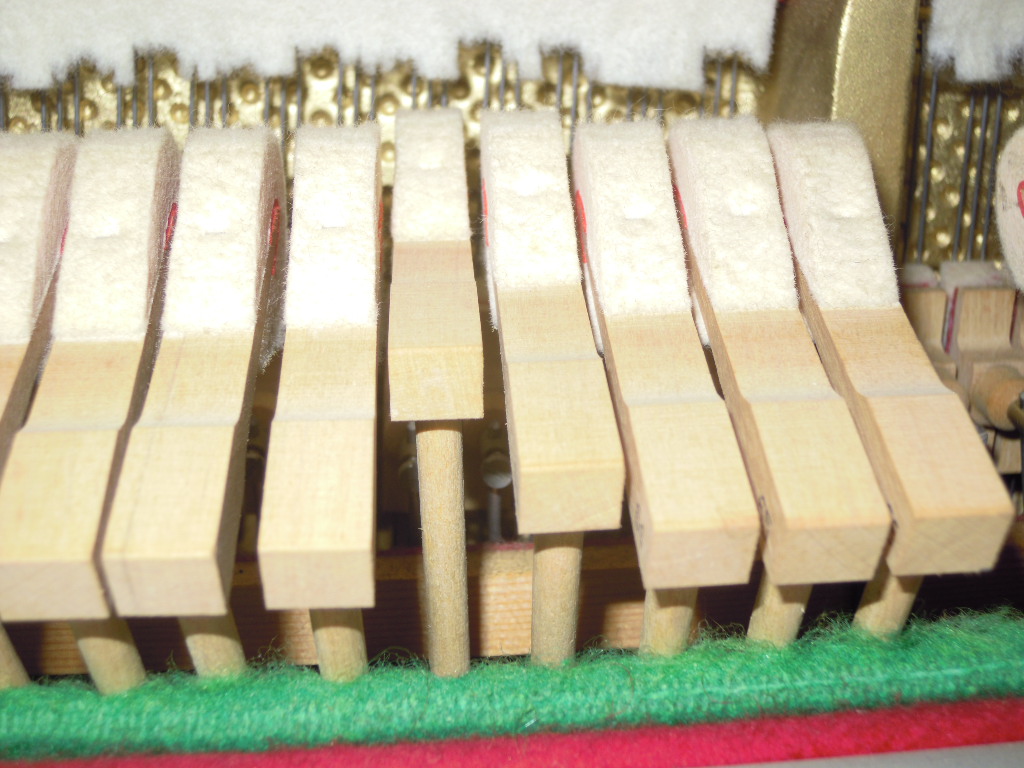
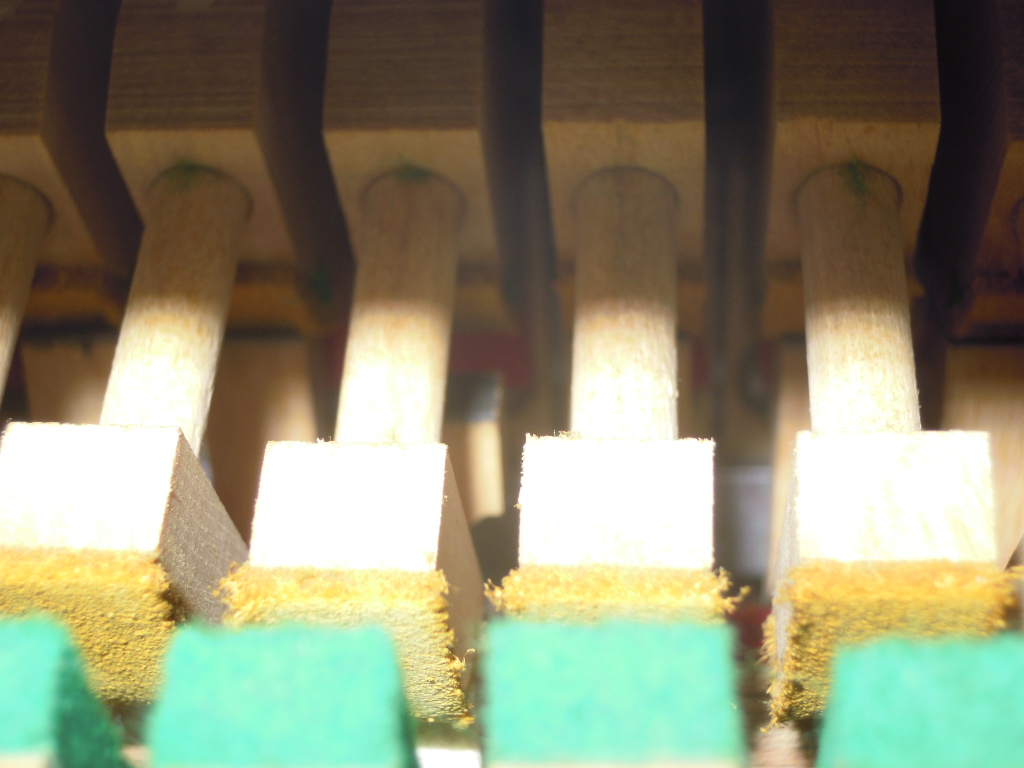
Hi everyone, I am starting to play again after a long time and I have unfortunately realized that the problems that existed some years ago have not resolved themselves! It actually happens on some keys in particular, the E's (it must be a curse), which after being pressed two or three times no longer sound. I disassembled the panels and noticed that the "escapement finger" of that key in its resting position is lower than the others and that the escapement remains out of position when the key does not sound. I did several [tests]: the first on the "finger" with the key at rest, the second with the adjacent key (D#) also pressed, the third after releasing the keys, the fourth on the escapement.
What do you think? Could it be that the spring is a bit weak? The strange thing is that I have always been disappointed by this piano; it has always had these problems since the beginning 20 years ago, and it seems to me that the tuner used to solve it (unsatisfactorily) by putting some small weights that I can no longer identify. Advice?
It definitely depends on the hammer pins and/or the escapement uprights and/or the wippens. They must be replaced and enlarged. Absolutely increasing the weight is against all good sense and does not solve it. Let me know
I have encountered a few pianos from friends with the defect you describe, and as pianoexpert tells you, the problem is almost certainly with the pins, either those of the escapement lever or those under the keys.
I don't seem to see hammers that touch each other and brake during their stroke, which is another reason why sometimes there isn't a complete return.
However, it is not clear to me, so I am asking Paolo for clarification, because he says that the pins (are they also called center pins?) should be oversized. Is the reason that it is always done this way when they are replaced? To prevent them from "rattling" inside the bushings, even after having replaced the cashmere lining?
Last thing, is it worth trying to lubricate with a bit of teflon spray? (it has often saved me from inexplicable situations!)
So no lubricants!! The pins are also called wires or center pins because they constitute the fulcrums, i.e., the centers of the action. There are three: the center of the hammer flange, the center of the repetition lever flange, and the center of the escapement upright. In the grand piano, there is also that of the repetition lever, and there are also, in both the grand and the upright, those of the damper flanges. Replacing the buckskin is a difficult task and is done as an extrema ratio. Each pin must be tightly and immovably fixed on the wooden part of the hole and as mobile as necessary within the buckskin holes, which shall be bored with straight reamers and not conical ones!!! The movement tolerance must ultimately result in no more than 3 gr. for the hammer flange and up to 6-9 for the repetition lever flange. For the escapement upright, once removed from its spring, it must fall naturally. With these tolerances, the parts must be very secure. The test that must be performed is to fix the flange with a finger on a flat surface and check that the piece does not oscillate at all. The increase [in size] favors better movement, but above all ensures the firmness of the new pin in the wood. It is something for experts, and one must have experience to be able to perform a satisfactory job... even over time
Thank you for the answers. I suspected a spring problem more than anything else. But now that I think about it, my (un?)trustworthy tuner would disassemble the entire action, lay it on the table, detach the hammers that had this problem—which, I repeat, is an ancestral problem with the E's—and with an awl, he would pull out some pins and replace them. Then I would try to play, and systematically I was not satisfied, and he would add some little weights with almost no substantial effect. Now, I don't want to say he was incapable; on the contrary, he would spend an entire afternoon on it. But I don't know what to say, perhaps my piano left the factory a bit defective? It is a Petrof Concertina II. I remember that in the academy there were some low-level Korean instruments that had a more pleasant keyboard than mine. I don't know what to say. I will start looking for a technician.