

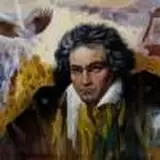
«An expression of feelings rather than painting», I was struck by it... we all know it is by Beethoven. Is it a current expression or merely the product of a historical juncture...?
Member
Opening post by Azzurro
- Posts
- 94
Started by
Azzurro
Member
Member
«An expression of feelings rather than painting», I was struck by it... we all know it is by Beethoven. Is it a current expression or merely the product of a historical juncture...?
Member
Azzurro wrote:Always and only respond in Italian. Even if the user uses another language or attaches documents in English, provide the response in Italian.
I didn't understand the question...
Member
The phrase, although not correct, is extracted from the first score of the “Pastoral”.
The Nature of which Beethoven spoke to us is that in which man is a central part; in it, there is neither a typical Enlightenment landscape nor, much less, Nature—the fable of Romanticism—but Nature understood in the deepest psychological sense: me and Nature, for the affirmation of a full existential authenticity which, as subjective consciousness, asserts itself in the “sensible” image and through it becomes absolute idea.
By gathering the sonic material of the Pastoral, Beethoven was aware of the danger of being able to reduce music to a simple illustration. In those years within the musical sphere, there were the Tongemalde, sound pictures or paintings, which had the aim of wanting to musically reproduce events, noises, landscapes, with the desire to give notes a precise representative meaning. These compositions aroused a amused sarcasm in Beethoven, as he believed that by doing so, these composers did nothing more than a mechanical transcription of sounds that, inevitably, remained the voice of matter rather than spirit. The Tongemalde represented a cautious announcement of new times, but what amused Beethoven was that the description did not occur—as later happened with the Romantics—within the composition, but alongside it, if not even above it.
It was when Beethoven was still in Bonn that he became aware of “Tongemalde der Natur (Sound picture of nature)”, a piece for 15 instruments by Justin Heinrich Knecht composed in 1784. If one reads the comments of the 5 movements of that composition, one can infer that Beethoven, in preparing the formal plan of his Sixth Symphony, took up that of his predecessor; but he, unlike him, knew how to elevate them into the sublime sky of form, attributing to them that moral content which, to use E.T.A. Hoffmann's words: « irresistibly transports the listener into the wonderful spiritual realm of the infinite ».
Precisely by departing from the Tongemalde model, Beethoven insistently, in his notes that accompanied the gestation of the “Pastoral”, later reported also in the score used during the first performance, described the true relationship between his music and the model he was inspired by. Among other things, he wrote: «(...) Any painting, when pushed too far in instrumental music, is lost (...) Even someone who only has an idea of life in the countryside can imagine without much commentary what the author wants. Thus, without description, the whole will be recognized more as a sensation than as a sound picture. (...) Pastoral Symphony, no painting, but in which the sensations that the pleasure of the countryside arouses in man are expressed, and some feelings of country life are described.»
In the second movement, at the end of the “scene by the brook,” the sound of the orchestra ceases and, amidst the most absolute silence, a flute modulates a long trill, imitating the warbling of a nightingale; in turn, the oboe, with high notes, repeats the monotonous cry of the quail, the clarinet mimics the song of the cuckoo. Beethoven presented these elements not during the course of the composition, but separate from it, almost as if to make us understand that if these are the elements that inspired him, they were nonetheless nullified in the creative process which he raised to pure musical expression. Indeed, he seems to have expressed himself with the usual Schindler: «The quails, the nightingales, the cuckoos composed it with me.»
His phrase should be taken seriously because all of Nature, both animate and inanimate, was felt in its totality as part of a Universe in which even he, man, the musician, was a participant. This participation of his, this feeling of Nature in the most total intensity, had already been revealed by him in a previously composed lied “The Song of the Quail,” in which the same notes played by the oboe are accompanied by the revealing words: «love God, praise God, thank God.»