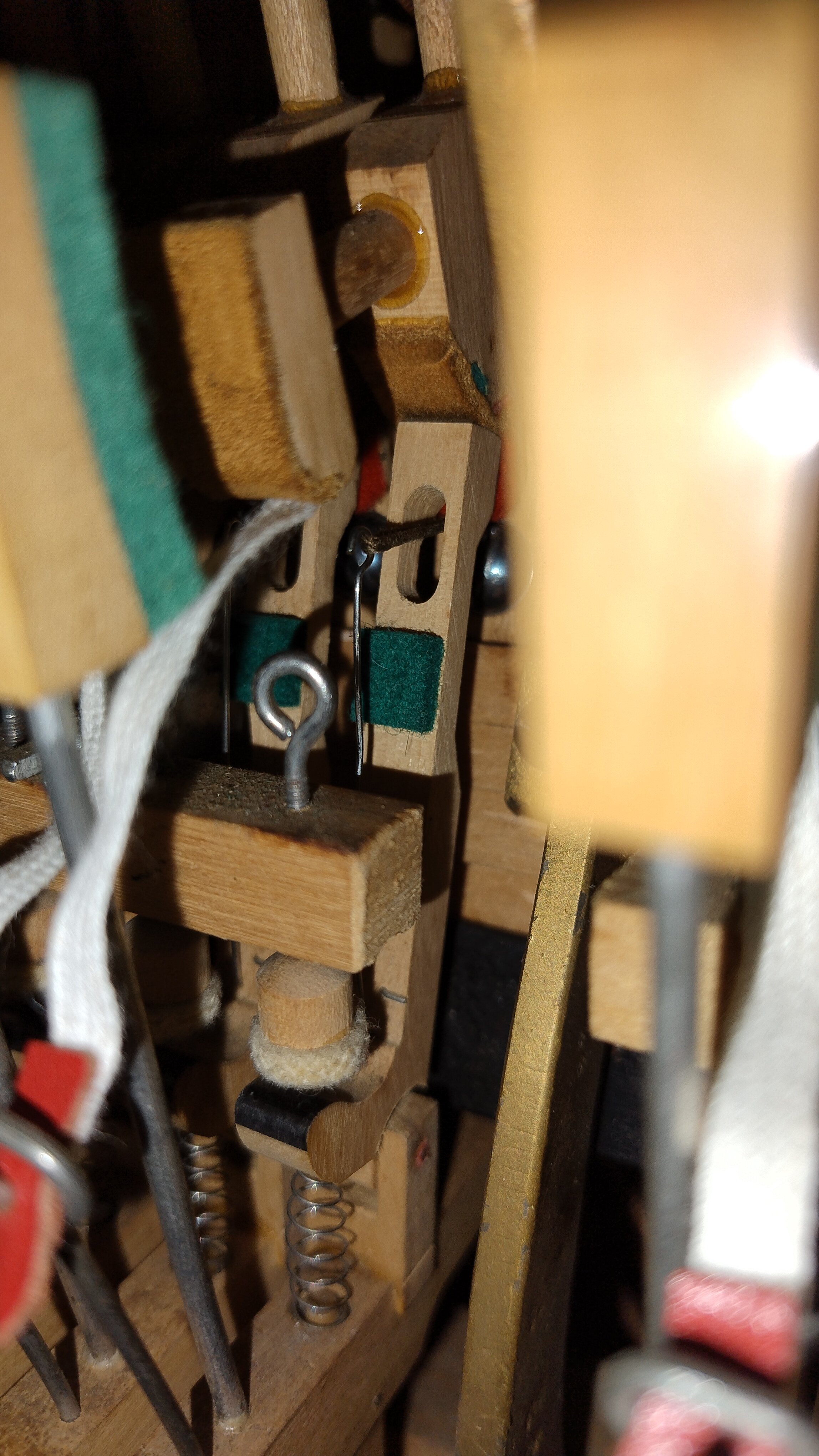
Good evening, while doing some repetition exercises on my upright piano, I noticed that the action is a bit "weak"
I rule out the problem of the center pins since they were changed a few months ago
So it occurred to me to increase the escapement distance a little
Currently I have 2.5mm in the bass section, 2mm in the mid section and 1.5mm in the treble
Hammer-to-string distance is 46mm and let-off is 1mm
By increasing the escapement by 0.5mm and moving the capstan slightly closer (so as to keep the hammer closer to the string), would I achieve the desired result?
I checked the movements more closely and noticed that the repetitions tend to gradually rise towards the end of the escapement instead of returning underneath, and therefore the hammer tends to recoil
I have the check as close as possible; I tried to set it a bit closer, but it ends up that in pianissimo, the hammer remains "pressed" against the string, so I would say it's OK
But by tightening the springs more, do I facilitate the return of the repetition lever into its seat?
Additionally, my piano has a repetition return system via a spring... Could this last one be worn out?
No. You must, then, check the hammers. The hammers must rest on the rest felt and the shank must be able to position itself freely and easily under the cap almost without play, easily. Stimulating the shank with a wire, it must return under the cap without friction. The regulation, from what you are telling me, seems to be too far forward
That is, by how much must the hammer retreat after striking the string?
Additionally, I have a curiosity...
If after "escaping", the hammer returns and upon releasing the key, the hammer advances a few millimeters forward before coming to rest, is that a sign of good regulation?
And anyway, the mechanism I was referring to is this one, but without spring and cord adjustment screws https://youtu.be/UOV6Khfk4cg?feature=shared
Gib wrote:
On 11/03/2025 at 13:24, Gib said:
I was making various attempts on some notes anyway and I tried to bend the upright's return spring and I must say that the problem seems to be resolved
you cannot explain everything from a distance. The aftertouch also takes into account the depth and the hammer-string distance. Generally, it is about one millimeter. The video you posted refers to an attempt made on some pianos (e.g., Schimmel) to simulate a sort of vertical repetition. One should ask why many manufacturers have not embraced the idea.
I understand, with the aftertouch we are there anyway
I was wondering how to best adjust this action since with the weak spring it's like not having one; if I tighten it a bit more, the repetition works great, the hammer still manages to escape but when playing pp sometimes the hammer hits the string twice
This Langer mechanism is interesting, but be careful not to overdo the spring tension so as not to compromise control in pianissimos. Perhaps a compromise between tension and escapement regulation could help you maintain the repetition without the double strikes you are currently hearing.