hi, anyone who tunes pianos has certainly encountered the phenomenon of false beats.
especially in the initial phase of learning this trade, the phenomenon makes the search for clean sounds much more complicated.
then, with practice and listening, one manages to find an acceptable compromise, at least for the end user.
in the past, in the stubborn search for the cause of this disturbance, I have tried replacing the string, plucking it instead of striking it, pulling it more up and down by a tone hypothesizing that it would resonate with some other component of the piano, building a temporary bridge to reduce the vibrating length, stopping all the other strings to exclude any contribution from them... nothing to be done, one (often more than one) steel string, on its own, besides the note it is supposed to play, produces an unwanted oscillation.
in the end I resigned myself and refined my search for unison, but curiosity still drives me to find the answer to this which for me is a dense mystery.
i add that the phenomenon has presented itself to me almost always in the notes from cantabile upwards; only once did I encounter a wound string that did something similar, but in that case it was enough to replace it.
hi, as I stated in my post, I have encountered this phenomenon in several pianos, including grands. even in the two I currently own, a Kawai NS 15 and a Blüthner, also an upright, from over a hundred years ago. among the tests I performed, I placed the tip of a small screwdriver to lever against the adjacent string to create a temporary bridge, but the disturbance remained unchanged. perhaps you have so much practice that you don't even notice it and still find the optimal unison. I, sometimes, when the phenomenon is very evident, try to find which of the three strings produces the cleanest sound and, if there is one, I tune that one first and then the other two.
thank you anyway for your willingness to listen to problems that are not yours.
I had already tried to reply and I don't know how it went.
I never would have imagined that such a tiny section of free string could generate such a disturbance. I had noticed the strip of felt that is often woven with the strings between the bridge and the hitch pin, and with this, I had mentally filed the problem away. The video is perfectly centered on what I have been looking for for years. I thank you warmly and will make good use of this new information, which I will verify as soon as possible.
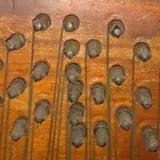
my request was to see the position of the bridge pins relative to the centering of the notch. Sometimes double strikes are caused by the fact that the pins are driven not quite in the center of the notch, thus generating two different lengths of the same string (from the agraffe to the pin and from the agraffe to the wood notch)
first of all, thank you for the time you spend free of charge; this denotes a clear objective of striving for perfection, regardless of whether it concerns your own pianos or not.
i am sorry for not having read your first response carefully, in which you spoke about the bridge. one point remains unclear to me: you speak of two different lengths of the same string. i cannot understand. i add that in the first case presented to me, it was Gia's hypothesis, whom I also sincerely thank
So. The string vibrates from the nut to the point embedded in the bridge. Sometimes the factory technician does not embed the pin perfectly in the center of the notch! So, for what length does the string vibrate? Once it vibrates from the nut to the bridge pin.... but at the same time it vibrates from the nut to the bridge notch. This creates an antagonism between the two lengths which, vibrating together, create false beats... as if they were two strings of different lengths that do not reach unison. If the bridge notch is further forward than the pin, the discordance can be corrected. Otherwise.. no!
well, thank you, now I am starting to understand. I will be able to claim that I have understood as soon as I encounter the phenomenon and dive into it.