Thank you Goffredo....
are you joking? Who knows what Fiorella would think! Then, driven by the numerous likes on this post, here are the latest developments: the CDs (and the YouTube videos) contain a single recording, the one made by Weingartner with the Royal Philharmonic Orchestra and recorded on March 26/27/28 and 31, 1930, in Central Hall, Westminster. The exact division of the matrices is as follows:
I Allegro (WAX 5487/ 88; Columbia LX 43)
II Scherzo - Assai vivace (WAX 5489; LX 44)
III Adagio sostenuto (WAX 5490/92/98/99; LX 44/46)
IV Largo; Allegro risoluto (WAX 5485/86/91; LX 46/47)
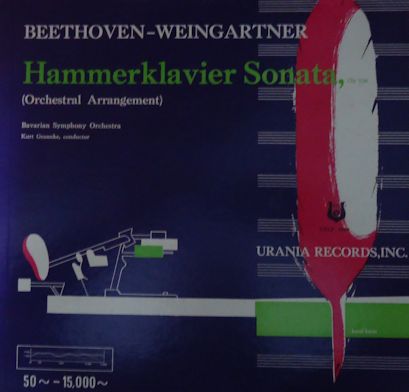
My rare LP, on the other hand, was recorded in the Munich studios in August 1952 by Kurt Graunke with the Bavarian Symphony Orchestra and published in 1953 in the USA. I have put the four audio files online right on the site, so we can enjoy this rare novelty: http://www.lvbeethov...te.html#Opus106 .
-------------------------------------------------------------------------------------------------------------------------------------------
Here is what I found regarding Weingartner's orchestration (Pearl):
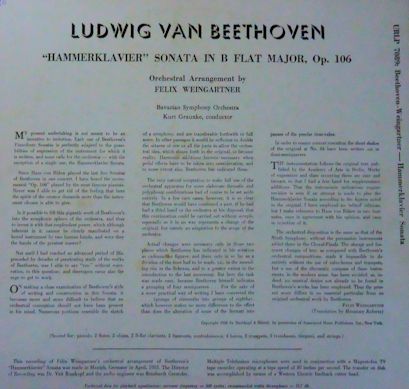
In view of the fact that he was both a pupil and a protégé of Liszt, it would be easy to deduce that in Felix Weingartner we have an invaluable link between the golden age of Romanticism and the more dispassionate temper of our own times.« It would also be mistaken In reality, as evidenced in the present recording, Weingartner was among the first conductors to take aim at the Romantic movement and shoot to kill. When Debussy described him as “a new knife’’, he referred to something more than the maestro’s angular and incisive demeanour on the rostrum. In a lifelong artistic crusade of almost unnerving consistency, Weingartner sought to purify the memory of the masters by ruthlessly stripping away what he saw as the excrescences of Romantic self-indulgence (egregious rubatos, the irrelevant highlighting of inner voices, capricious fluctuations of tempo, orchestral retouchings etc.). In championing this then unfamiliar respect for the markings in the score, he brought to his interpretations the fellow-feeling of one who knew musical creation from the inside out. Unlike the famous Hans von Bulow, who represented most of what Weingartner despised in a conductor, he was himself an accomplished and prolific composer, whose failure with the public was the bitterest disappointment in his artistic life. And therein lies the greatest paradox in his eminently successful career as a conductor. While on the one hand espousing fidelity to the score, he was not averse to making liberal cuts, particularly in the works of Wagner, as though to demonstrate that even the greatest geniuses were prone to imperfect judgment. “I came to the conclusion,” he once wrote, “that many pages [of Wagner] are too long, not only in actual time but also in organic structure, dramatic necessities and unity of style. I therefore consider judicious cutting an artistic duty that greatly enhances the aesthetic pleasure to be obtained.”
It was in a similar spirit, though from different motives, that he helped to complete Beethoven’s own (ostensibly) imperfect vision of the titanic Hammerklavier Sonata, Op. 106. This colossal work - with Liszt’s B minor Sonata, the greatest overall challenge in the 19th-century piano repertoire - was unique, in Weingartner’s view, for reasons far transcending its unprecedented length and difficulty. Alone among Beethoven’s sonatas, said Weingartner, the “Hammerklavier” exceeds the limits of the instrument for which it was written. And here too, he brought the authority of first-hand experience to his judgment: the great Liszt himself applauded Weingartner’s achieve-ments as a pianist. From his earlier contact with the piece, the “Hammerklavier” preyed on Weingartner’s creative imagination. Might it be possible, he asked, “to lift this gigantic work into the Symphonic sphere of the orchestra, and thus to invest it with that resplendent power which cannot clearly be manifested on a keyboard by two human hands?” Late in his career, after a lifetime’s study of Beethoven’s works, he felt ready to answer in the affirmative. Accordingly, in 1926, and convinced that he was fulfilling what must already have been in Beethoven’s mind, he published the score performed here.
Restricting himself to the orchestral forces used by Beethoven in the Ninth Symphony (minus the percussion instruments of the finale), W'eingartner nevertheless availed himself of certain post-Beethovenian developments. For the abrupt and frequent key changes (a feature, incidentally,not characteristic of Beethoven’s own orchestral compositions), he felt obliged to introduce the use of valve-horns and trumpets, but apart from this he adhered strictly to musical devices sanctioned by the composer himself. There are moments, however, as in his Wagner emendations,"
when Weingartner the composer/ adapter might seem to be trying to have his cake and eat it too. “In a few rare cases, ” he notes, “it is so clear that Beethoven would have continued a part if he had had a third hand or the orchestra at his disposal, that continuations can be carried out without scruple, especially as they in no way represent a change of the original (!), but merely an adaptation to the scope of the orchestra.” Harmonic additions, too, became necessary in the translation of pedal effects. Otherwise, the arrangement is a model of the transcriber’s art, whose fidelity to its model may be easily checked by following the performance from the original piano score. In one important particular, however, it may be said that Weingartner’s painstaking act of interpretative recreation robs the music of one of its most fundamental properties, the element of struggle. In the hand of even the most finished virtuoso, the sonata is manifestly the work of one of music’s most exalted and indomitable.
------------------------------------------------------------
There is so much material to write a book chapter... by the way; I remember a passage from a book that reports more or less textually that the incipit of the first movement of the sonata has something grandiose in the piano version that is lost in the orchestral transcription.... if Daniele or good Luigi don't help me, I will start rummaging through a mountain of volumes....