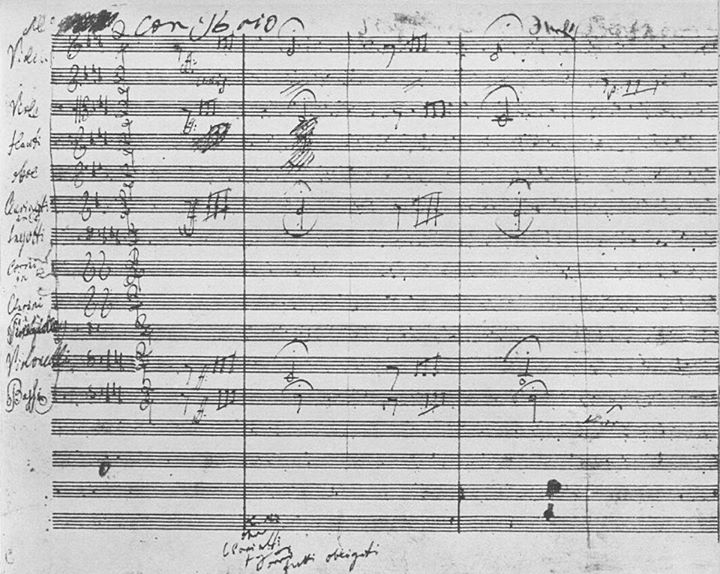
I would like your opinion on the fact that despite Beethoven having placed at the end of the manuscript of the fifth symphony the notation: "oboe, clarinets, bassoons, horns, all obbligato" and not having ever written the bar with more than one tied note to the fermata, the incipit continues to be performed only with clarinets and strings.
In your opinion, could it be that Beethoven desired a full orchestra opening?
I believe that Beethoven had a very precise vision of the timbre he wanted to achieve. By renouncing, for example, the high octave (of the tutti), one risks returning the "usual" loud and bright tutti. Clarinets are the darkest woodwinds, especially in that register. A beautiful effect in my opinion.
Thanks Rotore, but don't you find, for example, that about eighty strings from the Berlin [Philharmonic] plus four clarinets is a bit disproportionate?
Many bows with metal strings definitely need to be balanced, so the solution applied by Karajan, with the doubling of the woodwinds, is just as good. If we considered using gut (and its "transparency"), everything would be simpler in terms of orchestration.
Ettore! .... it occurred to me this morning, while thinking back to an interview with Claudio Abbado, something that could be the explanation for why, in practice, not all the mandatory woodwinds indicated by Beethoven in the manuscript are present, and only the clarinets remain to accompany the strings.
we must refer not to the manuscript but to the first editions.
Beethoven, who had no possibility of sound recording, could only verify an ensemble timbral effect through performance.
Whether it be a public performance or rehearsals, we are already in a stage where the manuscript has served its purpose: that of serving the copyists to produce the individual parts, the fair copy, if not even the first edition.
Perhaps once heard (even during rehearsals?) those mandatory woodwinds did not please Beethoven, and then one should find traces of this change of mind in the first editions revised by the copyist himself.