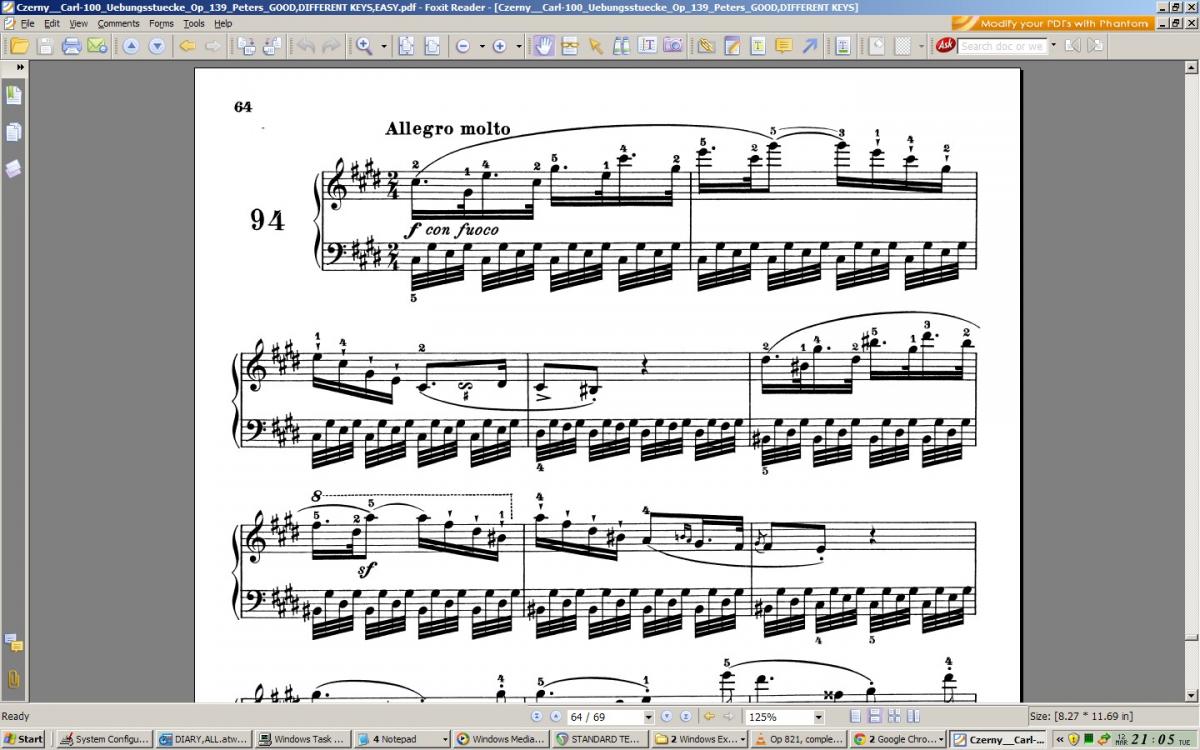
great study.....fingering advice: C7 arpeggio with the ninth, in measure 5, the fingering 2-1-4-2-5-1-3-2 seems like a mess to me (thumb on black keys when maybe it could be avoided?), I chose 2-1-4-2-5-2-4-1, what do you think? image and audio attached (it's not me playing)
I think you should start getting used to putting your thumb on the black keys. Look at Chopin's Etude Op. 10 No. 5... Just to give you an idea.
T
ttw
Member
Reply 4 by ttw
Posts
277
Play the chords fully, you will see that the most natural fingering is the one indicated
First phrase right hand:
- First 5 notes, C# minor... nothing could be better
- Idem for sixth, seventh, eighth and ninth note ...same chord, different position, indicated fingering is perfect including 525 of the second measure with 2 acting as a pivot
In the left hand you could put 4 on C#, but you will then have to manage the first note of measure 4, where the best solution is 4 on D
P
pianistamaggiorenneDi38
Member
Reply 5 by pianistamaggiorenneDi38
Posts
113
thanks guys, both points you made make perfect sense, great advice.
I will work on getting used to using my thumb on the black keys...... strangely, it feels more natural with my 'fingering' than with the one indicated, which means several things:
i haven't practiced enough arpeggios, aside from minor and major ones, and not even that much....
i spent too much time 'winging it' when I was doing harmony exercises, with the result that my 'unnatural' fingering now feels 'natural' to me, but not vice versa.
I don't think it will take me long to remedy this problem if I put some work into it; if you can suggest other little studies with arpeggios, please do (but not Chopin's, they are a bit too demanding and besides, I still don't understand Romantic period harmony very well, I will open another post regarding that)
i think I will also start working on CPE Bach's Solfeggio..... if you can suggest others similar to it from the Baroque/Classical period, let me know
thanks everyone !
T
ttw
Member
Reply 6 by ttw
Posts
277
Mannino wrote a method for arpeggios.
L
Ludovica
Member
Reply 7 by Ludovica
Posts
298
If I am not mistaken, arpeggios are also proposed at the end of Hanon. Surely, as ttw says, Mannino is complete. Let's not forget the repertoire
Even if you find Chopin's studies a bit difficult, in my opinion it is always better to study a type of technique (for example the arpeggio) by integrating it with a piece that contains arpeggios and studies of the same genre. In this way, one learns the technique in the sense of a "gym" but also applies it in a musical expressive sense.
Maybe even slowly, but for the arpeggios, I would do Chopin's op. 10 no. 1. It is simply magnificent.
Fingering is part of the art of music and denotes your idea of a passage. One thing I criticize about the way scales and arpeggios are taught is that only ONE way to perform them is taught, when several fingerings could be used, each different at an artistic level. Let's imagine a C# arpeggio over two octaves. The thumb is located at the moment of greatest emphasis in the musical breath. So I can place it on the C# or on the E (whether it be sharp or natural), depending on what you want to communicate
Yes, absolutely right. Much limitation in the miscellaneous of understanding things. Doors are not opened, but generally one tries to make a student enter a room where they must stay forever...this is very limiting.
The conservatory trains pianists who are very closed-minded, obviously considering the due exceptions. Speaking with a female pianist, she was scandalized by how she saw organ students approach the instrument, the strange fingerings, and some of the "liberties" they take, in contrast to the almost scientific rigor that is passed down to pianists. I replied to her: "We have much to learn from them". And then we reason too much "about fingers" without considering the pianistic gesture that involves the whole body, particularly when approaching scales. Or when we are faced with polyphony and counterpoint: in order to respect the durations of sounds with maximum rigor, I see people performing "contortions" and acrobatics worthy of an athlete, which however contrast with the musical idea and the pianistic gesture. There is a difference between typists and pianists. Forgive my rebellious spirit
Regarding Bach, I care a lot about the held notes, and if you study with certain criteria, everything flows even with fluency. There are choices to be made, however. If a note causes unnaturalness, it must be resolved in another way.
More and more in agreement with Francesco... And it is also a viol way of playing, loose articulation on leap notes, then agogics and articulations are basic, especially for me at the harpsichord.
It is also important to "interpret" the written phrasing. I will give an example. Mozart often marks articulations himself, for example in 4/4 time. A purist might come to me and say that every 4 notes I must lift my hand or at least create a caesura. And this is where interpretation comes in. That written slur is part of a non-pianistic language, but one pertaining to string instruments: a violin would change the bow stroke every 4 notes and, not because of this, would create a caesura every 4 notes. The same goes for the pianist. So what is our bow stroke? In my personal opinion, it is the sustain pedal: a brush not on the downbeat, but in the center of the cell, conveys the idea of breath, without necessarily having to muddy or play Mozart as if he were Chopin. The same applies to Bach, Scarlatti, Haydn. Another way to change the bow stroke on the piano is the thumb passage. Let's imagine a passage like E F G F E D C. We can perform it with fingering 3 4 5 4 3 2 1 or 1 2 3 2 1 2 1. What changes? How many parts it divides the gesture into, much like the violin's bow stroke, regardless of the legato, the "non-legato", or the staccato. I use the pedal with due parsimony but in accordance with the chosen fingering, and that does the trick.
Yes, it doesn't make a wrinkle... in fact, it depends on what you want to say and how you want to say it. The two fingerings you provide as examples clarify this well; one is more fluid and the second is more mechanical/reflective, so to speak; the 2 1 2 1 presupposes something like a pause for reflection or a desire to "tighten" psychologically and mechanically at the end of the phrase; more fluid and linear instead is the 3 4 5 4 3 2 1.