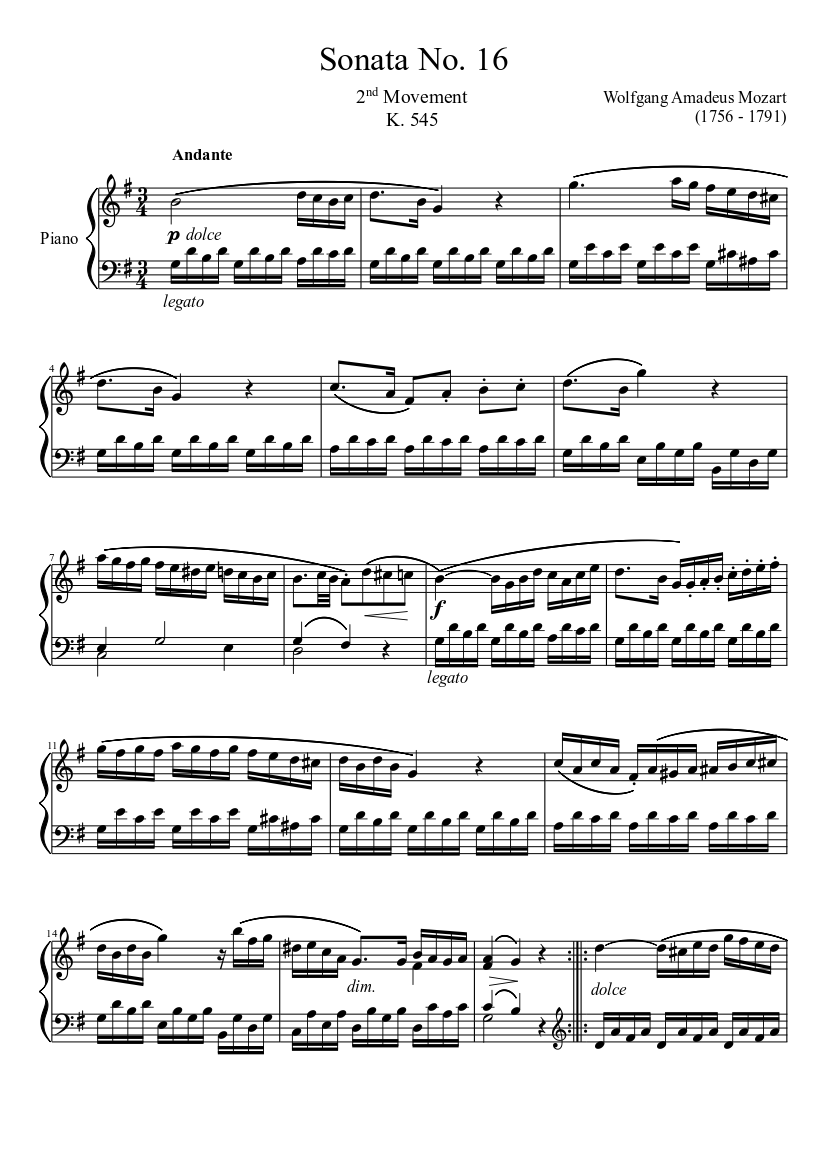
I am self-studying the sonata in question (Curci editions, Edwin Fischer revision).
At measure no. 13, the fingering recommended for the first 5 sixteenth notes (in treble clef) is: 4-2-5-4-2. I find it unnecessarily complex. I would like to use the fingering: 5-3-5-3-2.
I would like to understand from the experts if the suggested fingering has a reason that escapes me, or if I could change it.
Certainly!!!! Where it is possible to repeat small patterns (42 42 53 53 etc.) it is always advantageous. Even in trills, 31 31 31 is always better than 31 32 31. This method of changing fingers on the same pattern is called "old school". Not that it is wrong, but it stems from the fact that instruments from the late nineteenth or early twentieth century might not have been so docile, especially in rapid notes and repeated notes. We can, however, admire Rubinstein using this old method.
Take, for example, Beethoven's Appassionata Sonata and find on the numerous repeated notes 321 321 321 (especially in the Schnabel edition). Modernly, one finger is used, especially on the repeated C long before the reprise of the first theme in the first movement.
Naturally you must place the thumb on F-sharp.... which may seem unorthodox... but convenient. I remember that Chopin's teacher had started and not finished the "method of methods", where he explicitly "debunked" the pedagogical obligation to never place the thumb on black keys. His music (especially etudes and concertos) often forces this choice. It is best to get used to it immediately.
By the way, using the thumb on F# (as you suggested) which I wouldn't have thought of, simplifies the continuation. I wanted to ask you again if in the following measure (no. 14) instead of the recommended fingering (4-1-2-1 -4), could I use (4-2-4-2 -5). The doubt arises from the fact that I would go to B (5th quarter note) with 5, then again with 5 on B (6th quarter note). Is this "orthodox"?
Ultimately, it is not quite clear to me whether one has complete freedom in choosing the fingering or if there are general rules that must still be followed.
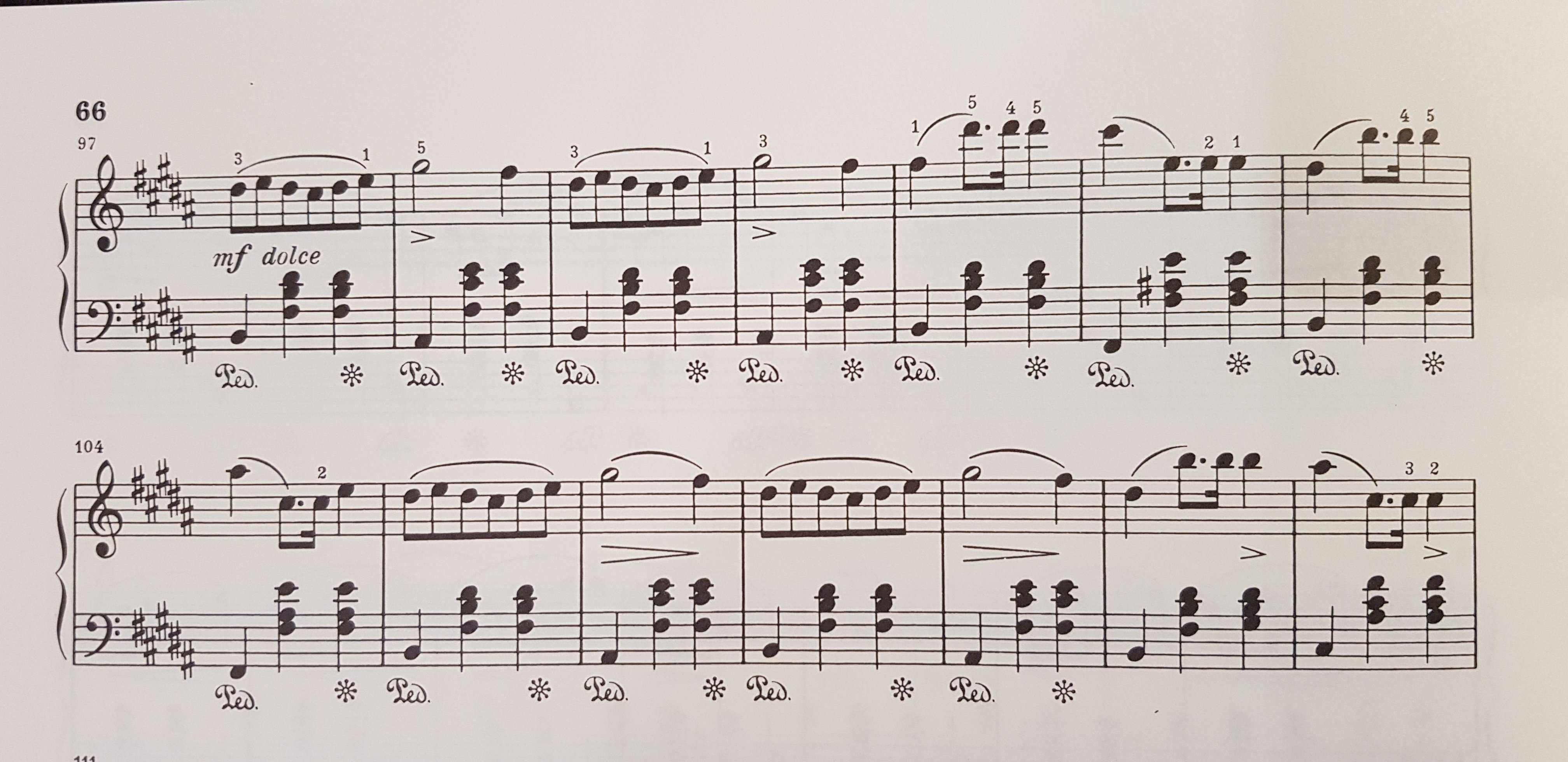
On the other hand, from what you wrote to me, I seem to have understood (correct me if I'm wrong) that it is permissible to use the same finger on repeated notes. For example, in Chopin's Waltz op. 69 no. 2:
at measure 101, on the three repeated D's, the teacher suggested I follow the Urtext fingering. But couldn't one do 5-5-5 or 4-4-4 instead? Especially because the last repeated note always slips away with my pinky?!
The same goes for the three E's in the following measure, 102. Why use the fingering 1-2-1 when one could do 1-1-1 or 2-2-2?
in my previous post, I wanted to say that I would go to G (5th sixteenth note) with 5 then again with 5 on B (6th sixteenth note). I can't edit anymore!
One should also see how you relate to the hand. Let's say these are general principles. The appropriate fingering is the safest and therefore the easiest for us. The Teacher, observing from the outside, must grasp any difficulties and simplify. For the waltz, 555 is also fine. Furthermore, sometimes changing fingers requires greater mental attention and can therefore distract from other things... especially in the early years. I remember suddenly finding 'my' solution in a passage of the third beat of the Appassionata, when the themes chase each other in imitation. I had been looking for a solution for days. I was on a bus, sitting down, fortunately. I hurriedly grabbed a piece of paper and wrote down some numbers... looking up, I saw the gaze of a gentleman who perhaps thought I was an international spy noting things down in numerical secret code. I still use that fingering, which helps me to make the two hands synchronous at the meeting of the accents. Far from being academic.... on the contrary, but it is effective!