dalrmi wrote:Perfect Simone (but Maestro you are always, having finished the conservatory! )
Yes, but it feels old to me and like someone my age trying to act superior (I turned 30 practically 3 months ago!), like when they call me Doctor or Engineer; I don't feel comfortable, I don't like it, especially in a place like this where people speak to one another in such a friendly and direct way. It is an appellative that I try to use as little as possible because just mentioning it creates a sense of distance from people, whereas I consider myself very expansive, extroverted, and companionable; I only use it in concert programs and official documents, i.e., where I cannot avoid it, otherwise... Let's stick with "Simone"; I didn't have to pay for it, I didn't have to study to obtain it, and I like it because my mom and dad gave it to me as a gift.
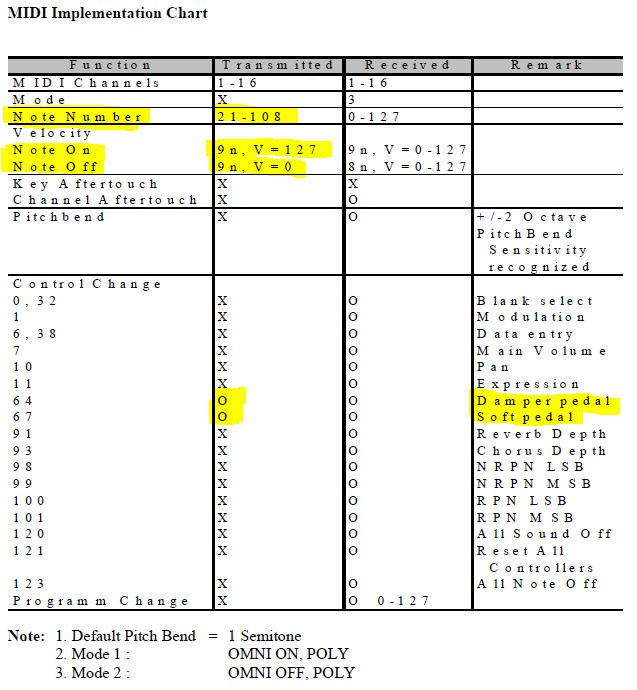
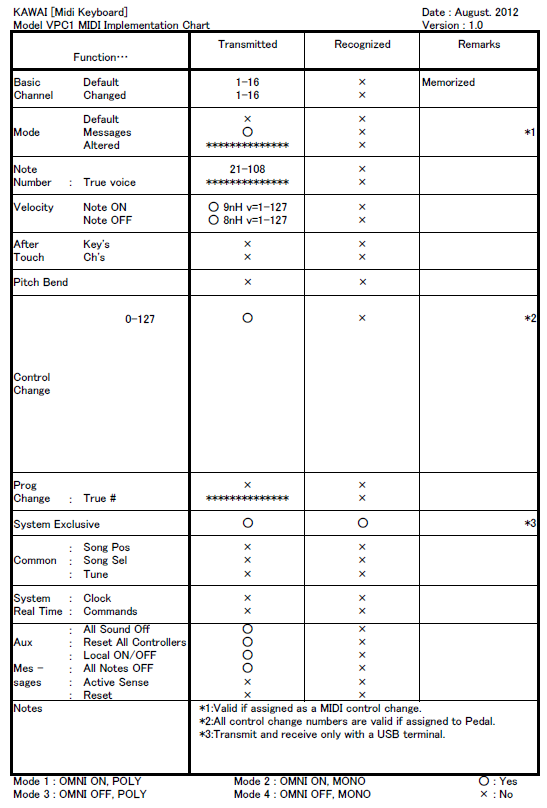
then I did other tests and now it seems improved to me, I manage to reach 127 as velocity when playing loudly on the piano (hurray, what a pun!).
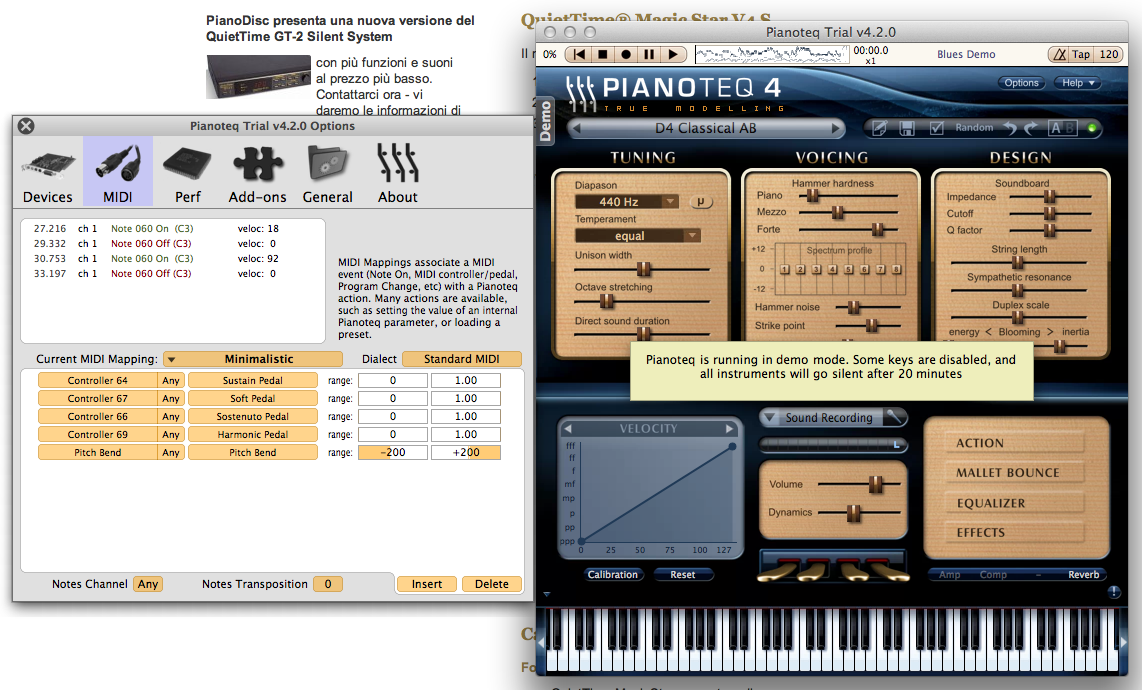
Anyway, I saw that by playing with the VST parameters (in my case Pianoteq in demo version) the result changes quite a lot!
On my silent [system] there is the possibility to calibrate the keys (all together pressed one after another or individually on specific keys) to regulate the sensitivity which goes from 000 to 255; for example, I took middle C and saw that it had the sensitivity set (by the tuner) at 116, I deliberately brought it to 150 but I haven't yet understood if this ultimately results in an increase of velocity in the VST; in the manual, sensitivity is associated with output volume, therefore it should be that low sensitivity = low volume while high sensitivity = high volume, but does this also ultimately correspond to the velocity parameter produced in the MIDI world? Huh!
I mean, does the optical sensor of the silent system feel this sensitivity? I believe so! but I still need to understand it deeply.
The game is all there. VST parameters are usually not touched. The velocity curve must be a straight line that starts at 0 and goes straight, without making curves, to 127. This means that the dynamic response of the VST is homogeneous. It practically means that an increase in force corresponds to a homogeneous and proportional increase in dynamics. I emphasize "proportional" precisely because as much as the force increases, so does the dynamic increase. Modifying the velocity curve means that a certain increase in force corresponds to a disproportionate increase in dynamics, both positively and negatively. I'll give an example: If I modify the velocity curve by making it concave, I press a key with a certain force (beyond the halfway point of the graph) -> I get a certain dynamic; I press the same key with a little more force and I get a much higher increase in dynamics. The fact that it is disproportionate also depends precisely on the graph.
Let's analyze it at least to clear things up, because I don't know how understandable this explanation I gave above was...
So here we have three velocity curves. Y-axis is the force we exert on the key, X-axis is velocity. By intersecting with the graph, we obtain the sound level coming out of the speakers every time we press a key with a certain force. In all three graphs, there are green and purple lines. Being able to move the velocity above or below the linear trend line, to find the center point of the graph—that is, the average value of velocity and exerted force—I must trace the reciprocal line which must form a right angle with the linear trend graph (if the graph was made well). In the other modified graphs, this line instead shows us the "exchange" value, and you will see that I will clarify the concept well in a moment.
As I said at the beginning. Playing with a linear velocity curve, an increase in exerted force corresponds to the same increase in velocity (being linear). Let's see what happens in the case of the concave curve...
Exerting forces within the range of the Y-axis before the exchange point, we see that we obtain a very low change in velocity; this means that even when playing with the intention of obtaining a forte, we will actually get a piano. After the exchange point, increasing the force even slightly will result in progressively much higher velocities. The sound will all grow together at the end.
The last graph, the convex one, is the exact opposite of what we have just analyzed...
Exerting quite weak force on the keys, we see that the velocity value is very high; this means it will be very, very difficult to play pianissimo, while it will be very easy to play forte. Once we reach the exchange point, all the force exerted from that point onwards will cause the dynamics to increase only slightly, and therefore unlike when we exert little force and with little difference we obtain"
very different dynamics before the crossover point; in this case, (that is, after the crossover point) you won't notice much difference in dynamics even when applying increasing pressure each time. In short, this solution helps to play loud, but it proves very difficult to play pianissimo and manage weak dynamics. Everything ends up being crushed into forte.
As you will have understood, in neither case would it sound natural. What best conveys the pianist's sensations is linearity; to this force, this velocity corresponds linearly, and that's it.
Imagine playing a piano where you press hard and hear a very faint sound, then by applying just a little more force you pass the crossover point and suddenly you burst the eardrums of everyone in the room... "And yet I had only used a little more force..." Ehehehe, you can see for yourself that it is unmanageable and unnatural.
If you have the ability to manage velocities, then you are all set. Try this and close everything... Set a range from 000 to 050, so you can evaluate if even playing fortissimo results in a very dull sound. I believe that to take full advantage of VST velocity, you should set the minimum value to 000 and the maximum value equal to the full scale, which is 255. Being optical sensors, they probably have much more sensitivity, but since they must transmit MIDI data with a maximum velocity = 127, they must surely multiply by a correction factor (0.498). Example... I play at 150 and I have to convert it into MIDI velocity to be sent to the VST... 150*0.498=75 rounded up. Now the problem is that if you give it 150 as a maximum, it sounds like 75 to me as the maximum velocity! That's why you sound quiet. I believe my logical deduction is the only possible one. Try setting a range from 0 to 255 inclusive and you will see that you solve the problem.
Anyway, I am happy; this means that my silent system (and therefore the optical sensors) works well. Now I just have to decide whether to purchase Pianoteq or Synthogy. By the way, Simone, since you are very experienced with VSTs, I saw that Synthogy offers four products: Grand Pianos, Italian Grand, Upright Pianos, and American Concert D; taking into consideration that I would always use it in my studio (a normal room of about 10sqm) and mainly with headphones (I managed to route the output audio from the Mac to the line in input of the silent system) connected to the silent system (maybe in the future, if it's worth it, I will equip myself with some good speakers for the piano), what product would you recommend? I saw that the prices are (+ or -) all around €200
In the meantime, thanks for the answers and for your willingness to help me.
Roberto.
As Caesar said: "De gustibus non disputandum est" (In matters of taste, there can be no disputes). I can tell you mine, which is, neither... I would opt for East West but I realize it's quite expensive! To do things properly, including shipping etc. etc., it costs almost 700 euros and a very powerful Mac (at least 8 GB of RAM, i5 or better i7). Having to settle for the two you mentioned, then I would go blindly for Ivory II - Italian Grand, which also sounds very good.
Regarding the speakers... Look, putting the silent device on just to hear through speakers seems absurd to me; deactivate the silent mode and play normally on the acoustic piano... Unless you want to record in MIDI, then that's a different story.
Even for the speakers, you have to choose with knowledge. I would opt for two nice studio monitor speakers. But with 200 euros, you won't get anything. You need to reach at least 600 euros and you'll get two nice Genelec 8020A, which are not very powerful (bi-amplified 20w+20w)... And you must hear how the Genelecs sound, they are extremely clean! Otherwise, if you want to save something, for about 300 you can get two Yamaha HS50M 70 watts; they are more powerful than the Genelecs, they don't sound bad, but they don't even come close to the Genelecs.
It depends on you.
Obviously, for monitor speakers worthy of being called STUDIO MONITOR SPEAKERS, we are talking about different prices altogether. Just think that often a pair of excellent studio monitors costs almost more than all the rest of the equipment. There are monitors that cost even more than 20,000 euros. I've told you everything. Obviously, you don't have to produce Celine Dion records, so for you, the ones I wrote are more than fine. In 10sqm, power isn't needed, clarity is; I strongly recommend Genelec.
Ciauz