Sorry Daniele,
one thing I didn't understand in your clarification of Hans Von Bülow's metaphor (what he thought doesn't interest me much) but . . . you?
do you feel that Bach, with his music, spoke directly to God? And a little less to men?
(regardless of the fact that he wrote "Soli Deo Gloria" underneath it) (Luca)
I think your question, beyond what my answer will eventually be, deserves a broader reflection.
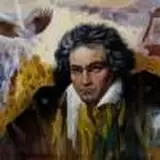
In reality, the issue is once again framed within that watershed moment that was the figure of Beethoven in the field of music.
Beethoven was indeed the first composer who, behind the legitimization of a neologism of those times: Genius, coming from Immanuel Kant's "Critique of Judgment," had full awareness of composing music not only for his present but for future generations; and it was through this conviction that he spoke to Man. Bach and Mozart, despite having an awareness of their greatness, did not have the awareness of being Geniuses and were convinced that, as with all the composers of their past, their music would be forgotten or, at most, would serve as study material for specialists in generations to come.
When Bach composed his entire immense body of sacred music, he did so exclusively for those "lords" he was dependent upon and for those who followed the masses in which this music was performed. He, a man of profound Lutheran faith, certainly thought only, through his music, of singing and praising God and, through it, relating directly to Him. There is also, in Bach's vast production, that Himalayan part of speculative music: "The Well-Tempered Clavier," "Goldberg Variations," "Musical Offering," "The Art of Fugue"—to mention only some of the most immense—in which, as the Spanish philosopher Eugenio Trias states: « In them, music and theology revolve around the great questions of Man, the Universe, and God. ».
Returning to Beethoven, and specifically to the "Eroica," a symphony that you and I have extensively discussed in other settings. People have often wondered behind this Symphony what man was present: Napoleon? Prometheus? And what if Trias is right instead: « Could it be, then, Man—Man emphasized and with a capital M—the true subject of this heroic drama? Man in his ideal form (struggling with himself and with his "principle of reality" as in the clashes and oppositions (...) culminating with Hegel in the "Phenomenology of Spirit," a work contemporary to the "Eroica" and closer to it than any other? (...) What is to be shown and described in its internal and immanent oppositions and conflicts is not simply Man. It is rather the Artist-Man, the Genius, to whom the gods have granted the gift of his morality, the iron and absolute dominion of his Will: that imposed by an Ego (Beethoven) ready to face a thousand difficulties in order to reach, through the cult of the beautiful and the sublime, the stars of the firmament, beyond which lies the Most Loving Father (...). »
It was after Beethoven, then, that those metaphors began which, to exalt and describe the greatness of great Geniuses, were inspired—as indeed in the case of Von Bülow—by biblical texts, if not directly by God.
These expressions did not end with Romanticism but are still very much in vogue. A very famous statement was, for example, that of Karl Barth, a Christian theologian of the Reformed Church: « Perhaps the angels, when they play intent on rendering praise to God, play Bach's music. I am certain, however, that when they are among themselves they play Mozart, and then even the Lord finds particular delight in listening to them. ». But even Trias—and we are thus at the present day—finds no better way than to turn to a divine metaphor to speak of the classical triad: Haydn, Mozart, and Beethoven, comparing them to a Viennese "Holy Trinity," even if the third element is not the Holy Spirit but, indeed, Man. Haydn is: « God the Father, the creator, the demiurge of the sonata form, of the string quartet and of the symphony in the modern sense of the term (...) » Mozart: « the Son (...) Immolated on the sacrificial altar of contemporary cruel Vienna, (...) in the human version of the Incarnatus est and the unsettling Crucifixus, this time not under Pontius Pilate, but in the Calvary and the labor of a cold and stormy autumn bringing diseases that, at the very least, one would have expected, cut short a life that was beginning to recover after a dark period that began in the fateful annus horribilis of 1788.
Ludwig van Beethoven (...) Joins the rest of humanity in a bond of love to the order of the hymn "Embrace, multitudes!". The hero is no longer God the Father, the creator, nor even His Son (...). Now the hero is Man (...) in his ideal form, as Artist Genius: the creator himself"}
Ludovico van."\n\nEven we, when speaking of these great Geniuses, use hieratic metaphors. I often read and hear: "The divine Mozart," an adjective that is actually absolutely improper for the figure of Mozart. Giovanni Carli Ballola corrects this: "But if it is true that, according to the mythology of the arts, Michelangelo was called divine rather than Raphael, or Monteverdi rather than Palestrina, then within the scope of eighteenth- and nineteenth-century Viennese Classicism, divine should be Beethoven, not Mozart. Because the divine artist is one who, like a new god, builds, shapes, creates, invents from nothing—in short, dares to surpass what already exists, what is an element of nature. Precisely Michelangelo with his unnatural and gigantic figures, Monteverdi with his unheard-of madrigals and his literally extraordinary sacred music, and Beethoven with his dilated, thickened, and properly titanic forms (...)."\n\nIf we join the two reasonings of Trias and Ballola, we are actually arguing that, in reality, the "divines" in the classical period were two: Haydn—always too undervalued and ignored even by experts—and Beethoven. The first was the "Creator Father," the second "the Genius, the Artist-Man who brought the sonata form to its highest peak and from there to its final dissolution.\n\n \n\nTherefore, Luca, to whom does Bach speak today—because it is to those who speak today that it matters—? Or rather, to whom do Palestrina, Monteverdi, Bach, Haydn, Mozart, Beethoven, and so on, speak today?\n\nThe answer that comes to me is this: to those who have the ears and the brain to understand!"